
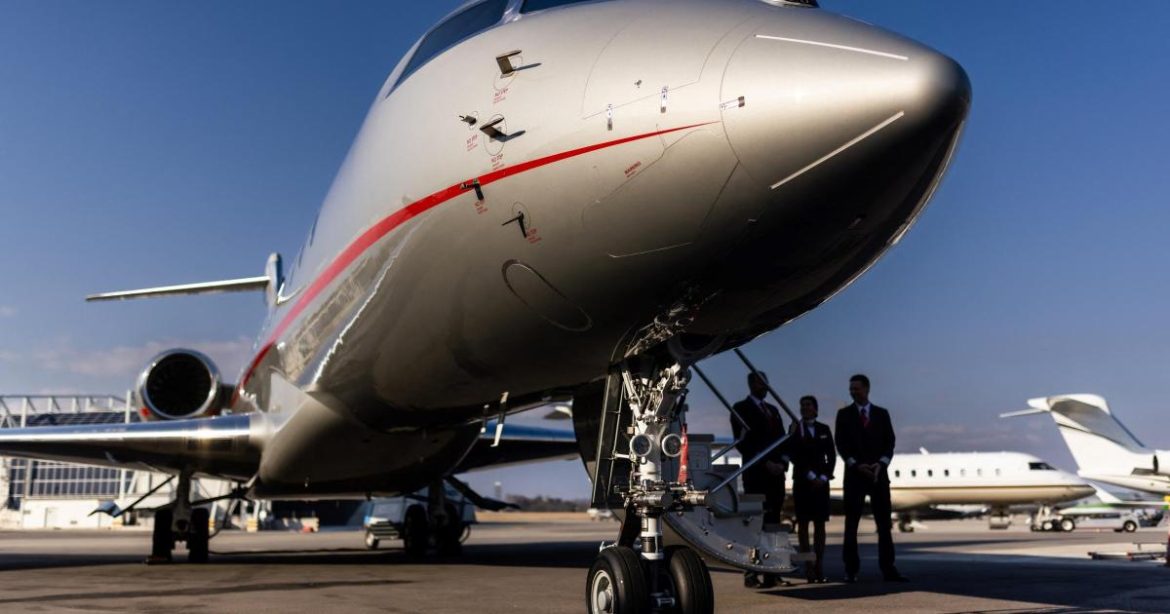
However, the planned tax on private jets is not scheduled to be introduced for a year after that.
Campaigners say the new tax could raise up to £392million, but that will require the new Scottish Government to introduce it more quickly, set the rate high, and ensure all private jet passengers using Scottish airports are targeted.
Read More:
The joint call, from Oxfam Scotland, Possible, Safe Landing, the Wellbeing Economy Alliance Scotland and the Patriotic Millionaires, comes as a former private jet owner, millionaire entrepreneur Stephen Prince, described private aviation as “more addictive than cocaine” and urged Scotland to set a global example in tackling their egregious emissions.
Oxfam Scotland’s illustrative modelling estimates a strong private jet tax introduced in Scotland in April 2027 could raise up to £122 million more by the end of the new Parliament in 2031. If the rate was set higher, as called for by campaign group Possible, modelling suggests this could reach up to £392 million more over the same period, with even more money raised if the tax rate rose year-on-year.
Both figures assume flying habits stay the same as wealthy private jet passengers are likely to simply absorb the extra cost. However, any fall in the use of private jets would help cut emissions, with the latest data showing international aviation and shipping emissions climbing rather than declining.
Analysis by Possible suggests those from Scotland’s six major airports alone produced more than 32,000 tonnes of emissions last year, equivalent to driving around 18,000 cars for 12 months or taking more than 2.5 million train journeys between Glasgow and London.
Campaigners say the revenues could support climate action, such as faster rollout of the proposed national £2 cap on bus fares or reducing energy bills through better insulating homes.
Polling by the Diffley Partnership for the Wellbeing Economies Alliance found 88% of people in Scotland support a tax on private jets landing or taking off from Scottish airports.
Katherine May, Oxfam Scotland Advocacy Adviser, said: “The First Minister has promised action on private jets, now he needs to prove he means business. A weak tax, delayed or diluted, will change little; not emissions, not behaviour, not the money needed for climate action.
“Scotland’s private jet tax must start in 2027, be set punishingly high to make passengers think twice and hit those who prioritise luxury travel over lives. At the moment, we see white trails in the sky, and climate destruction on the ground. The gap between excess and consequence is exactly what this policy has to close.”
Stephen Prince, founder of Card Market, Inc. and member of Patriotic Millionaires said: “There are many perks to being rich, but chief among them is private air travel. It’s truly a luxury’s luxury, and while I’ve never used cocaine, I’d bet it’s less addictive than having a jet on standby.
“Three years ago, after seeing the damage it causes, I made the difficult decision to sell my jet. But we can’t rely on goodwill to cut emissions. What we can do, though, is make sure that private air travellers pay at least the cost they create through their selfish extravagance, but preferably more, as they can more than afford it.
“That’s why I’m excited by the move in Scotland to make private jet passengers pay a new tax. But for it to bite, the price has to be set high enough to make people think twice. By punitively punishing people’s pockets, Scotland can inspire other countries to rein in private air travel and forge a new path in saving our shared planet.”
Alethea Warrington, head of aviation, heat and energy at climate charity Possible, said: “It’s outrageous that ordinary people struggle and vital public services suffer while the wealthiest few keep flying around in virtually untaxed, ultra-polluting private planes. The Scottish Government now has an opportunity to fix this, and start properly taxing the ultra-rich for the harm they’re causing to our climate. Why should a billionaire on a private jet pay a lower rate of tax than an ordinary person on their only holiday of the year?”
Amanda Grimm, advocacy lead for Stop Climate Chaos Scotland, said: “Allowing the super-rich to jet about the globe without care for the people suffering the consequences of their luxury lifestyles is not only unfair but also a missed opportunity to raise crucial funds for action to protect the planet.
“The latest data shows greenhouse gas emissions from international aviation and shipping are growing rather than declining. Meanwhile, ordinary people are struggling to afford basic household bills, farmers and crofters are facing increasing challenges from climate breakdown.
“It’s time for the polluters to pay for their privilege, with taxes raised to be spent on vital measures that will protect communities, jobs, health, energy and food security.”
Scottish Greens co-leader Ross Greer said: “The super-rich take around 12,000 private jet flights in Scotland every year. That is nothing short of a disaster for our climate.
“There is a direct link between behaviour like this and the heatwaves and wildfires causing so much damage across the country this summer. That is why the Scottish Greens pushed so hard to secure a private jet tax earlier this year.
“The powers to ban these flights outright still sit at Westminster, but in Scotland we can at least tax them enough to keep most of their jets on the ground. That will also raise money for public services like the NHS in the process.
“The public shouldn’t have to pay the price for multi-millionaires and billionaires hopping between their shooting estates and super yachts. That is exactly what is happening right now though, with homes being burned down by wildfires or destroyed by flooding. This extreme weather is the end result of a climate crisis made far worse by the behaviour of the super-rich.”
