
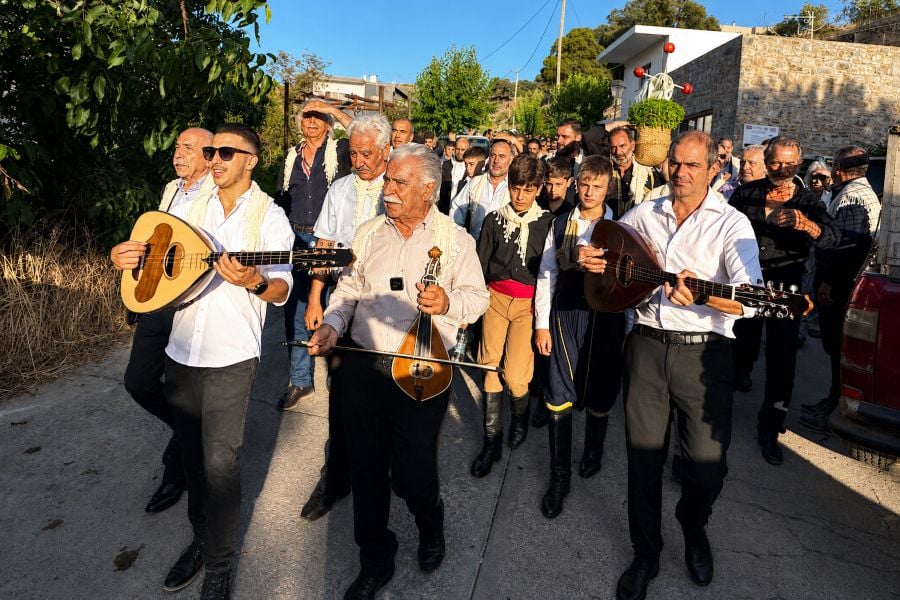

A traditional wedding on Crete is about far more than the bride and groom, bringing together family, friends, and generations of guests in a celebration that reflects the enduring traditions of Greece’s largest island. In Anogeia, a mountain town on the slopes of Psiloritis, music, food, traditional dress, and dancing become part of one large communal experience.
These photographs from a wedding in Anogeia offer a glimpse into that celebration, from the preparation and serving of food to musicians traversing the streets and, eventually, a large circle of people joining in on the dancing. For visitors unfamiliar with the traditions of Crete, the magnitude of such a celebration can be striking. In Anogeia, however, music, dance, and hospitality are deeply connected to the town’s cultural life. The Municipality of Anogeia describes music as closely linked to dancing and notes that traditional dances remain a vital part of the local community.

A wedding that brings the whole community together
One of the first things a visitor notices at a traditional wedding in Anogeia is the sheer number of people present. Long portable picnic tables stretch through the outdoor celebration, with several generations eating together. Children sit alongside adults as people move between the tables and more food continues to arrive. The scene feels less like a formal reception and more like a gathering of the entire community.
That sense of collective participation has deep roots in Anogeia. The municipality’s account of traditional weddings describes preparations that historically involved families and the wider community—from gathering firewood and preparing food to slaughtering animals and organizing the wedding feast.
Today’s weddings are not identical to those of previous generations, but that communal spirit remains an important part of the experience.
Tradition is worn and celebrated at weddings on Crete
The traditional clothing seen at the wedding offers another expression of the connection between the celebration and local heritage. Cretan dress is no longer worn as everyday clothing, but the Municipality of Anogeia specifically notes that local attire continues to appear at celebrations, particularly weddings.
Anogeian clothing features distinctive embroidered and woven elements with separate traditions for women’s and men’s formal dress. At a wedding, these garments are more than historical costumes. They are worn by people taking part in a contemporary celebration, bringing local tradition into the present. For visitor, that makes the clothing particularly meaningful. The past is not being recreated for an audience. It remains part of the occasion itself.

Food at traditional weddings in Anogeia, Crete: Part of hospitality and a warm welcome in Greece
Food occupies a central place in the celebration, with large quantities of roasted meat being prepared and carried to the tables, offering a sense of the scale of the wedding feast. Anogeia is particularly known for its roasted meat, while the local culinary tradition also includes gamopilafo, a rice dish traditionally associated with weddings and cooked in meat broth. The municipality also lists kalitsounia, pies, and other local specialties among the area’s traditional foods. Its historical account of traditional Anogeian weddings likewise describes extensive preparations for the wedding meal, including meat and rice dishes.
At a large wedding, however, food is about more than what is served. It is part of the hospitality and a way of bringing people together.

Music takes to the streets at weddings in Greece: Anogeia, Crete
In Anogeia, music and dancing are closely connected and deeply woven into the town’s cultural life. The town has a particularly strong musical tradition, with the Cretan lyra and laouto among the instruments associated with local music. Traditional dances include the pentozalis, pidichtos, sousta, and syrtos, along with local variations.
At the wedding depicted in the photographs, the music did not remain confined to a stage or a single part of the celebration. Musicians and guests moved together through the streets, extending the celebration beyond the tables where people were eating and allowing the wedding to become part of the town itself.
There is something revealing about the way the musicians interact with guests. Rather than remaining disconnected from everyone else at the celebration, they move among them, making music a way of bringing people together while the streets themselves become part of the wedding. This fits naturally with Anogeia’s broader cultural identity. The municipality describes music, dance, song, and poetry as deeply rooted in the town’s cultural life.

Where generations join the dance: Weddings in Anogeia, Crete in Greece
Eventually, the celebration gathers around the dance. One of the most striking moments captured in these particular photographs shows the bride and groom surrounded by a large circle of dancers, with people of various ages taking part. The dance becomes a shared experience rather than a performance watched from the sidelines. For someone witnessing a traditional Cretan wedding for the first time, this may be one of the most memorable parts of the celebration. Dancing is not simply entertainment. It is something people participate in, and the entire community is free to join.
The Municipality of Anogeia describes traditional dancing as a ritual with specific unwritten rules that continue to be respected in the community. The circular formation itself also creates a powerful image of the community, with people connected to one another as the newly married couple remains at the center.

Where the wedding begins
Amid all the noise and movement, there are also quieter moments. Before the musicians take to the streets and the tables fill with guests, the celebration begins with the preparation of the groom and the gathering of family and friends around him.
The photograph above brings the focus back to the people at the heart of the occasion. There is an intimacy to these moments of preparation, from the clothing to the anticipation, before the larger celebration (seen in the photo below) gets underway. A wedding may eventually involve an entire community, but it begins with two people and the families and friends gathered around them.
When a wedding becomes a community celebration
The most revealing thing about a traditional wedding in Anogeia may be how difficult it is to separate the wedding itself from the community surrounding it. Musicians become part of the procession, food becomes an expression of hospitality, traditional clothing connects the celebration with local heritage, and the dance brings people of various ages into the same circle.
That is what makes the wedding experience in Crete distinctive. It is a celebration of a couple but also of family, friendship, hospitality, and place. In Anogeia, where music and dance remain deeply woven into local cultural life, a wedding provides a vivid setting for those traditions to come together. The bride and groom may be at the center of the celebration, but they never celebrate alone.
