
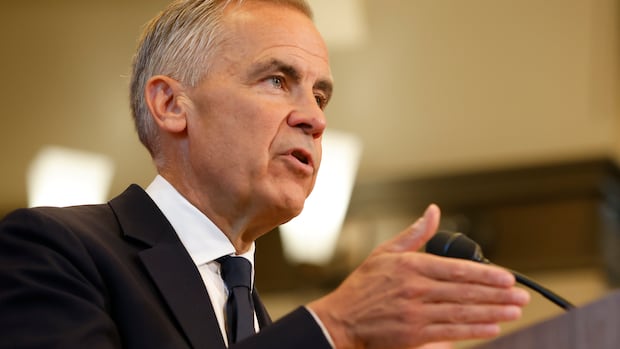
Prime Minister Mark Carney told his negotiators to walk away from the table after the Trump administration introduced late unacceptable demands on culture, autos and sovereignty that, when taken in concert with their overall approach to talks, revealed the U.S. was not interested in a “true economic partnership” with Canada.
In a departure from his usual diplomatic language, Carney suggested the U.S. sometimes signs trade deals in “pencil,” and while Canada’s government is united and working together, the same is not true of the Trump administration.
“We cannot accept what they’ve offered, and we will not give what they’ve asked,” Carney said on Saturday in Ottawa, adding that the United States ‘asked too much and offered too little.’
The prime minister revealed that the U.S. had issues with Canada’s subsidies for French culture; the prevalence of French-language media online and even the requirement to have bilingual labels on products sold in Canada.
“It was unacceptable right from the start, but the Americans kept trying and trying and we said no,” Carney said. “Ultimately it’s simple. That was never on the table for Canada and it would not have been acceptable to Canadians.”

Asked for specifics of the Americans’ last-minute changes to terms of a trade deal, Prime Minister Mark Carney outlined three examples. He said Americans looked to change the scope of tariffs on Canadian auto content, made efforts to restrict Canada’s ability to have other trade deals around the world and made efforts to restrict Canada’s protections of language, culture ‘and in effect, our sovereignty.’
When it came to the auto industry, Carney said the U.S. wanted to treat Canadian-made parts unfairly and to exempt some pick-up trucks from U.S. tariffs while leaving them on cars without any explanation.
Carney said those demands were introduced late and, if accepted, would have moved Canada “into a series of terms that would have made the production [of vehicles in Canada] more un-economic over time.”
Ontario Premier Doug Ford welcomed Carney’s decision to abandon negotiations and insisted Canada would win a trade war with the U.S. because Canada is united and prepared for a fight.
“I’m glad he didn’t sign that deal because it was a bad deal,” Ford said in Toronto on Saturday. “It was a bad deal for Ontario. It was a bad deal for the auto sector, the steel sector and the manufacturing sector.”

Ontario Premier Doug Ford said he heard feedback from the province’s steel and auto sectors over the past few days that the U.S. government had put forth a bad trade deal and gave Prime Minister Mark Carney credit for standing up for Canada in a ‘very complicated’ situation.
The premier said Canada needs to inflict pain on the U.S. to remind the Trump administration that Canada is its best customer and should be treated as such.
The U.S. team also wanted to introduce measures into the pact that would significantly undermine Canada’s sovereignty, the prime minister said.
“The U.S. introduced, in the last hours, efforts to restrict our ability to have other trade deals,” Carney said. “Because we believe in free trade, we’re the partner of choice, in many respects, for countries around the world, and Americans wanted to restrict that, they had language to restrict that. Unacceptable.”
Throwing shade at the Trump team
Carney said the effort to try to squeeze more concessions into the deal at the last minute derailed months of negotiations.
“Any of [those issues] individually, but collectively put us in a position here that had been on a trajectory, absent those elements, for a fair deal, a good deal for Canadians — not perfect — but a good deal [became] a deal we would not accept,” Carney said.
“The prime minister’s decision to recall his negotiators means threatened 50 per cent tariffs on a wide range of Canadian products kicked in at 12:01 a.m. Saturday. Carney said Canada’s dollar-for-dollar matching tariffs on U.S. goods will begin the Tuesday after Labour Day.
He was asked if U.S. Commerce Secretary Howard Lutnick’s intervention in the talks was an impediment to the deal, and he used the opening to get a dig in at his southern neighbour’s approach to the talks.
“The Canadian team, unified … everyone in the loop, everyone knows what our objectives are, collective decision making — ultimately, I and the cabinet bear responsibility for those decisions, but unity. You cannot say that about the United States administration.”

Prime Minister Mark Carney pointed to the Trump administration’s repeated defiance of the terms outlined in CUSMA in response to a reporter’s question about the U.S.’s trustworthiness. ‘If you execute a deal, you have to stand by that deal,’ he said.
Carney said Canada went into the trade talks fully aware the U.S. had changed its spots and had embarked on a mission to reshape its trading relationships to one where it used previous “economic integration as a weapon.”
He noted that the Trump administration has justified tariffs on Canada with a continually changing rationale that began with fentanyl and since moved to wildfire smoke, dairy quotas, the certification of U.S. aircraft and Ontario Premier Doug Ford’s anti-tariff ads that quoted former U.S. president Ronald Reagan, all of which violate the Canada-U.S.-Mexico Agreement.
Through the Trump administration’s actions, Carney said, Canada has come to realize “that sometimes, its signature was written in pencil.”
Conservative Leader Pierre Poilievre issued a statement saying he is disappointed with the U.S. decision to impose tariffs on Canada and that his party will “support action to protect Canadians and our industries.”
“Canada cannot accept one-sided tariffs that will deindustrialize our country. Nor can we accept a bad deal. Instead, we must continue the fight for tariff-free trade,” Poilievre said.
The Conservative leader said he is hoping to have a conversation with Carney later on Saturday “to discuss what we can do to fight for our workers, businesses and economy.”

Prime Minister Mark Carney said the Canadian negotiating team was itself unified in talks with American counterparts toward a trade deal, but ‘you cannot say that about the United States administration.’
Writing in The Hub on Friday, University of Calgary economist Trevor Tombe said the 50 per cent tariffs might only knock a “couple of tens of a percentage point off of GDP growth,” but they will hit Canada’s job market hard.
“If these tariffs take effect and remain in place, I estimate that nearly 90,000 jobs across Canada could be lost. And those losses go beyond where the tariffs directly land,” he wrote.
Tombe said Alberta’s exports will be “barely touched” by the tariffs compared with Ontario, Quebec and British Columbia, but Alberta-based businesses that provide support for exporters elsewhere in the country stand to lose 9,000 jobs. He also said he expects about 36,000 job losses in Ontario, 18,000 in Quebec and 11,000 in B.C.
The federal Liberal government estimates the tariffs will impact about $27 billion worth of Canadian goods and put about 56,000 jobs at stake.
Carney said he’s concerned about how the failure to secure a deal with Trump will impact ordinary people and promised to do whatever is required to help support businesses harmed by the tariffs.
“We’ll be releasing details of this early next week — alongside our tariff actions — to support these businesses, and we will support these businesses for as long as it takes; in other words, beyond the life of this administration,” he said.

Prime Minister Mark Carney explained why the government chose not to sign a trade deal with American counterparts as U.S. President Donald Trump’s 50 per cent tariffs on almost $30 billion of Canadian goods are in effect. ‘We were not prepared to compromise Canada’s sovereignty or undermine our key industries,’ Carney said.
