
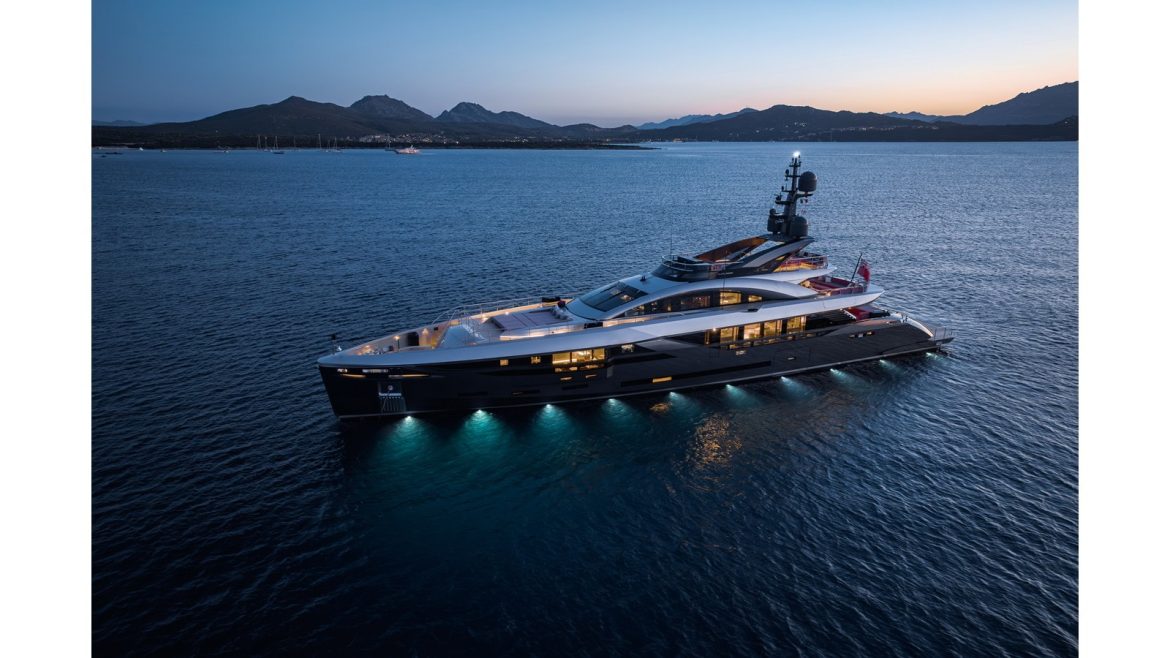
Flying Dagger III has recently joined the market and is set to become one of the most interesting, unique offerings in its size category. Radically different from the behemoth megayachts preferred by most billionaires these days, this superb Italian masterpiece is all about exhilarating speed and efficiency while matching the opulence of a floating mansion.
One look is enough to see that the Flying Dagger III is meant for adrenaline-pumping speed without compromising onboard comfort. The sleek, angular shape screams dynamism, and dark-toned hull with metallic accents turns it into a stealthy arrow at sea. Many luxury yachts were built to embody the James Bond aesthetic, but I believe that this Italian beauty is one of the best James Bond yachts out there, without even trying to be one.
“A compact, sculpted shadow” – that how is was described by its builder Rossinavi. At the time of its delivery, almost a decade ago, it was touted as “the most powerful and quietest Rossinavi ever”. Strikingly attractive and an instant head-turner, the Flying Dagger had to be watched in motion to be truly appreciated.

Photo: FGI Yacht Group
The Flying Dagger was built for speed, and its overall aesthetic clearly references automotive roots. A fully aluminum structure (both the hull and the superstructure), sporty lines, and a dynamic silhouette make this yacht very different than other models this size (49 meters/163 feet). The name that was kept since 2018 until today clearly hints at its impressive speed and sculptural silhouette.
Arrabito Naval Architects signed the Flying Dagger’s naval architecture, Venice-based Enrico Gobbi of Team for Design was in charge of exterior design, and Lazzarini Pickering Architetti created the spectacular, contemporary interior design.
Speed was the main priority, therefore the Flying Dagger features three MTU engines and 3 Kamewa waterjets that guarantee a thrilling top speed of 31 knots (35.6 mph). When cruising at a moderate speed of 24 knots, the Flying Dagger is still faster than most yachts this size. Although not intended for extended cruising and transatlantic crossings, this sporty yacht can also deliver a decent range of more than 3,000 nautical miles at an economical speed of 12 knots.

Photo: FGI Yacht Group
In fact, versatility was one of the goals, making the Flying Dagger capable of both short trips with lots of adrenaline-pumping speed and longer, more relaxed cruises. The triple 2,600hp MTU 16V 2000 M96L engines add up to 7,800 horsepower coupled with a shallow 7.2-foot (2 meters) draft for easy access to a wider range of locations.
The combination of an efficient hull form with a generous full capacity of up to 6,400 liters allows this sleek pleasure craft to cover an extensive range for longer voyages, but this is still ultimately a speed monster for those who want more adrenaline on the ocean.
To make this powerful beast even better, Rossinavi focused on making it as silent as possible as well. The most advanced research on noise and vibration reduction at the time was incorporated into the build. As a result, even though technically a water jet boat, the Flying Dagger’s noise and sound propagation performance was comparable to that of a full displacement yacht.

Photo: FGI Yacht Group
The yacht’s performance standards also dictated specific requirements for the interior design. Instead of heavier options that could interfere with the delicate weight balance, the interior design team went for lightweight alternatives, but just as luxurious. Paper-based finishes included custom wallpapers. This hand-painted wallpaper specifically created to mimic the natural textures of sand and clouds was both functional and a work of art.
Another spectacular element of the interior design was the heavy mirroring – more than any other yacht. The reason behind it was also strategic, because all those mirrors along the ceilings, window frames, and multiple surfaces created the optical illusion of much wider spaces. Aesthetically, the inspiration behind it was the reflection of water, as the initial brief for the yacht mentioned “the idea of feeling the water from every corner of the boat.”
Another unique feature of the interior design specifically linked to the performance requirements was the integration of modular furniture – space-efficient, lightweight, and versatile. The large sun pad on the foredeck, for instance, is recessed into the structure. The sundeck is another versatile space, centered around a convertible table, that can be used either for sun lounging or al-fresco dining.

Photo: FGI Yacht Group
In 2019, this minimalist, efficiency-oriented, and at the same time opulent interior design fetched the Flying Dagger a finalist status at the International Superyacht Society Awards. The contemporary minimalist approach included soft tones of gray and beige, lots of reflective details inspired by water, and clean lines for a comfortable, calming ambiance.
In terms of accommodation, this 163-footer can welcome up to ten guests in five cabins. A similar crew quarters configuration provides accommodation for a nine-person crew. As usual, the owner’s suite is the most spectacular, boasting floor-to-ceiling glass doors for a boost of luminosity and a sense of connection to the surroundings. Also, these doors open unto a fixed, large balcony exclusively for the owner.
All the other four guest cabins are located on the lower level, and they all have en-suite bathrooms and large porthole windows. A double-width swim platform connects to the aft deck via a dedicated staircase and directly to the ocean via retractable stairs. The aft beach club houses a generous selection of water toys, and a strategically placed midship garage houses an elegant (and expensive) Castoldi 21 tender.

Photo: FGI Yacht Group
Polish billionaire Jerzy Starak, owner of one of Poland’s biggest pharmaceutical drugs manufacturer, is believed to be the original owner that commissioned the Flying Dagger, and it’s unclear whether the yacht changed hands or not over the years. It’s currently known as Flying Dagger III, which would indicate a change of hands at some point.
It was also offered for sale last year, at the price of €25 million ($29 million), and that was following a considerable €3,5 million ($4 million) price drop. This year, the Flying Dagger III is back on the market, asking for €23,5 million ($27 million). Even though the yacht is now almost a decade old, it’s still one of the most impressive and technologically advanced in its size category.
Currently, the yacht is being offered as lightly-used, with just 1,700 hours on its triple MTU engines. It’s also presented as being in excellent condition, with upgrades (both mechanical and aesthetic) completed as recently as 2024 and 2025.

Photo: FGI Yacht Group
Rossinavi, the Viareggio-based yacht builder, isn’t as old as some of the top superyacht builders in Italy, but has managed to secure a solid reputation in a short time.
The original Rossi shipyard was founded in the 1970s, but it only started building superyachts recently, in the 2000s. The first official Rossinavi yacht was the 54-meter South, delivered in 2008. In 2011, the 70-meter High Power III became the third-largest private yacht built in Viareggio.
The Flying Dagger III exudes that timeless Italian style coupled with the top-tier performance inspired by Italian cars. This yacht was built for millionaire owners who prefer speed and a sleek silhouette rather than the massive silhouettes and static nature of floating mansions at sea. At the same time, it doesn’t compromise on luxury when it comes to interior style and comfort. This is a yacht where performance meets elegance.

