
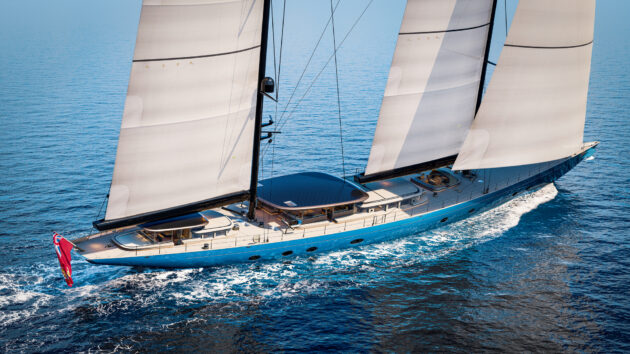
Is a 70m yacht with zero emissions even possible? Sam Fortescue visits Vitters shipyard on the eve of the launch of this truly groundbreaking yacht, built to propel the industry into a greener future
When the idea of a big sailing yacht with no combustion on board was pitched to designer Marnix Hoekstra at Vripack, he was instantly enthusiastic. A mould-breaking electric boat of 69m was just the sort of challenge he relished. It was the summer of 2019, and experienced clients had put their faith in yacht management company Fraser to recruit the right build team for a luxurious superyacht with zero emissions.
“Everybody else was like, ‘yeah, no – that’s not going to happen’,” remembers Hoekstra with some glee. “So, I brought my smartest guys, and we got into those ‘how might we?’-type questions.”
Hoekstra agreed to take the commission on two conditions: “First, I would only participate if there was no fossil fuel on board. If we had a range extender or generator as back-up mode, we’d quickly fall into the trap of using it.” Then there could be no compromise on good looks. “Nowhere in the project could the technology we innovate reduce the aesthetic beauty of the boat itself.”
Dykstra Naval Architects was the next to embrace the project, followed by Vitters Shipyard, completing a Dutch trifecta. And though we don’t know the identity of the clients, progress on the yacht has been more than public. Working closely with the owners’ non-profit, a renewable energy accelerator called Foundation Zero, every piece of research and every technical solution has been published under an open-source agreement aimed at driving change across the marine industry. Now, after more than six years of work, project 3094, aka Zero, is finally nearing launch.
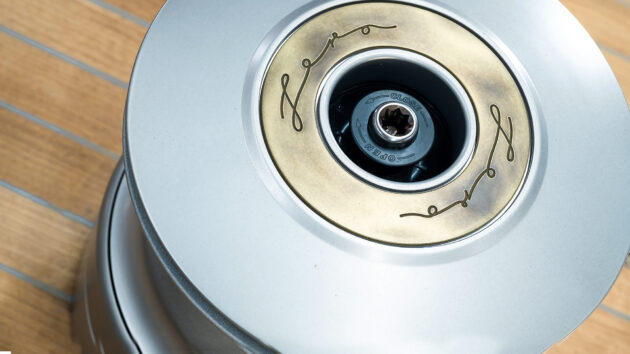
Regenerative power: custom sheet winches and captive winches generate electricity in rewind mode or as they pay out
Leap of faith
“There were just so many unknowns when we quoted for the project – more than the items we knew!” exclaims sales and marketing manager Bas Peute at Vitters. “We knew it had to operate with zero emissions. We also had the notion of the outside shell, that it should be a superyacht with a high level of comfort and detail. But at that time, we still had no idea how we could get a zero-emission yacht up and running!”
That outside shell bears all the hallmarks of modern classic Dutch design, with sweeping flush decks, low-slung twin deckhouses and lavish overhangs. But with energy use forming the core of the project, it was below the waterline that the first big decisions had to be made. And that’s where Dykstra brought to bear its vast experience, which spans yachts as different as Maltese Falcon and the J-Class.
Article continues below…
The world of superyachts is continually pushing boundaries, blending unparalleled luxury with cutting-edge design and impressive performance. As we look…

When Nilaya’s 46.82m hull emerged from the vast build sheds at Royal Huisman’s Vollenhove yard in 2023, she was slipped…
“The design of the hull was very important in conserving energy while under power and also being able to sail in as light a breeze as possible,” explains Dykstra partner Mark Leslie-Miller. “We really made a very long hull for the amount of interior space.” A volume of 491 gross tonnes may sound like a lot, but for comparison, Perini Navi’s 70m Sybaris offers nearly twice as much.
Dykstra tapped into some flashy software and the expertise of Emirates Team New Zealand as they sought to find the sweet spot between low drag and high form stability. “For different points on the polars, we could see how much speed it cost or gained if we changed the parameters of the vessel,” explains Leslie-Miller. “It made it very efficient to research.”
Although she packs a jaw-dropping 28 tonnes of custom lithium batteries storing 5.2 megawatt-hours of energy, Zero’s range under electric motor is still a relatively modest 400 nautical miles. “So, she needs to go sailing,” concludes Peute.
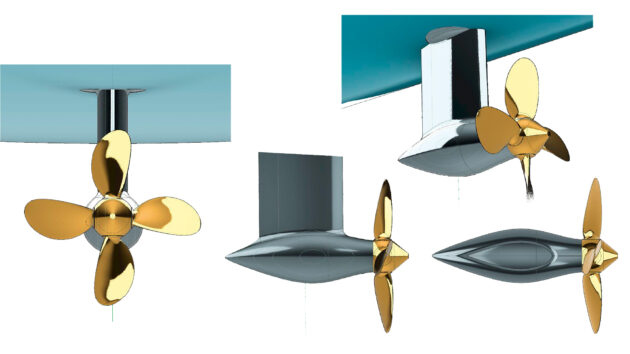
Hydrogeneration when sailing: two props, mounted on rotating pods fore and aft of the keel, swing forward for hydrogeneration and can produce up to 250kW of electricity when sailing full speed.
Maximising energy
Sailing is also the way that Zero will generate most of her renewable power. The hyper-modern hard-tops carry 100m2 of solar panels that can churn out 23kW while also capturing up to 55kW thermal energy. But this is dwarfed by the yield from so-called hydrogeneration under sail – when the movement of water past the hull turns the twin propellers and allows them to generate electricity.
The two Hundested props are mounted on rotating pods fore and aft of the keel, so they can act as side-thrusters, or swing forward for hydrogeneration. This system is expected to produce a staggering 230-250kW of electricity when the boat is making her optimum 16 knots of boat speed. But even from speeds of 8 knots the boat can cover her own energy needs – both for sailing systems and hotel loads.
“She should reach peak speed in 15-20 knots of true wind,” says Eduard van Benthem, a highly experienced marine engineer and project manager of Zero. “But hydrogeneration could cost up to two knots of boat speed, so it makes sense to find the right sailing conditions.”
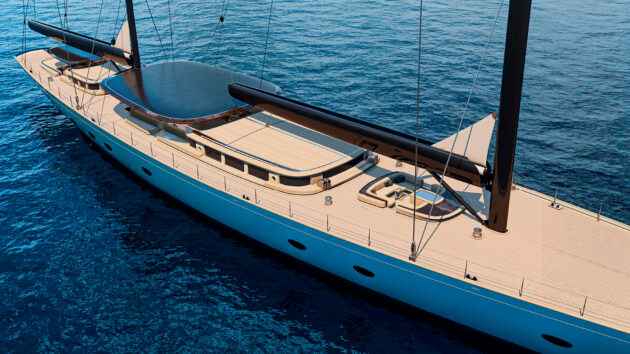
Solar fields: the carbon fibre biminis are fitted with 100m2 of panels that can produce 23kW
To this end, Zero is equipped with a dedicated navigation room, backed with a comprehensive suite of custom software, whose purpose ranges from monitoring the complex flow of energy to analysing weather data to identify the best route for recharging the batteries. In an unexpected way, technology has brought us back full circle to the days of trading under sail, when masters attempted to spot weather systems that would bring the ship to her destination as fast as possible.
I ask whether this means that the owners must be prepared to accept limits on where they go, and when.
“First and foremost, this is a sailing boat,” answers van Benthem in what I interpret as slightly cryptic affirmation. Peute is clearer: “You can’t go from Amsterdam to Antigua under power, and if there’s no wind or the wrong wind, you have to change plans. But the data gives you more options.”
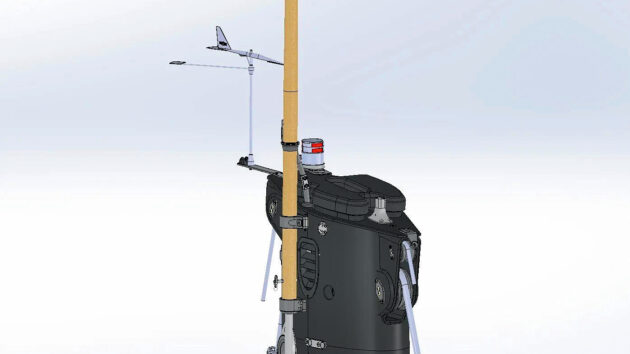
Natural ventilation: smooth, hollow Carbo-Link masts use a natural chimney effect to extract hot, stale air from below
Big data
That said, Zero won’t be spreading her wings too wide in the first year after launch. There are so many complex systems to test, calibrate and master that it’ll take that long simply to complete the sea trial phase. The boat is packed with more than 1,000 individual sensors capable of generating over a billion data points every day.
“That data’s got to be streamed onshore for post processing,” says Leslie-Miller. “It’s all super interesting stuff that you can look at in a lot of detail. But it’s not for interaction with the crew on a day-to-day scale. The trick is also to know where you can do more with less.”
Among the data gathering is some experimental sail monitoring tech, which might be more familiar from the world of self-driving cars. Lidar scatters invisible light towards the sails and picks up reflections that allow a computer to build a 3D image of the sail shape in real time. This could then be used to make recommendations to the crew. “One of the things we see on large cruising boats at some point mid-ocean, is that getting the sails trimmed optimally becomes less of a priority,” explains Leslie-Miller. “We want to help the crew with that.”
It’s not just Lidar, either. They’re also looking at photoimagery, digital telltales and exit angle sensing devices. “It’s very much a development thing, but I have high hopes for this,” he continnues. “Zero would benefit so much from having optimal trim to sail everywhere and produce maximum power.”
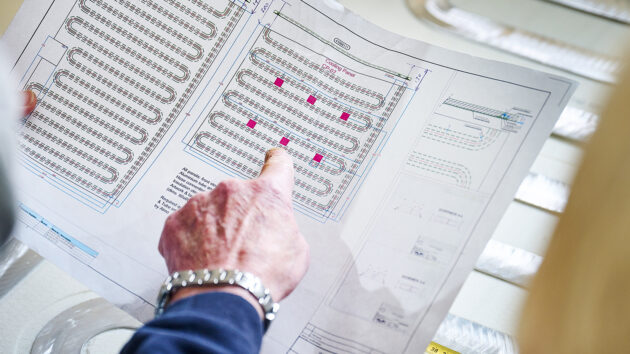
Heat harvesting: waste heat from devices such as thrusters is stored in a molten salt battery. Heat fired chiller tech uses this energy to cool water, feeding water circuits around panels and bulkheads to cool the living spaces
Development has focused just as hard on the debit side of the energy equation. Hotel facilities are believed to account for half the energy consumed on board, but solid data was difficult to come by. So, the team installed data loggers on a large yacht and pored over the results. Aircon and water heating proved to be the chief energy culprits, but the next step took a flash of insight from a physicist called Bob.
“Bob came with the understanding,” says Hoekstra. “He said, ‘I’m looking at a lot of thermal here’. Only when he separated that out did we have the ‘Aha!’ moment. Then we could collaborate again on how to harvest, store and supply heat.”
The first part of the solution is to extract waste heat from the many onboard devices and from a novel glycol circuit cooling the solar panels. Then a mind-boggling molten salt battery stores it for use during the night. As well as using the harvested heat for hot water systems, established heat-fired chiller technology uses the heat energy to cool another water circuit to around 12°C. Wall and ceiling panels throughout the boat circulate this cold water to cool the living spaces.
“It’s a bit like underfloor heating in homes, except it’s in the walls and ceilings,” says Peute. “It keeps things at a very nice temperature without any of the noise or draught associated with aircon blowers.”
At the same time, natural ventilation replaces inefficient fans, thanks to a smart redesign of the carbon mast. Working with spar manufacturer Carbo-Link, the designers realised that they could exploit a natural chimney effect – if the masts could be built hollow and perfectly smooth on the inside. As the mast heats up during the day, the hotter air inside starts to rise, pulling in stale cabin air from below. “By using the mast as a fan, we save 3-4kW in forced ventilation,” says Van Benthem.
Taken altogether, Zero’s cooling is some eight times more efficient than traditional aircon, saving an astonishing 300kWh of energy every day. “It’s all about a series of small, incremental gains,” he adds.
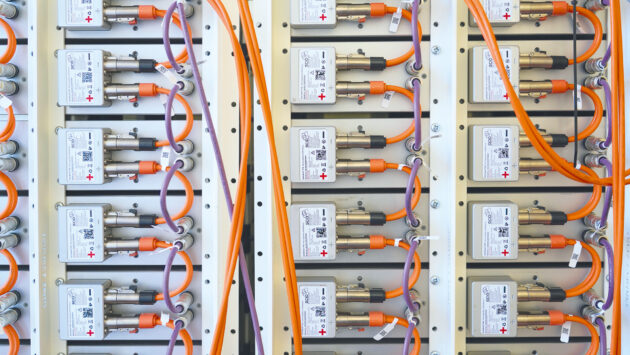
A new scale of battery bank tech: 28 tonnes of custom lithium batteries store 5.2 megawatt-hours of energy
On the flip side of the cooling coin is insulation, and the team has also been busy here. Zero has double glazing with a heat-reflective finish, a 2-3cm layer of cork between the Tesumo decking and the aluminium substrate, and a novel melamine foam, called Sorbermel, lines the interior.
It is far more efficient than traditional glass wool, giving a 70% weight saving for the same performance. “Normal insulation is held to the aluminium hull with metal pins, but all these pins are potential heat bridges,” says Van Benthem. “So, we took literally thousands of them off and glued on the melamine instead.” Cable and pipe trees that pierce bulkheads or frames have also been insulated.
Designers took the quest for energy efficiency to the nth degree. For example, they have designed a camera system to monitor the temperature of the pans on the induction hob. The idea is to warn the chef if they are overheating – a feature they reckon will save 50% or more cooking energy.
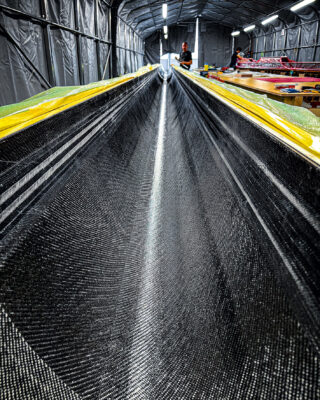
Smooth, hollow section carbon mast in build
They also re-engineered the extractor fan to harness the Venturi effect, halving the amount of ‘good’ air drawn out of the galley and slashing energy use by 60-80%. Or take the simple positioning of the freezer inside the walk-in fridge. “Any cold air that escapes from the freezer saves energy in the fridge,” says Peute.
Every little helps
On deck, the vast custom sheet winches engraved with a cursive ‘Zero’ have a rewind mode which actually generates electricity – just like the brakes on a hybrid car. “It’s not a vast amount, but every little helps,” says Peute. It’s the same for the 13 captive winches hidden below the deck, which generate power as they pay out. And the use of energy-hungry hydraulics has been kept to an absolute minimum, with most deck gear running off the boat’s DC power system. A large Reckmann headsail furler has even been converted to use electricity.
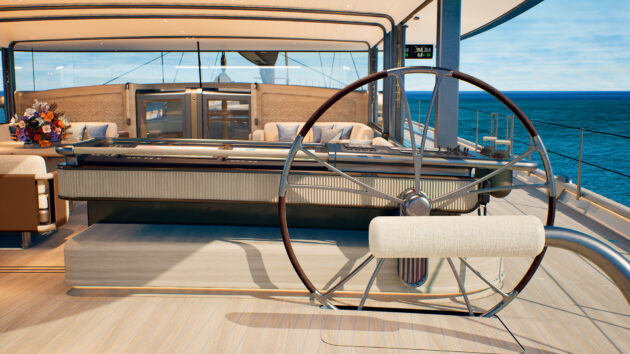
Comfort and elegance were a key part of the brief. Dykstra penned a boat with long overhangs and twin deckhouses, making sure to keep sailing controls well clear of the guest areas. Even the dorade boxes got a makeover
Water management has been another big focus, because even modern watermakers are very energy intensive. Besides all the usual water cleaning systems, there is a whole network dedicated to so-called ‘technical water’ collected from the sails when it rains and even from condensation around cooling systems. “It’s used for hosing down and cleaning the decks, and for flushing heads,” explains Peute.
Novel, it certainly is. Innovative and thought-provoking. But extraordinarily for a fully custom yacht that has not yet left the build hall, Zero is already slated for its first refit. There are some wry smiles about this, but the reason is obvious. “There’s always room for improvement because the technology moves on,” says Van Benthem. “You have to freeze the spec at the optimum available at that time, but batteries, for instance, are constantly improving.”
In building an open-source yacht that is designed to move the yachting industry towards more sustainable solutions, the owners have ended up with a sort of mobile science experiment. “A wolf in sheep’s clothing,” is how Vripack’s Hoekstra puts it. But perhaps the owner’s rep is closer to the truth: “This is not a sailing yacht, it’s a sailing platform!” says Van Benthem.
 If you enjoyed this….
Yachting World is the world’s leading magazine for bluewater cruisers and offshore sailors. Every month we have inspirational adventures and practical features to help you realise your sailing dreams.
Build your knowledge with a subscription delivered to your door. See our latest offers and save at least 30% off the cover price.
Note: We may earn a commission when you buy through links on our site, at no extra cost to you. This doesn’t affect our editorial independence.
