
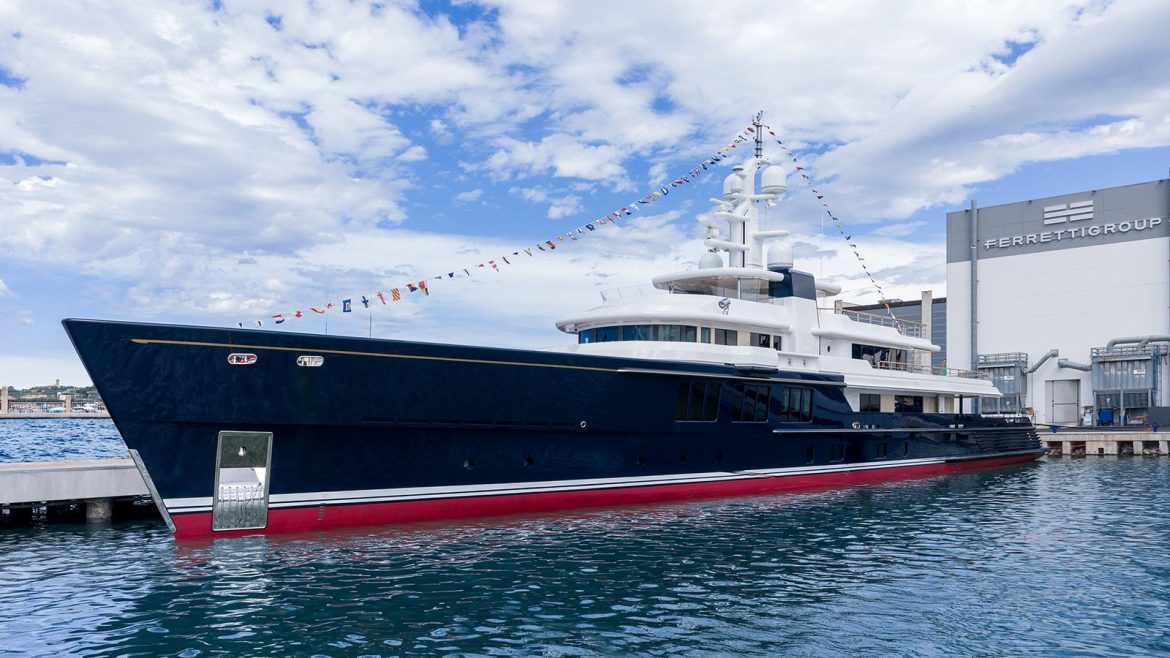
Italian shipyard CRN has launched its latest full-custom superyacht, the 70-metre Project Thunderball, at Ferretti Group’s Ancona shipyard. The steel and aluminium new build touched the water for the first time during a private ceremony attended by her owners and their family.
Following her launch, work will continue on Project Thunderball’s interior and exterior outfitting, ahead of sea trials and testing. Delivery is scheduled for summer 2026.
Previously known as CRN M/Y 145, the 1,100GT superyacht is the result of a collaboration between Dutch studio Vripack and Italian design firm Nauta. Vripack was responsible for the exterior design, preliminary naval architecture and general arrangement, while Nauta developed the interiors and outdoor living areas.
Y.CO has remained involved throughout the build as the owner’s representative and project management team, overseeing construction, technical inspections and supplier coordination.
Project Thunderball has been described as one of the team’s most demanding collaborations, designed to fulfil an exacting owner’s brief for a highly technical and capable yacht that avoids the “floating palace” look and feel.
She is typified by a classic elongated bow, sleek profile and “graceful, sailboat-inspired lines”, which are complemented by gently curved bilges.
The yacht spans four decks and accommodates up to 12 guests in an owner’s suite and five VIP cabins, alongside accommodation for 15 crew across nine cabins.
In terms of the interior, artwork and colour are key themes on board, with Mario Pedol, co-founder of Nauta, previously noting that “several areas are specifically thought for properly positioning the artworks or loose furniture elements”.
According to CRN, the interior concept was developed to transcend trends and reflect a strong connection to maritime culture, combining traditional detailing with a contemporary aesthetic. Material selections, technical solutions and spatial arrangements were all developed in close dialogue with the owner to balance functionality with personalisation.
The new build’s interiors are set to combine creativity and practicality, with each area maintaining its own identity without “breaking the overall sense of consistency” on board.
A key feature of Project Thunderball’s design is the continuity between her interior spaces and exterior decks, with echoed geometries and proportions creating a cohesive flow across her profile. “The interior design is based on a game of geometry, both for layers and for shapes,” Pedol previously explained. “This combination creates dynamism and rhythm in the interior: you never feel the space as too flat, on the contrary, geometry is always in motion with its details and finishings creating an intriguing movement.”
CRN said the design language creates a continuous visual connection between inside and outside spaces, with recurring patterns and proportions reinterpreted across different materials, scales and functions.
Lighting is also a major factor in the yacht’s design. Bespoke, fully integrated lighting (sometimes hidden or otherwise a feature) and “detailed technical studies” have been used to create an intimate atmosphere on board while simultaneously reflecting materials and shapes “at their best”. Another highlight is the implementation of “top-tier but discreet” onboard systems.
“Nauta has always thought that true luxury onboard lifestyle is achieved through the most direct connection with the surrounding environment,” Pedol continued. “This is achieved through design choices like very large glazing. We worked a lot with CRN to optimise structures and technical solutions […] to have better natural light illuminating the interiors”. Solutions like “leaning” the mullion structures in the windows of the main saloon aim to improve the perception of light and offer unobstructed views over the surroundings.
“It’s taken two years of designing,” the owner told BOAT International at the beginning stage of the yacht’s life cycle. The finished result has a low profile that Marnix J. Hoekstra, co-creative director and partner at Vripack, said is “deliberately reminiscent of times past”.
Hoekstra spoke to BOAT International about Project Thunderball in an interview last year. He said: “I still have those original drawings which, to an untrained eye, are just a lot of lines. And they would say, ‘Well, they will look the same’.
“When working with this owner, we were saying, ‘We should put it one hair higher, just one hair higher – let’s see how it works’. It’s rare to find yacht owners with that eye for detail on such elements.”
Read More/Vripack’s co-creative directors share their career-defining yacht projects
Hoekstra added that the owner – a sailing yacht aficionado – was firm in his desire for a limited number of decks and a profile not dissimilar to the look of The One (now V2V). As such, Project Thunderball draws inspiration from the lines of sailing boats and will be accompanied by a smaller sailing yacht that will tag alongside. The superyacht will be located between the Mediterranean, the Bahamas and Florida and be used as a base for spearfishing, sailing and diving.
Explaining the yacht’s technical platform, Hoekstra said: “We took the utmost care to [create] a set of hull lines that focus on highly economical cruising combined with a very soft and comfortable ride”. To this end, the yacht’s entry lines are sharp, akin to a sailing yacht, and her bilges are curved.
The yacht is also equipped with an Energy Storage System designed to manage onboard energy flows according to operational requirements. The system supports peak-shaving functionality and silent operation at anchor, contributing to reduced fuel consumption and improved energy efficiency.
Nauta sketches from Project Thunderball’s design
The owner has had a number of yachts over the years, but the 70-metre Project Thunderball will be his upper limit.
Amenities include a gym and spa. Project Thunderball has also been tailored with watersports in mind for a “family [who] enjoys activities on and in the water”, said Hoekstra. In terms of tenders, she can carry two nine-metre tenders on the bow and a suite of kiteboards, paddleboards and surfboards.
The owner admired the lines of The One (now V2V and formerly Carinthia VI )
The steel and aluminium yacht has a beam of 11 metres and a “relatively shallow” draught of 3.2 metres, allowing her to sail and anchor closer to shore. Performance-wise, the yacht is equipped with MAN V12-1213kW engines, providing her with a top speed of 15.5 knots and a cruising speed of 12 knots.
According to BOATPro, CRN currently has four yachts in build or on order, including the secretive 85-metre CRN 144. BOATPro recently spoke to Ferretti Group’s new Global CEO Stassi Anastassov about plans for the future of the €1.23 billion empire.
