
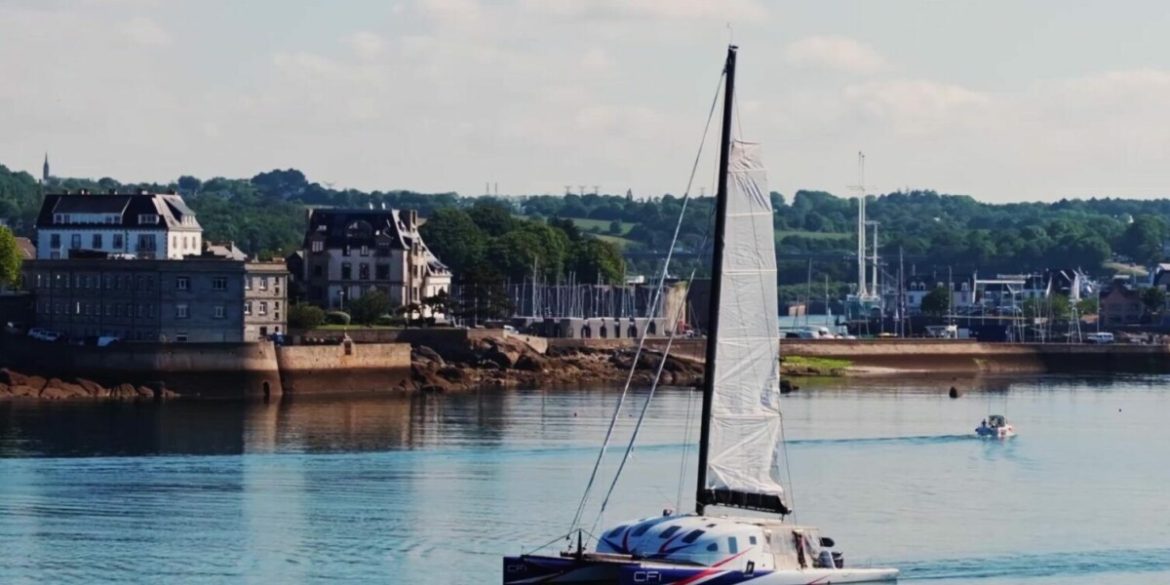
Latest route by British start-up will be captained by Vendée Globe winning sailor on his own vessel
A new wind-powered catamaran service linking Sussex and Normandy is set to be trialled next month, skippered by an award-winning French sailor.
It will be the second cross-Channel route operated by British start-up SailLink, which seeks to offer a unique alternative to traditional ferry crossings by using catamarans powered entirely by wind for the journeys.
The company has operated a crossing between Dover and Boulogne-sur-Mer (Pas-de-Calais) since 2025, which a member of The Connexion team tried out last year to rave reviews.
The trial route connecting Shoreham-by-Sea and Fécamp (Seine-Maritime) will run between September 8 and 13 and take around eight hours to complete, with three departures from the UK port and two from the French side.
Similar to the current route between Dover and Boulogne-sur-Mer, each journey can carry up to 12 passengers, with cyclists able to bring their bikes and store them on the vessel.
The catamaran will be captained by sailor Michel Desjoyeaux, one of the most famous names in the sailing world and the only person to win the illustrious Vendée Globe race twice.
He will be using Mer Agitée, his own catamaran, for the crossings.
A promotional video for the boat can be found below.
Tickets start from £220 one-way and are available through the SailLink website.
As of publication however, only three tickets heading towards France remain, with nine on the return journey back to Shoreham-by-Sea still available across the two days.
For the trial service, a maximum of two tickets per person can be booked.
Similar to the other SailLink crossing, there will be a chance for passengers to engage in activities such as manning the helm of the catamaran, however a fully-experienced crew will be on board.
Note that typical international travel conditions apply – passengers will need a valid passport (checked by port authorities prior to departure), and those entering France without a residency permit or valid visa will begin using their rolling 90-day visa-free allowance for visiting the Schengen area.
For those travelling to the UK, they will either need to use a British or Irish passport (dual citizens must travel on these passports or have a Certificate of Entitlement), with citizens of other nations – including France – ensuring that they have obtained the Electronic Travel Authorisation (ETA) prior to travel.
