
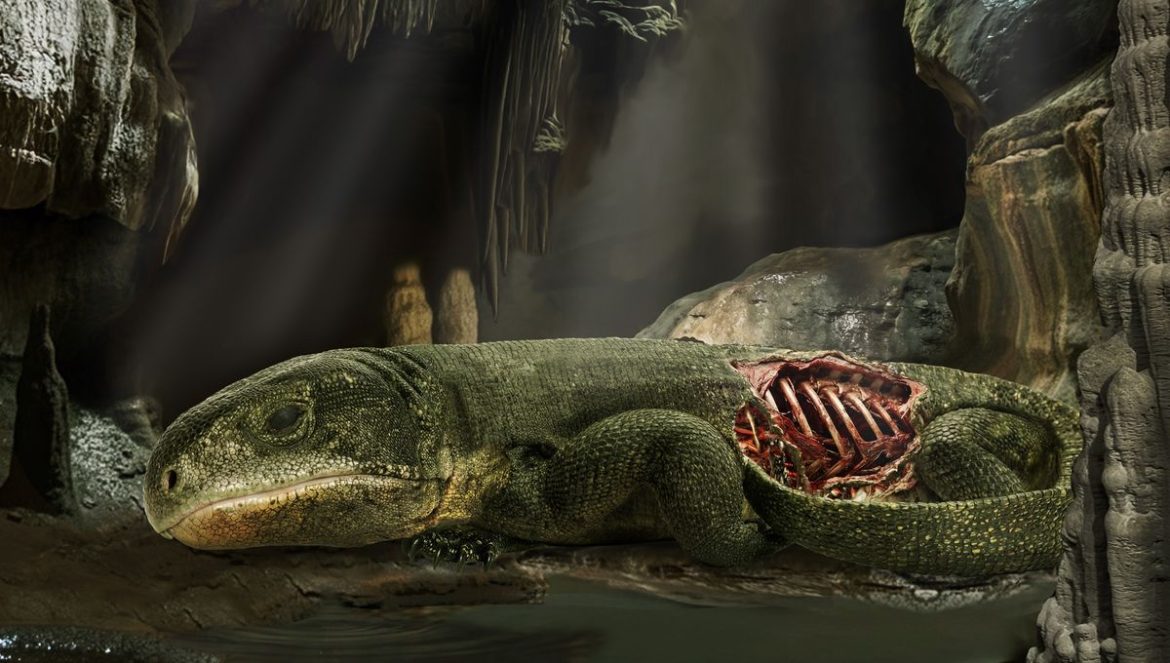
Scientists have discovered the remains of a tiny, mummified reptile in an Oklahoma cave. The species is Captorhinus aguti, a small lizard-like animal that lived in the Permian period, dying 289 million years ago.
The rest of this article is behind a paywall. Please sign in or subscribe to access the full content.
These creatures are among the earliest reptiles that decided to experiment with living on land. So, if you think we’d be better off back in the ocean, you know who to blame. Still, we can also be grateful because they appear to have had the earliest known system that allowed them to breathe like we do.
This critter was an ancestor to the amniotes, the group that includes reptiles, birds, and mammals as well as their now extinct ancestors. While the creature could reach a few feet, this current specimen is just a few inches long. It died in excellent conditions that have preserved, in a three-dimensional structure, the bones, skin, calcified cartilage, and even protein remnants. The previous oldest example of fossilized proteins is almost 100 million years younger.
“Captorhinus is an interesting lizard-looking critter that is critical to understanding early amniote evolution,” co-lead author Ethan Mooney, a graduate researcher from Harvard University, said in a statement.
Mooney was a student at the University of Toronto when he started this work together with co-author Professor Robert R. Reisz. They discovered the specimen in the unique cave systems near Richards Spur, Oklahoma. That site holds the most diverse terrestrial vertebrate assemblage known from the late Paleozoic.
The team used neutron computed tomography (nCT) at a specialized facility in Australia, to look inside the rock without harming the fossilized specimen. They were able to identify what they believed to be skin, as well as segmented cartilaginous sternum, ribs, and a structure connecting the ribcage to the shoulder girdle.
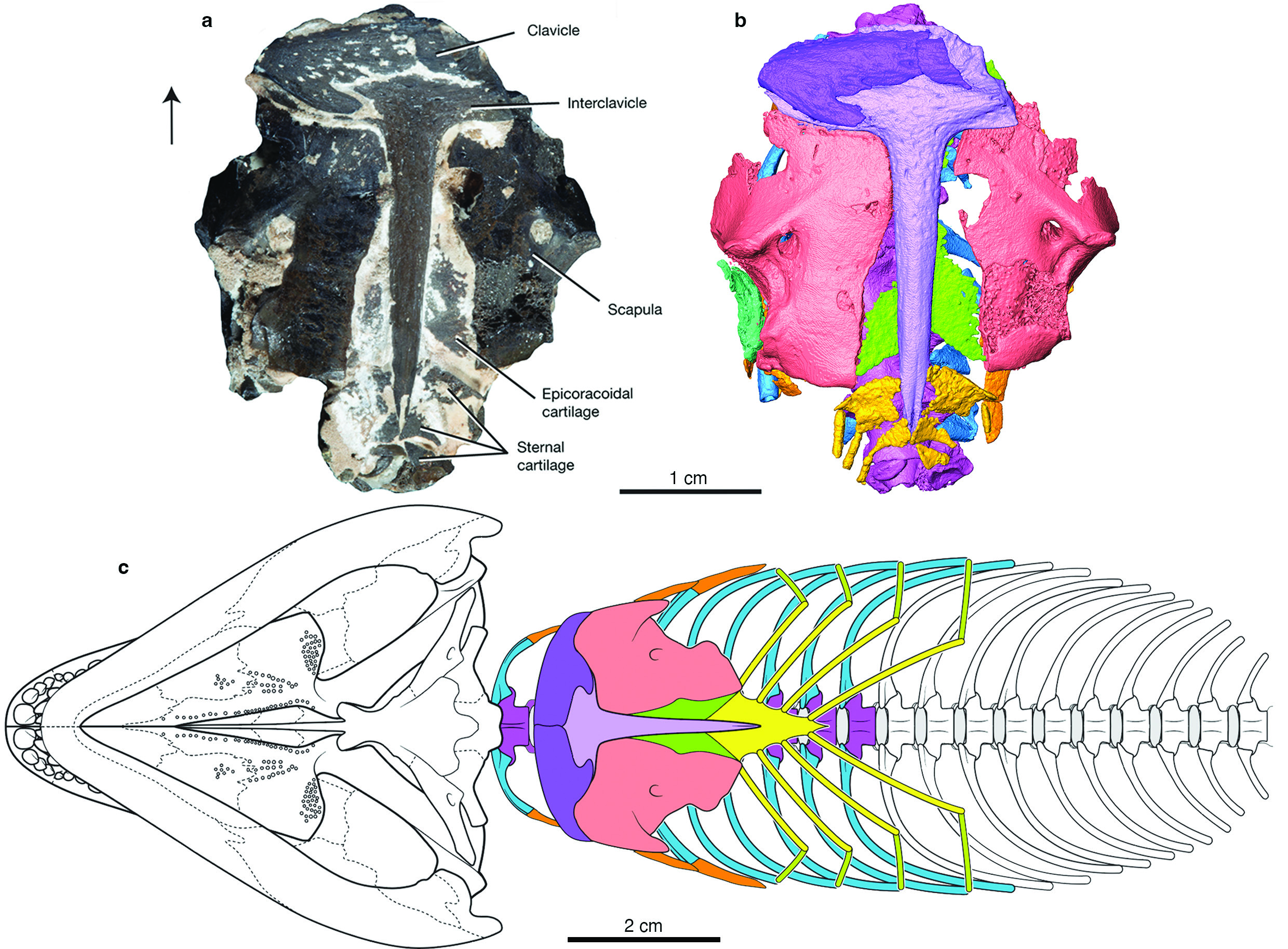
The specimen encased in rock (a), alongside an nCT digital image of the skeleton and cartilage and an illustration of where these structures would have existed in the skeleton.
Image credit: Reisz et al. (Nature 2026) diagram altered from Heaton & Reisz (1980). Heaton, M. J. & Reisz, R. R. A skeletal reconstruction of the early Permian captorhinid reptile Eocaptorhinus laticeps (Williston). J. Paleontol. 54, 136-143 (1980)
“I started to see all these structures wrapped around the bones,” he said, “they were very thin and textured. And lo and behold, there was a nice wrapping of skin around the torso of this animal. The scaly skin has this wonderful accordion-like texture, with these concentric bands covering much of the body from the torso and up to the neck.”
The work allowed the team to reconstruct the breathing apparatus of an early amniote, one that breathed like we do rather than using the system the amphibians at the time (and today as well) relied on.
“We propose that the system found in Captorhinus represents the ancestral condition for the kind of rib assisted respiration present in living reptiles, birds, and mammals,” explained Reisz.
“It was a game changer that allowed these animals to adopt a much more active lifestyle,” added Mooney.
The fossils are now housed in the Royal Ontario Museum in Toronto and they are available for future study.
The study is published in the journal Nature.

ORIGINALLY PUBLISHEDYesterday
FOLLOW