
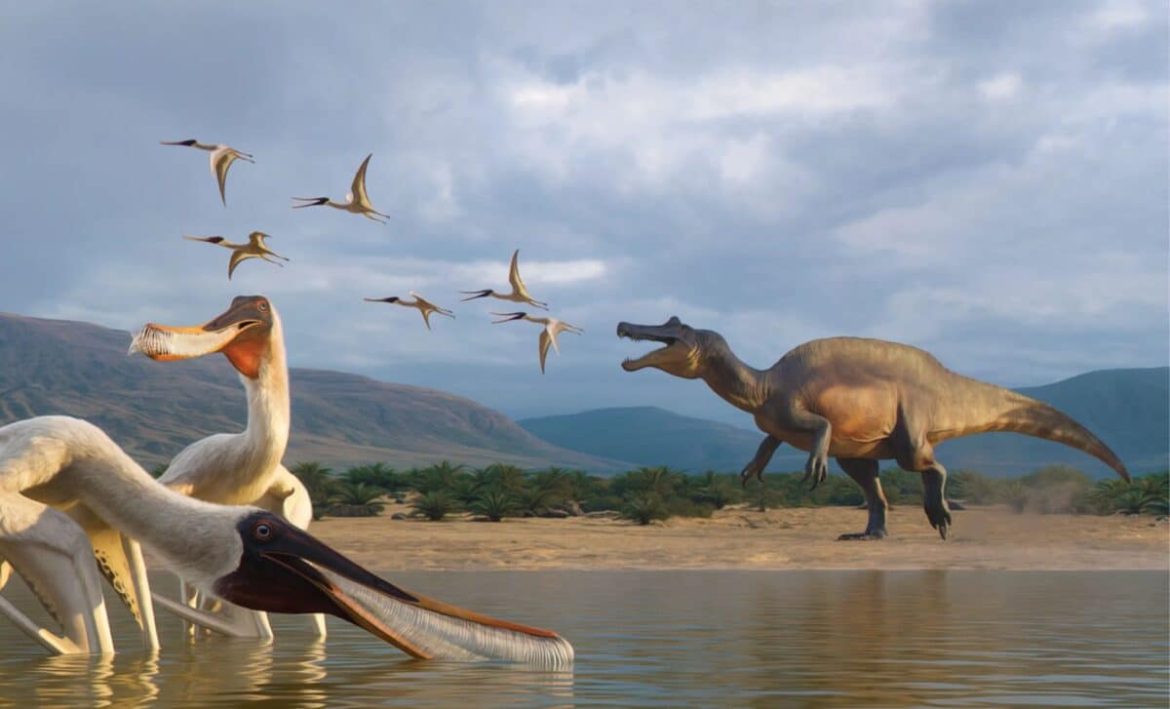
A fossilized mass of regurgitated material stored unexamined in a Brazilian museum collection has yielded the first known filter-feeding pterosaur from tropical latitudes, a species that may never have been discovered had it not been accidentally preserved inside a predator’s expelled stomach contents. The find, published in Scientific Reports, reshapes understanding of how a specialized group of flying reptiles spread across the ancient world some 110 million years ago.
The specimen, named Bakiribu waridza, meaning “comb mouth” in the Kariri language of the Indigenous people native to the region, was identified by researchers from Brazilian universities after a scientific initiation student, William Bruno de S. Almeida, came across it while reviewing fish fossils at the Câmara Cascudo Museum at the Federal University of Rio Grande do Norte. The fossil had sat in the collection for years, catalogued among ordinary fish remains from the Araripe Basin in northeast Brazil.
“Fish are very abundant organisms in the Araripe fossil record, which is perhaps why no one realized that among them was an animal that was still unknown,” said Rubi Vargas Pêgas, a postdoctoral researcher at the Museum of Zoology of the University of São Paulo, who was involved in the study.
A Species That Should Not Have Been There
What makes the discovery particularly significant is that Bakiribu waridza belongs to the Ctenochasmatidae family, a group of pterosaurs previously found only in Europe, East Asia, and Argentina, and one associated almost exclusively with calm freshwater or lagoonal environments. The Araripe Basin, by contrast, was a coastal to near-marine setting during the Early Cretaceous, the kind of environment where ctenochasmatids had never before been documented.

According to the study, the most likely explanation for the animal’s presence in the fossil record there is that it was never a resident of the basin at all. Instead, the researchers propose that Bakiribu was consumed by a large predator in a separate, nearby freshwater environment, then carried into the Araripe depositional zone before being expelled. The fossil assemblage, technically called a regurgitalite, contains the partial skulls of two Bakiribu individuals alongside four well-preserved fish, all oriented in the same direction, consistent with the head-first swallowing behavior observed in modern piscivorous birds.
“It was therefore an environment surrounded by others that weren’t necessarily preserved in the fossil record,” Pêgas noted. “This species might never have been known if it hadn’t been regurgitated in Araripe.”
Anatomy and Evolutionary Position
Bakiribu waridza was roughly the size of a modern seagull and carried rows of densely packed, bristle-like teeth, an adaptation for straining small aquatic organisms such as crustaceans from the water. According to the published research, its tooth density measured 17.6 teeth per centimeter, with an estimated total tooth count of between 440 and 568 across both jaws. The teeth are notably elongated, with an elongation index exceeding a ratio of 1:60, and display a distinctive subquadrangular cross-section not seen in any other member of the family.

Phylogenetic analysis places Bakiribu as the sister species of Pterodaustro guinazui, the Argentine pterosaur known for its thousands of hair-like lower teeth. In several measurable respects, tooth elongation, density, and count, Bakiribu sits between the older European genus Ctenochasma and the younger Pterodaustro, partially bridging a gap in the evolutionary record of filter-feeding adaptations within the group.
The leading candidate for the predator responsible for producing the regurgitalite is Irritator challengeri, a spinosaurid dinosaur documented in the same formation and already linked by fossil evidence to pterosaur consumption. A large ornithocheirid pterosaur, Tropeognathus mesembrinus, with a wingspan exceeding eight meters, is considered a secondary possibility.
Following the identification of the specimen, one half of the rock concretion was transferred to the Museu de Paleontologia Plácido Cidade Nuvens in Santana do Cariri, Ceará, the region from which the fossil most likely originated. The move was described by lead author Aline M. Ghilardi as part of a deliberate effort to keep significant specimens within their territories of origin.
