
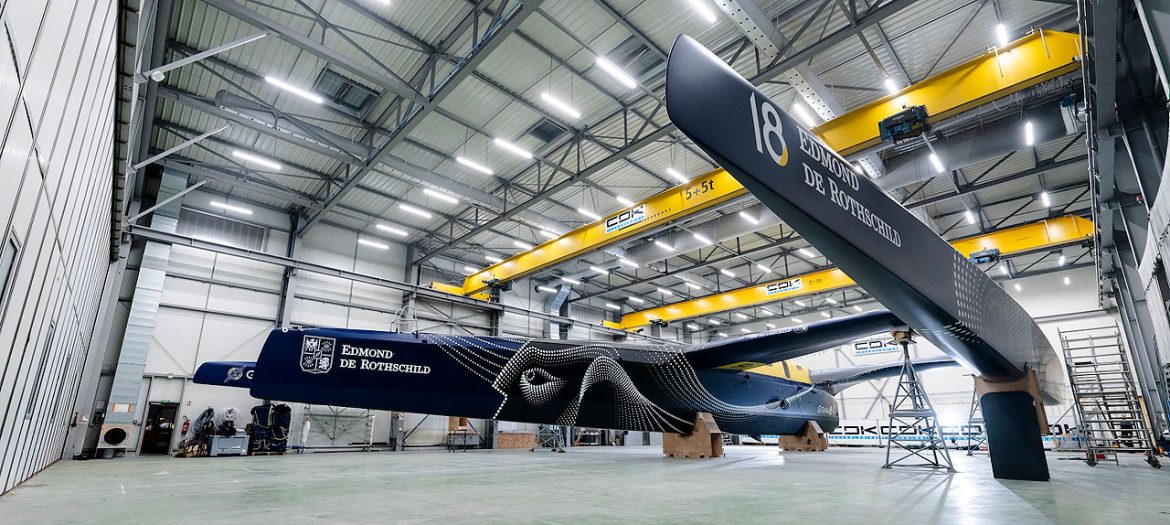

Launched late last year in Lorient, France, the Gitana 18 trimaran was immediately hailed as the most advanced – radically advanced – offshore sailing multihull ever built. It earned every superlative before even touching the water; one look at its hulls, foils, and control systems was enough to recognise a groundbreaking, next-generation racing machine.
Background
The trimaran is the crowning achievement of years of work by the professional sailing team Gitana Team, founded in 2000 by Baron Benjamin de Rothschild. The team has built numerous outstanding racing yachts – Gitana 18 is the 28th boat in the stable. This is its own name; when racing, it will be known as Maxi Edmond de Rothschild, continuing the tradition set by Baron Benjamin in honour of his father. After the founder’s death in 2021, his widow Ariane de Rothschild took over the project. At the launch ceremony she said, “Our family has always had a passion for competition and technological innovation. We’re talking about breakthrough solutions, the ability to take risks, assess them and manage them. This is fully in line with our philosophy.”

The development of Gitana 18 drew on data and experience accumulated by the team during the creation of the previous model, Gitana 17 (now renamed Actual Ultim 4), launched in 2017. At the time, it was the most sophisticated 100-foot trimaran – a fact it brilliantly proved by covering over 200,000 nautical miles across all the world’s oceans, securing 10 wins and 15 podiums in 16 races, including extreme events like the Transat Jacques Vabre, Route du Rhum and Arkea Ultim Challenge.
All‑star team
Once again, top‑tier talents worked on the new Ultim‑class yacht, designed to set new records. The structure was designed by Guillaume Verdier – designer of America’s Cup and IMOCA yachts – together with Sébastien Senson, head of the Gitana design studio. Legendary sailor Charles Caudrelier, who was skipper on Gitana 17 and will also skipper the 18th, made a significant contribution to the process.

The project incorporates cutting‑edge expertise from CDK Technologies (builder), C3 Technologies (rudder manufacturer), Re Fraschini (foils), Southern Spars (mast and boom), North Sails (sails), and Harken (deck hardware). The futuristic exterior and striking livery were designed by French artists, brothers Florian and Michaël Kvistreber.
Parade of innovations
Despite its impressive dimensions – 32 metres long, 22 metres wide and 38 metres high – the trimaran is incredibly elegant and looks less like a vessel than an aircraft. Its creators call it a “polymorphic creature” that autonomously extends, retracts and adjusts numerous moving parts to adapt to waves and wind. Even those elements have moved far beyond classic shipbuilding.
Instead of L‑shaped hydrofoils – which until recently were considered the last word in design but have become common on racing multihulls – Gitana 18 features sculptural wings of complex shape (something between a T and a Y), mounted on oscillating struts.

The central hull, which integrates the deckhouse and cockpit, sits on a T‑shaped daggerboard nearly 5 metres deep with a wingspan of 3 metres.
But the most radical innovation is the A‑frame rudders. Unlike conventional rudders, where the entire blade rotates, here the rudder stocks are fixed. Directional control is provided by movable flaps on the trailing edge of each blade, which can be adjusted independently. The blades themselves can be raised and their angle changed. This complex design is intended to compensate for the deformations that highly loaded rudders experience – without, according to calculations, sacrificing drag. The rig has also been upgraded. The raked mast features spreaders that can be tilted aft under sail, adjusting mainsail leech tension – this unloads the mast when transitioning to foiling mode and in gusty winds. The idea itself is not new, but this is the first time it has been realised on such a scale.
Dozens of moving elements – with unexpected geometries, original attachment systems, extensive wiring and cutting‑edge electronics – are difficult to describe. Their closest analogues might be found in aerospace. “Mechatronics – the combination of mechanical, hydraulic and electronic systems – is undergoing radical change on Gitana 18,” notes Sébastien Senson, head of the Gitana design office.

Towards new records
All these innovations are meant to deliver a significant speed gain – according to simulator results, between 10 and 15 per cent.
Unlike its predecessor, Gitana 18 will be able to switch from a hybrid sailing mode to 100% foiling flight, which undoubtedly marks a new stage in the evolution of high‑performance ocean‑going maxi trimarans.
“With this new boat we want to achieve a flight as close to ideal as possible. We hope to fly over three‑metre waves without touching them and to achieve an average speed close to 40 knots. The maximum potential speed exceeds 55 knots,” says Charles Caudrelier, captain of the Maxi Edmond de Rothschild Gitana 18.
The project was launched in January 2024. Design and associated research took 50,000 hours; construction took 200,000 man‑hours. Eighty percent of the platform was built in an autoclave. Patent applications have been filed for many of Gitana 18’s structural elements.

Racing plans
Based on extensive computer simulator trials, the maxi trimaran’s designers have good reason to predict a championship future. However, taming this fantastic creation and mastering all its functionality in real conditions will take several months. So, according to the schedule, more than half of 2026 will be spent on shakedown.
Its racing debut will be the transatlantic Route du Rhum regatta, which starts on 1 November from Saint‑Malo in France and finishes in Pointe‑à‑Pitre on the Caribbean island of Guadeloupe. There, skipper Charles Caudrelier will have to defend his own title: the previous race record belongs to him. In 2022, on Gitana 17, his team covered the 3,540 nautical miles in 6 days, 19 hours, 47 minutes and 25 seconds.

Caudrelier will then sail the trimaran solo around the world. The current record, set by François Gabart on the trimaran Macif in December 2017, stands at 42 days, 16 hours, 40 minutes and 35 seconds.
After that, Caudrelier and a crew will take aim at the Jules Verne Trophy. This is not a regatta with fixed dates; the trophy is awarded for the fastest non-stop circumnavigation under sail, starting and finishing between the French island of Ushant and England’s Lizard Point. Attempts can be made at any time (usually from November to February to harness strong winds in the Southern Ocean), but the mandatory condition is that the course must be completed without outside assistance. The current record belongs to the crew of Thomas Coville, who, on 25 January 2026, on the maxi-trimaran Sodebo Ultim 3, circumnavigated the planet in 40 days, 10 hours and 45 minutes – 12 hours and 44 minutes faster than the previous record holder, Francis Joyon’s crew on IDEC Sport. That earlier record had stood since 2017.
The team of Maxi Edmond de Rothschild Gitana 18 has no doubt that all these achievements will be surpassed.
