
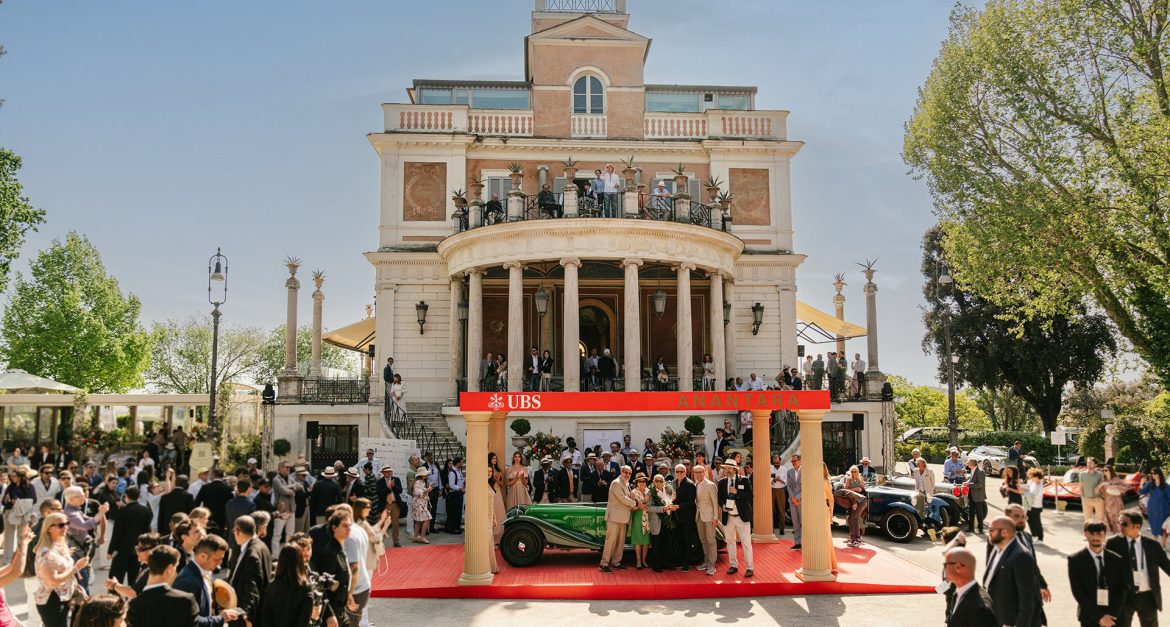
Rome hosted its first Concours d’Elegance since 1960, and it definitely was worth the wait. Featuring 70 all-Italian automobiles, a spectacular and picturesque setting, and a monstrous 16-cylinder Maserati connected to Rome’s history that stole the show, it was a first edition to remember.


Rome has hosted popes, gladiators and emperors. The eternal city is unmatched when it comes to historical significance and cultural depth. Unlike the metropolises of northern Italy, it’s not a car city though. At least it wasn’t in the last decades. Now, for the first time since 1960, it has hosted a Concours d’Elegance. From April 16 to 19, 2026, the country’s capital welcomed 70 of the rarest and most significant automobiles with the Italian Touch, gathering them in one of the city’s most breathtaking settings. The inaugural Anantara Concorso Roma did not merely live up to its billing. It announced itself as one of the most distinctive and emotionally resonant automotive events in the world.
The idea behind the concorso is deceptively simple: an all-Italian celebration of Italian automobiles, held in Italy’s greatest city. No foreign marques, no concessions to the international standard of mixed fields. Jury president Adolfo Orsi Jr. conceived the event because he felt that a concours dedicated exclusively to Italian cars was missing in his home country, a basic orientation he intends to preserve for all future editions. That singular focus gave the event a strong identity few others can claim. Walking among the cars, one was not merely watching four-wheeled relics of a long-gone era. One was reading a century of Italy’s automotive pride and joy through metal, leather, and glass.


The venues couldn’t have been more adequate
The setting was extraordinary and Italian as it gets. The 70 competing cars were displayed in the heart of Villa Borghese, at the Casina Valadier, a neoclassical villa perched on the Pincio Hill with sweeping views over the city’s rooftops. The warm April light filtered through mediterranean trees, casting long shadows across bonnets and coachwork in a way no utilitarian exhibition hall could ever replicate.
A selection of cars was also displayed in the grand atrium of the Anantara Palazzo Naiadi hotel on Piazza della Repubblica, which served as the event’s official host venue. On Friday, April 17, the competitors took to the city’s streets for the Giro d’Anantara, a dynamic parade that sent pre-war Alfa Romeos and 1960s Ferraris threading past ancient stone and baroque fountains. On Saturday evening, after a full day of judging on the showfield, guests were treated to fine Italian dining and entertainment at the historic Palazzo Brancaccio.


From Alfa Romeo to Pagani
The 70 cars were organized into 16 classes spanning nearly a century of Italian automotive heritage. The pre-war classes set an immediate tone of curated quality. The jury’s President’s Prize went to a 1929 Alfa Romeo 6C 1750 Sport Zagato. A 1938 Alfa Romeo 8C 2900B Cabriolet with coachwork by Stabilimenti Farina, from the Keller Collection, was recognized as the most elegant pre-war automobile of the concorso.
Among the post-war classes, Ferrari dominated in terms of sheer numbers. A 1951 Ferrari 340 America Barchetta by Touring took the barchette class win, a 1965 Ferrari 275 GTB from the Ronnie Kessel collection won the Pininfarina berlinetta class, and a 1967 Ferrari 275 GTB/4 was recognized as the most influential design of the concorso. A 1958 Lancia Aurelia B24S Convertible by Pinin Farina won the open-car class and received the Spirit of the Journey award, while a 1954 Fiat 8V took the best restoration prize. The later classes showed that Italian greatness did not end with the switch from front-engined berlinettas to mid-engined supercars: a 1968 Lamborghini P400 Miura won Class XIV and a 1993 Bugatti EB 110 GT took Class XV, a reminder that the Romano Artioli-era Bugatti, built near Modena, carries genuine Italian credentials even though the brand is quintessentially French despite being founded by a Milanese. The final word belonged to a 2021 Pagani Huayra Roadster BC, which took the hypercar class and closed the show on a suitably theatrical note. The Lifetime Achievement Award went to classic car-restorer Paul Russell based in the Boston region.


Spectacular racer with an eventful history
The event’s most anticipated prize, the Best of Show, went to one of the most historically extraordinary automobiles in the field: a 1932 Maserati V4 Sport Zagato, owned by American collector Lawrence Auriana. One of only two ever built, it is a car with a strong historical connection to the Vatican and the Italian capital, because it was first purchased by Professor Riccardo Galeazzi-Lisi, the controversial personal doctor of Pope Pius XII, who roamed the Roman streets in this converted race car for a while. In 1934, Zagato rebodied it as a roadster in a distinctive two-tone green, giving it the silhouette it wears today. Its wartime story is equally remarkable: a Dutch owner named Erik Verkade dismantled the car after the German invasion and hid the V16 engine in his bedroom for five years, keeping it safe until the war was over.
Powered by a four-liter sixteen-cylinder unit assembled by joining two straight-eight engines derived from the racing Tipo 26B, a solution that gave the car a monstrous character and a claimed top speed of an eyewatering 255 km/h. On September 28, 1929, Baconin Borzacchini had already taken the V4 to a world speed record at Cremona, covering ten kilometers at over 246 km/h on an unsealed road, before the car went on to deliver Maserati its first major international victory at the 1930 Grand Prix of Tripoli. The Zagato body that clothes this mechanical tour de force is equally remarkable: lightweight, aerodynamically considered for its era, and possessed of a muscular tension that makes it still feel modern. Auriana acquired the car in 1999, restored it to original specification, and had already taken the top prize at Pebble Beach in 2003 before bringing it back to Rome. That homecoming felt entirely right. A Maserati, built in Bologna and raced across Italy, winning Best of Show in the Eternal City, was the kind of symmetry that a first edition deserves.


The Trident showed up in force
Maserati served as Official Partner of the event and brought a carefully curated selection of its own history to Villa Borghese, a presence that gained additional meaning given that the concorso coincided almost exactly with the centenary of the Maserati Trident, the Neptune-inspired emblem that debuted at the 1926 Targa Florio. Among the official display cars, the 1927 Tipo 26B on loan from the MAUTO in Turin and the 1954 A6GCS-53 Berlinetta Pininfarina from the Umberto Panini Collection drew sustained attention, as did a privately owned 1959 3500 GT Vignale Spider prototype, which won its class and took the prize for the finest interior.
The objective was to create an event capable of attracting the world’s most renowned collectors to Rome. On that measure, the first edition succeeded completely. The atmosphere was one of genuine connoisseurship mixed with accessibility: the event was open to the public on both weekend days, and the sight of ordinary Romans and tourists stopping to stare at Italy’s most spectacular four-wheeled creations was a pure pleasure. The credit belongs to Anantara Hotels & Resorts, who organised the event, and presenting partner UBS, who helped bring it to life. The already confirmed second edition, scheduled for April 1 to 4, 2027, will have considerable expectations to meet.
