
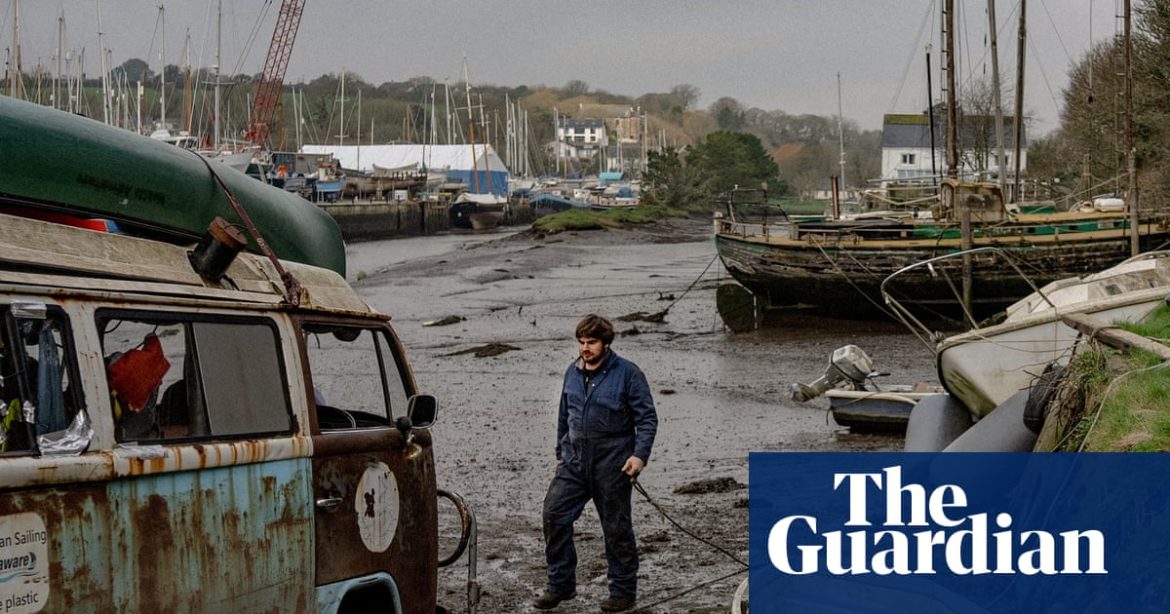
Steve Green, a boat engineer from Cornwall, was pulled over by the police just before Christmas. He was driving a decrepit-looking VW campervan and towing an even more dilapidated yacht up to Truro. He hadn’t broken any laws, but he admits that Cecil the campervan, which runs on donated chip oil from local pubs and has a crane and a winch on the front, “wasn’t quite what VW intended”.
Green (and Cecil) are on a mission to rid the beautiful hidden creeks of Cornwall’s Helford and Fal rivers of 166 abandoned fibreglass yachts, which are leaking plastic and toxins into the predominantly marine waters. Marine biologists have likened the thousands of shards of fibreglass they have found embedded in the flesh of sea-creatures in areas with wrecks such as these to asbestos, a substance known to have a noxious effect on humans.
The problem stretches far beyond Cornwall. Across the UK – and indeed the world – the legacy of the mass-produced fibreglass pleasure boat boom is unfolding. Yachts bought in the 1960s and 1970s are now reaching the end of their useful lives and there is no clear plan for what to do with them.
Green was towing the 22ft Hurley yacht that had alarmed the police to Truro recycling centre – but the recycling part is euphemistic. These yachts end up in landfill. Disposal is charged by the tonne and Green paid £1,200 to dump it there. Larger yachts cost up to £3,000. It’s one reason so many of them are abandoned by their owners, who don’t want to foot the cost or take responsibility for disposing of them.
It takes Green days to clear a discarded yacht of rubbish, silt and sand, bail it out and float it to a place where it can be lifted on to Cecil’s trailer or pulled upstream to Truro by Annie, the 100-year-old wooden “pirate ship” schooner he has lived on for most of the past two decades. But it matters to him that even he is causing some damage to the environment by doing this. “I don’t want a massive barge with a digger on it,” he says. “That would do it in a day, but the impact [of that vehicle on the environment] is huge.”
The organisation he runs with his wife, Clean Ocean Sailing, relies on small charitable grants, crowdfunding and enthusiastic volunteers willing to paddle kayaks out to wrecks and help. Green ran up £8,000 on credit cards last year when the grants didn’t cover all the decaying boats he took to the dump. “It’s a balance between not being so broke that my kids can’t live a normal life, and wanting to preserve the environment for their future,” he says.
Each rescue mission starts with Green putting a notice on the abandoned yacht, giving the owner 30 days to come forward and claim it. Unlike road vehicles, or even boats destined for rivers or canals, you don’t need a licence for a boat on coastal waters. This often makes tracing the owner impossible, especially if they don’t want to be found. “So many people have a dream of getting a boat, but with no thought of where to keep it or how much it will cost,” says Green.
-
Green repositions Jehol, which has changed hands four times for £1, but has become too costly and troublesome for owners to dispose of
Jehol, a 1970s Westerly Centaur – one of the most popular British-made yachts – is a boat that Green is in the process of tackling. “She has changed hands for £1 four times, always to people with a dream and the best intentions,” he says. “But life takes over.”
Babies were born, families moved, Jehol needed too much work and money. Left unused, the tarpaulin keeping the rain out of the cockpit ripped and it gradually filled up. One of the keels broke off underneath, leaving a big hole in the hull for water to come in and tip the boat over.
When a boat is abandoned, it can quickly begin to leak harmful oil and resin-based paint into the water. But Corina Ciocan, a marine biologist at Brighton University, is most concerned about the fibreglass. Her research has shown it breaks down into “shards of microplastic which spear the flesh of mussels and oysters like javelins”, as well as entering seagrass and algae that will in time be eaten by fish. “Once ingested, that fibreglass will stay in the organism, and I’m working to show that it behaves in the same way as asbestos,” she says.
Her team examined the flesh of oysters in the sea around Chichester harbour and found more than 11,000 shards of fibreglass per kilogram of oyster. “We were stunned,” she says. “It’s such a huge amount.”
Ciocan believes that abandoned, rotting boats should be categorised as hazardous waste rather than merely as rubbish. She argues that boat builders should have a duty of care to think about what happens to their boat at the end of its life.
-
Ponsontuel Creek, top, branches off the Helford River, bottom, which flows from Gweek toward the sea and is one of the many local waterways where Green collects abandoned boats and debris
Green is keen for Britain to follow the French model, in which boat manufacturers have to pay an eco-contribution for every boat sold. This is combined with an annual tax on boat owners – who are easy to track down because boats have to be licensed – and used to fund 35 free-to-use boat scrapping centres across France. The Association pour la Plaisance Eco-Responsable, which runs these centres, has removed more than 16,000 boats since it was launched in 2019, and is tasked with recycling as much as possible of the boats it dismantles. Green is carefully logging all the different components of boats he has hauled out to gain a clearer idea of what may be salvageable.
Over in nearby Falmouth, the harbourmaster was up early to catch the tide so he could tow a discarded yacht up to Truro, where it would end up in the ground.
Cornwall Harbours has powers under the harbour revision order to remove and dispose of abandoned boats. If the cost cannot be recovered from the owner, boat removal is paid for using harbour revenues.
-
Rescued boats, plastic, and marine debris pile up on Green’s dockside. The cost of disposal is prohibitive, so the waste accumulates while he works to raise the funds needed to clear it
Miles Carden, the chief executive of Falmouth harbour, said: “We can’t afford the fees for this, but we have no choice. We don’t want to sell [a boat] on cheaply and then see it reappear.”
Like other harbours, Falmouth has learned to act fast before the problem gets bigger. A boat that has sunk is far more expensive and difficult to recover. Yet Carden is also conscious that the real problem lies beyond carefully policed harbours such as his, where people pay to rent moorings and can be easily traced. “The [answer] to this problem has got to be some sort of circular economy on recycling boats,” he said. “With a use for the end product.”
The wreck taken to Truro by the harbourmaster had blown into Falmouth harbour with Storm Goretti. It probably came from one of the tucked-away creeks upstream, where Green and his already maxed out credit card are, at present, the only solution there is.
