
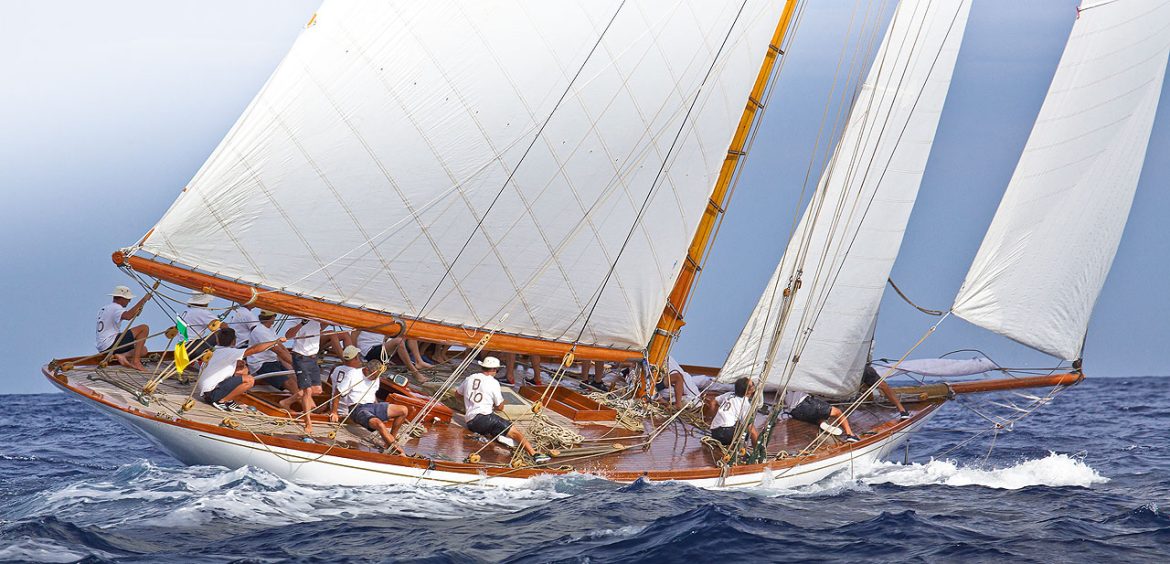
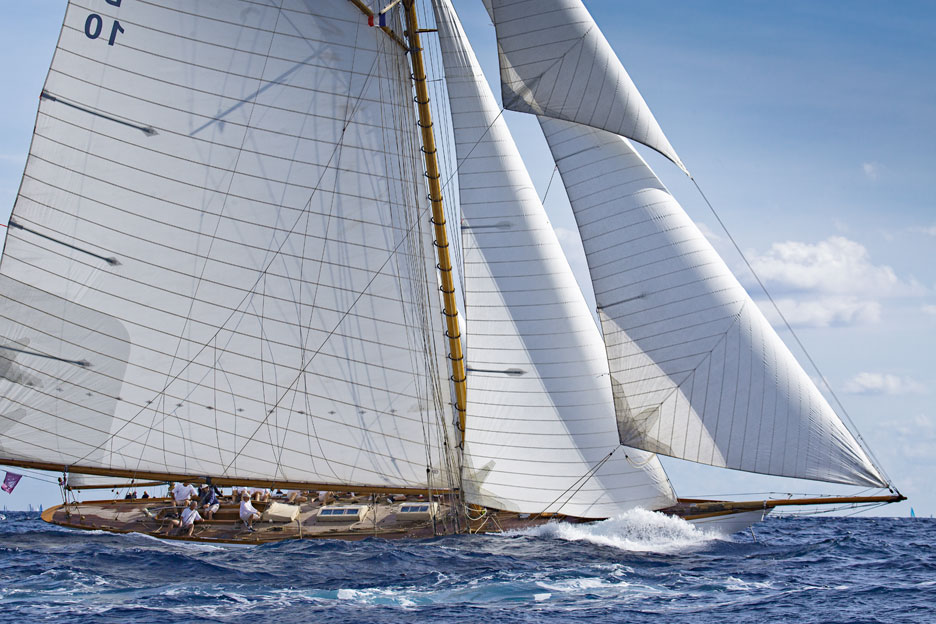
This is one of those vessels whose name serious fans of classic yachts utter with particular reverence. The Lady Anne is among the rarest surviving members of the legendary 15-Metre class. Today, only four remain, and Lady Anne is the youngest of them.
It is important to point out that “15 Metre” has nothing to do with the yacht’s actual dimensions. It is simply the result of a rating formula. In fact, the hulls of yachts in this class were nearly 30 metres long.
The “Metre” classes emerged in 1907 with the adoption of the International Rule, a turning point in sailing history. For the first time, this rule introduced a universal measurement formula accounting for length, beam, and sail area, thus creating a fair handicap system for yachts of different sizes.
The most significant marks on sailing history were left by the 6-Metre class for the 1908 Olympics, the 12-Metre class for the America’s Cup from 1958 to 1987, and the 15-Metre class, which bequeathed a legacy of the most elegant and expensive yachts of its era. Like other metre classes, the 15mR was a construction class: yachts were not identical but had to meet specified parameters, leaving ample room for engineering experimentation. Hulls were originally built mainly from wood, but even then, designers actively sought new structural solutions to boost speed and efficiency. At the time, the Metre classes represented the elite of international racing and served as a crucial testing ground for the evolution of yacht architecture.

The period from 1909 to 1917 was the golden age of the 15-Metre class. Twenty yachts of this type were built during those years. Only four have survived to our time: Tuiga, Mariska, Hispania, and the heroine of our story, The Lady Anne. Designed by William Fife III, these yachts set the aesthetic and technical standard for the class and are considered genuine maritime relics. As “maxi-yachts of their time”, these vessels embodied the pinnacle of prestige and luxury, accessible only to crowned heads and the wealthiest people of the era.
Lady Anne’s construction is impressive even a century later. Measuring 30 metres in length, with a beam of 4.15 metres, a draught of 3 metres, and a displacement of 39 tonnes, the yacht carries a colossal sail area of 229 square metres. The Lady Anne’s hull, like that of her sister ship Tuiga (which we covered in issue No. 105), is composite: a steel structural framework planked in mahogany and fastened with bronze rivets.
Over her long life, the yacht has changed rig several times, adapting to owners’ needs, and has gone from her original gaff tender to a ketch and back again. She was built in 1912 at the famous William Fife & Son shipyard in the Scottish town of Fairlie. The brilliant naval architect William Fife III personally designed eight of the twenty yachts in this class. The client was George Coats, a scion of an influential and wealthy dynasty from the banks of the Clyde. The goal was ambitious and patriotic: to bring back the 15-Metre Class Cup, which in 1911 had been won by the crew of the German yacht Paula.

Almost simultaneously with The Lady Anne, Istria was launched, the creation of another equally famous naval architect, Charles Nicholson. She was a revolutionary “speed machine” for her time, featuring a modernised mast. Nicholson developed a hollow topmast that was inserted into the top of the mast and fitted with a track for setting the luff of the topsail (the sail set above the gaff mainsail). This design eliminated the need for a topsail yard, making the rig lighter and taller and simplifying sail raising and lowering. It became known as the “Marconi mast” because it resembled a radio mast’s construction.
Istria became the dominant force in her class for several years, leaving The Lady Anne competitive only in light winds. Throughout 1912 and 1913, The Lady Anne’s hull and rig were repeatedly modified to maintain competitiveness, but she never managed to beat Istria. In the pursuit of speed, by 1914 The Lady Anne herself had been fitted with a Marconi mast, but the First World War put an end to the racing career of the entire class.
Fife’s creations were always renowned for their longevity, and The Lady Anne managed to outlive most of her contemporaries, whereas her unbeaten rival Istria was, ironically, broken up as early as 1924.

During the Second World War, The Lady Anne was rumoured to have performed dangerous work transporting ammunition. Around that time, her valuable lead keel was removed and replaced with a cast-iron one. After the war, the yacht spent a long period in Spain, where she was used for leisurely cruises. In 1959, the vessel came into the ownership of Patrick Neven. His daughter, Carol MacBeth, later fondly recalled how the whole family, including newborn infants, lived aboard The Lady Anne. Under the Neven family’s flag, the yacht twice crossed the Atlantic and sailed to the shores of Ireland and the Canary Islands.
Maintaining such a colossal vessel required vast sums of money, and in the mid-1960s, the yacht was sold. In 1968, while owned by Tom and Lynn Bullock, The Lady Anne once again showed her racing pedigree, winning the Puerto de La Luz — Jandia regatta. Then, the trail of the historic vessel went cold until, a couple of decades later, yacht historian William Collier discovered her on the River Hamble in England. The vessel was almost unrecognisable; with an aluminium mast and a heavy, clunky coachroof, it barely resembled a Fife masterpiece.
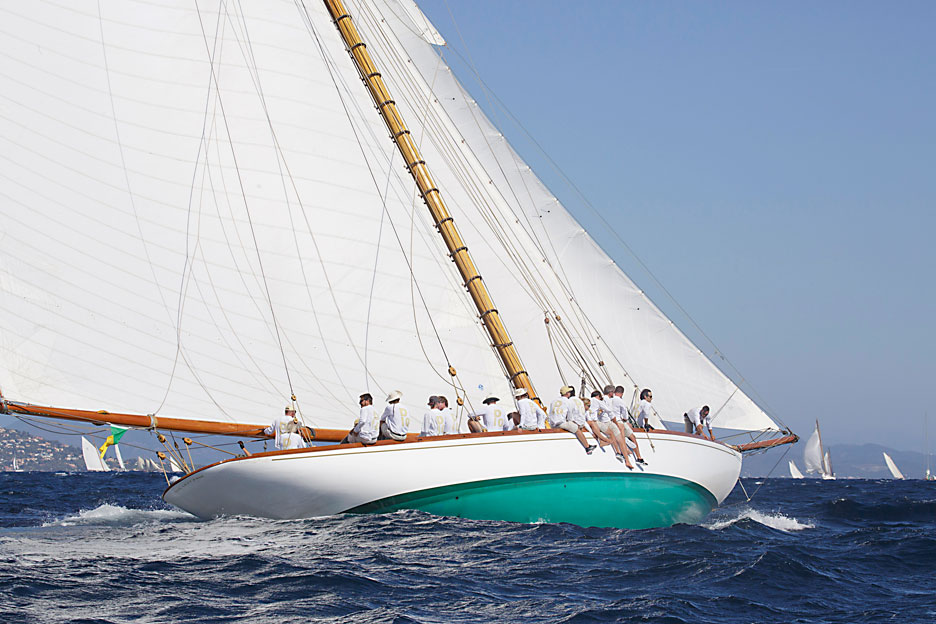
The legend’s rebirth began in 1998 at Fairlie Restorations’ yard near Southampton. The entire structure was meticulously inspected, corroded fastenings replaced, part of the stern rebuilt, and the hull restored with exceptional care. The original interior had to be recreated from scratch using historical drawings. The engine was installed so that the propeller shaft and propeller could be removed during races. For safety reasons, the mast was internally reinforced with carbon fibre, a decision that later sparked heated debate among advocates of authentic classic yachts. To complete the work, new rigging of stainless steel and bronze was fitted. In June 1999, the restored Lady Anne emerged once more into the public eye.
her resurrection caused considerable excitement on the racing scene. For many years up to that point, Tuiga had been the world’s only 15-Metre class yacht, and everyone gazed admiringly at her huge sails and alarmingly low freeboard. Now, Tuiga had a stronger rival. Many considered The Lady Anne’s profile less elegant than Tuiga’s, but she consistently outsailed the latter.
Around this time, it became known that two more Fife-designed 15-Metre yachts, Hispania and Mariska, were returning to the scene. Some even began to dream of a revival of the 15-Metre fleet, the construction of replicas, and full-blown class championships.
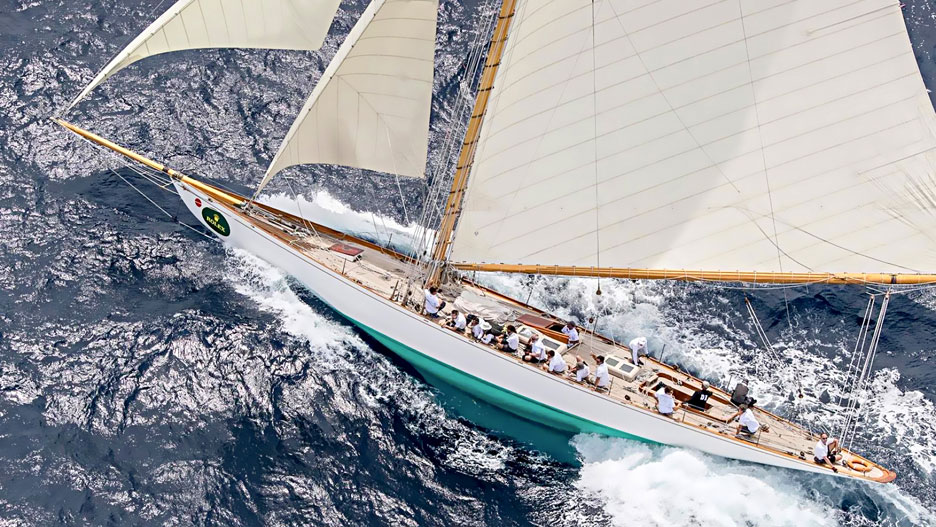
While the 15-Metre class awaited reinforcements, The Lady Anne faced sanctions from the rating committee that governs classic yacht racing in the Mediterranean (Comité International de la Méditerranée). The reason was non-compliance of her spars, which were traditionally made of hollow wood but reinforced internally with carbon fibre. Due to a significant reduction in her racing handicap, winning on corrected time became virtually impossible. Moreover, there were threats of the yacht being disqualified entirely if the mast was not replaced with a traditional one.
The owners tried to contest the decision, arguing that the carbon was used only for strength, not to reduce weight, and gave minimal advantage, especially in the absence of winches. Ultimately, during a subsequent refit in 2011, the mast was replaced with a new one built without the contested carbon fibre. The yacht continued her active life in regattas and cruises.
Today, having passed the 114-year mark, The Lady Anne remains a living link between past and present, a symbol of maritime history, underlining the timeless appeal of this elegant class to everyone who loves the sea and sails. Lady Anne does not participate in all regattas, so seeing her racing is a true stroke of luck.
