
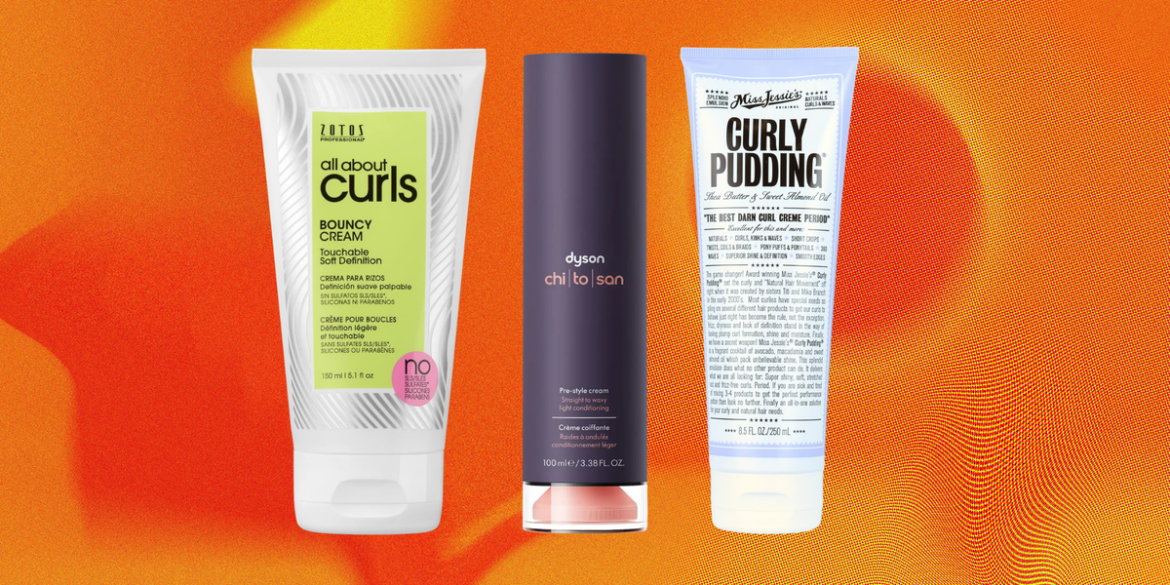
Hair is unique, so when it comes to curl creams, there isn’t a one-size-fits-all option. “A good curl cream is a balance of oils that will add shine while moisturizing the hair,” says curly hair expert Brendnetta Ashley. “It’s a thin coat to the cuticle layer to seal the cuticle down. So, it will control frizz and add moisture and shine without weighing the hair down.” Here are a few key components to keep in mind when shopping for the best curl cream:
✔️ Hair texture: Before you buy a new curl cream, determine whether your hair is fine, medium, or coarse. “Always seek guidance from your salon professional to help determine the hair type,” says Gina Rivera, celebrity hairstylist and founder of Phenix Salon Suites. However, to quickly determine your hair’s texture, consider proceeding with an at-home strand test. Take an individual strand of hair between your fingers. If you can hardly feel it, you likely have fine hair. If your hair typically holds a style well and you can feel it during the strand test, it’s likely medium or coarse. Coarse hair can typically hold a curl well, but can often be difficult to style due to its density. If your hair feels thick and strong during the strand test, it’s likely coarse.
According to Rivera, curl-boosting sprays are typically a great choice for fine hair. “They can be spritzed evenly over hair and tend to be very lightweight,” she says. “This allows fine hair to maintain its curl rather than being weighed down.” For medium hair, consider a lightweight curl cream that helps define the curl while reducing frizz. Finally, if you have coarse hair, a denser curl cream can provide additional control and enhance style.
✔️ Curl type: Finding your curl type is essential to finding the right curl cream. To find your curl type, hop in the shower: It’s easiest to determine when hair is soaking wet. “Detangle hair with a wet comb or brush, and then you can start to look for the pattern of the hair,” explains Rivera. Different types of curly hair, from wavy and loose to tight curls and coils, range by number. “For instance, slight to more distinctive waves fall in [Type 2] curls from A to C in distinction,” says Rivera, while “loose, more spiral-shaped, curls tend to fall into the Type 3 category, ranging from A to C in subcategories.” Coily or kinky hair (i.e., hair that forms tight curls in a zig-zag pattern from the scalp) is a Type 4, ranging from A to C in subcategories.
✔️ Hair porosity: Your hair’s porosity (a.k.a. your hair’s ability to absorb and retain moisture) informs how it retains product. High porosity hair tends to absorb water, oils, and other products more easily than other hair types, though not for an extended period of time. On the other hand, low porosity hair doesn’t easily absorb water and treatment; instead, products tend to stay on the surface of the hair. To determine if your hair has high or low porosity, observe how it absorbs products. Individuals with high porosity hair should reach for a denser curl cream and products with ingredients like shea butter and heavy oils. If your hair has lower porosity, it’s best to use light products that can penetrate easily, as the hair doesn’t absorb moisture as readily.
✔️ Curl cream ingredients: Keep an eye out for hydrating ingredients since for the best spiral-y, bouncy curls, your hair needs moisture. “For hair to look its best, it’s important to have a good daily wet line with hydrating properties packed with nutrients and vitamins,” explains Rivera. Different types of hair (and different curl types!) require varying levels of moisture. “Curlier hair tends to be drier in nature and appearance, and the dehydration [is] more obvious as the [hair] goes awry and more frizzy,” says London-based hairstylist Michael Van Clarke.
