
Bluetooth trackers went mainstream with the launch of Apple’s AirTag five years ago, and they’ve continued to evolve ever since. Apple and Google both expanded their respective Find My and Find Hub networks to support third-party trackers. Now, we’re at a point where third-party Bluetooth trackers are purpose-built to outperform the AirTag in specific situations. I’m a longtime AirTag user that didn’t buy into the tracking card fad until very recently, but now, I can’t imagine how I ever lived without one.
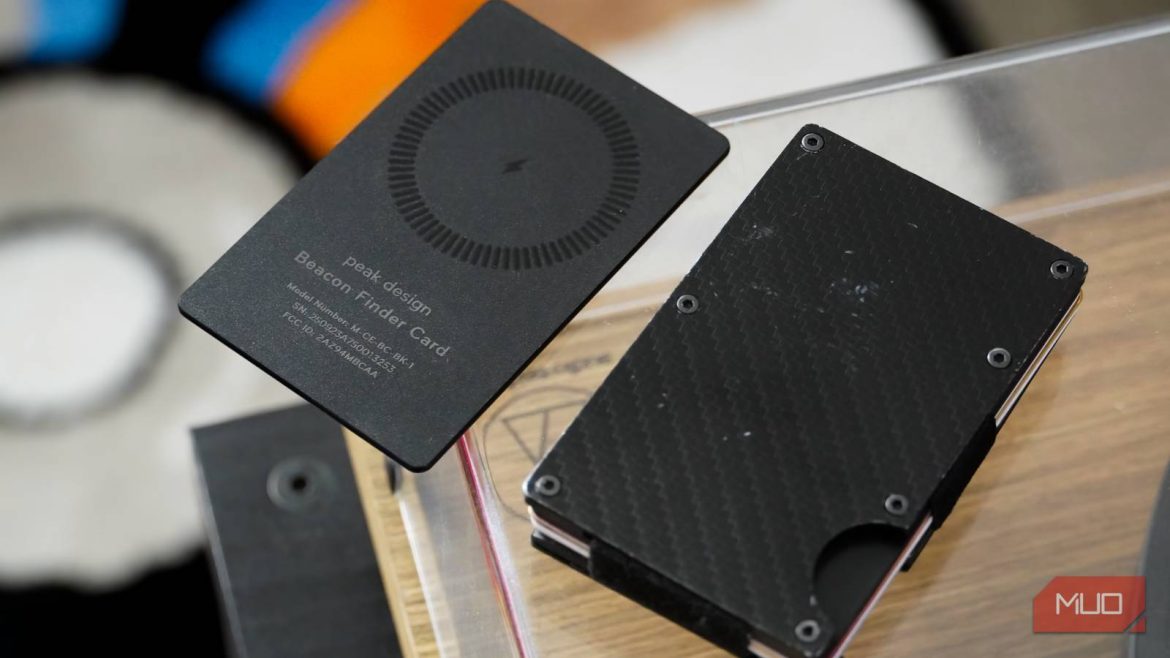
The market for Bluetooth tracking cards is ripe with options, but I settled on the Peak Design Beacon Finder Card. The discreet design caught my eye — it’s about the size of two credit cards and doesn’t look too out of the ordinary — and the 1.8mm thickness sealed the deal. When I started unpacking all the features, from the IP68 protection to the rechargeable battery, I couldn’t believe what I had stumbled upon. This isn’t just an AirTag alternative, it’s an AirTag replacement.

They lack Precision Finding, but make up for it with convenience
I dismissed tracking cards as a gimmick for far too long, but they’re actually superior to classic AirTags in major ways. AirTags only have a water-resistance rating of IP67, whereas card-sized trackers like the Peak Design Beacon Card bump that up to an IP68 certification. In simple terms, this means the Peak Design Beacon Card can survive submersion in about three feet of water for up to 30 minutes. The card is sealed shut, and since there’s no removal battery that needs replacing, Peak Design can offer that greater IP68 protection.
If the card is sealed shut, how does the battery work? It uses a tiny 110mAh rechargeable battery, and that’s the best part. The battery lasts for five months on a single charge, and recharges with a wireless MagSafe connection. Every five months, you’ll drop it on a wireless charger for roughly two hours, and it’ll be ready to last another five months. No more tracking down and wasting money on coin-cell disposable batteries to throw in your Bluetooth tracker.

This solves a major problem I had with AirTags — replacing the batteries was a costly and frustrating experience. I really only use AirTag trackers in my bags, luggage, and passport holder for quarterly travel. It felt like I was buying new CR2032 batteries every other trip, and eventually, I just stopped replacing them. I carried around dead AirTags because I lost an appetite for spending the money and time maintaining them. With a wirelessly rechargeable card tracker, I never have to worry about that again.
Let’s give the AirTag its due credit. It’s one of the few Bluetooth trackers with ultra-wideband (UWB) support, which enables the Precision Finding feature. Essentially, a supported iPhone can point you in the specific direction of an AirTag using UWB technology. It’s a neat feature, but I’m not sure if it’s worth the hassle of using disposable batteries.
I never lose my wallet now
The range and loudness of this tracking card is mind-blowing
If you add a tracking card to your wallet, it’ll come in handy in a matter of days. Due to the form factor limitations of AirTags, they can’t be easily shoved in your wallet. The credit-card-sized design of the Peak Design Beacon Card makes it easy to fit in any kind of wallet. Once you have it inside, the features start to make an impact. These include location tracking on a map, playable sounds that help you find the card, and lost mode that displays contact information if the card is found.
I don’t lose my wallet while out and about (fingers crossed), but I misplace it around the house or in my car every so often. This is where a Bluetooth tracking card really comes in handy. Instead of frantically digging through my home or painstakingly retracing my steps, I can open the Find My app and hit the Play Sound button. This plays an audible tone through the tracking card’s inbuilt speaker, and it’s louder than you would probably expect. Even if I’m in another room, I can find the tracking card and my wallet in minutes.
The great thing about the tracking card is that it isn’t a hindrance. I use a card wallet, similar to a Ridge Wallet, and it can stretch to hold tens of cards. The Peak Design Beacon Card is only about as thick as two cards, so it stays in my wallet without impacting what I can carry. That way, it’s there if I ever lose my wallet and need to use it.
It works for more than just wallets
A tiny card-sized tracker is easier to hide than a puck

Bluetooth trackers have a problem — they’re only useful if they are hard to find. Everyone knows what an AirTag looks like, and that includes thieves. A tracking card is more discrete, including the Peak Design Beacon Card. To be fair, there are more discreet cards than the Peak Design one, such as the Nomad Tracking Card Pro. Still, the one I have blends in with other stylized black cards in my wallet, like my Tesla key card or my WeWork entry key. It doesn’t immediately tell a thief, “I’m a tracker, throw me away.”
The same logic works outside traditional wallets. I often throw loyalty cards and similar items loosely in my bag, and no one would bat an eye when seeing them there. As such, a tracking card could actually help protect your bag or luggage better than an AirTag, which someone could immediately identify as a tracker. That benefit, combined with the rechargeable battery, makes tracking cards more appealing to me than a traditional Bluetooth tracker.
Now that I’ve switched to one, I can’t go back. Instead of buying more CR2032 coin-cell batteries for my AirTags, I might just invest in more tracking cards.

- Material
-
Plastic
- Connectivity
-
Apple Find My
- Battery
-
5 months between charges
- Range
-
50 feet
- Water Resistance
-
IP68
The Peak Design Beacon Finder card is a water-resistant tracker that works with Apple’s Find My network. It supports connections up to 50 feet away and IP68 protection against dust and water ingress. The tracking card lasts five months on a single charge, and recharges via MagSafe.
