
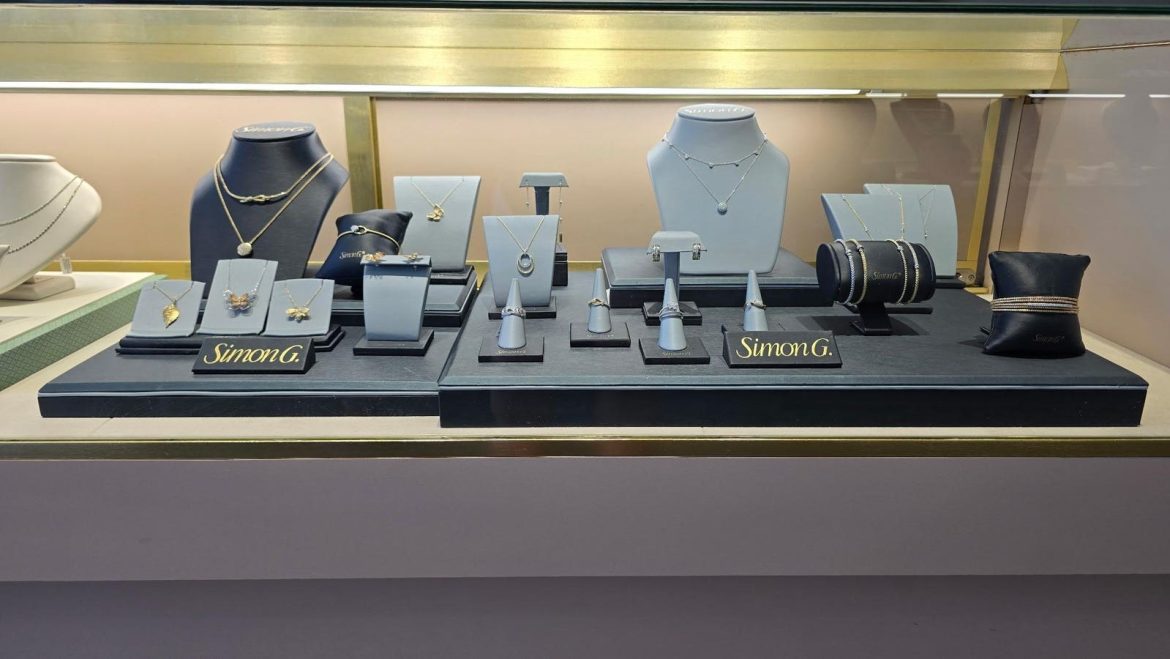
A Simon G. display at one of the brand’s nearly 1,200 retail partners.
Courtesy of Simon G.
When a person buys a piece of jewelry they are likely to be celebrating something personally important. It could be an engagement, an anniversary, a graduation, any one of at least a dozen reasons- even if the purchase is for the buyer, perhaps in recognition of achieving an important goal or personal milestone.
Whatever the case may be, when clients walk into luxury jewelry brand Simon G., or one of the hundreds of retailers across the United States who sell their designs, they are taking a tangible step towards creating a memory. And when that necklace, ring or bracelet is of the quality that this brand has been producing for three generations, it is almost a certainty that the piece will eventually be passed to the next generation. Personal artifacts like these, beautiful pieces of exceptional craftsmanship, are those that become heirlooms and part of legacies.
I met with Brooke and Zaven Ghanimian, the couple who run the luxury jewelry brand Simon G., over Zoom, to learn about the fine jewelry which has been the family business for almost 50 years. When our conversation began I had been thinking about all the intangibles bijouterie carries with it. So I began by asking what it was like to be part of so many happy memories for so many people and families.
“It’s funny you say that,” Brooke Ghanimian said. “We are in an industry where we get to share the best moments of people’s lives, literally only the best moments, and we know that we’re very lucky to be part of that. I say all the time, we give people the opportunity to hold a memory in their hand. That’s something that people sometimes don’t think is possible, but they really do want to find a way to preserve that memory, and oftentimes they can do that through the purchase of jewelry.”
A Real American Dream
Simon G. is a brand based in Southern California, it was founded in 1981, and has been Zaven Ghanimian’s family’s business ever since. It is not every high-end brand that survives as long as this one has and it is probably even less common for a family business to continue to be run by the children and grandchildren of a founder. I asked him if he would tell me the Simon G. origin story. Lovely Reader, please know, it was just as romantic and wonderful as I suspected it might be.
“I think the beauty of our origin story is it really speaks a lot about who we are today,” Zaven Ghanimian told me. “Our brand was founded by a man named Simon. He does exist and he’s very present in our brand to this day. He came to the States in the late 70s. There was civil war in his country and he found refuge here. And at that time, he really had an aspiration of becoming an engineer. And so he explored NYU and he came with $200. He very quickly learned that the amount of money he had was not going to be enough to put him through school. In his culture, he was always taught that if you could learn a skill with your hands, you’d never go hungry. His grandfather was in the jewelry business, hence the third generation that we are in now. At that time, 47th Street, in New York in the jewelry industry, seemed like a great option for him.”
The Bee gemstone pendant necklace (in 14k gold with diamonds), the Fallen Leaves pendant necklace (in 14k gold with diamonds) and the Monarch Butterfly pendant necklace (in 14k gold with diamonds), all by Simon G.
Courtesy of Simon G.
Simon worked his way up in the jewelry industry, finding as many opportunities as he could possibly cultivate. The brand’s founder likes people, he always takes an interest and focuses on relationships, a philosophy the brand continues to embrace under the third generation of Ghanimian stewardship. As he learned about the fine jewelry business, Simon began to travel around the country which became his family’s home. As much as he loved New York, the founder still felt a longing for somewhere that felt more similar to Armenia, and he found a taste of that landscape on America’s West Coast.
“He vacationed in California” Zaven explained, “and he felt it to be very familiar, with the water and the mountains. He moved there, and started knocking on doors to find the opportunity to work. And while he was working, he would create a few pieces for himself on the side.”
It wasn’t long before people began to notice his skills and work ethic, and soon Simon was picking up clients; his belief in the importance of relationships became a rising tide of referrals and recommendations.
Zaven Ghanimian, the third generation of his family in charge of the luxury jewelry brand, Simon G. Photo by: RobertKeithPhoto
Courtesy of Simon G.
“Someone told him he should venture out and start his own company,” Zaven continued. “But Simon is an extremely humble man and really had no idea what that would entail. He found himself at the registrar’s office, that was kind of the first step.”
The clerk who assisted the founder asked what the name for his new company would be, Simon wasn’t sure. Probably thinking about one of the many well-known eponymous labels and brands, the person at the desk asked what his name was.
“He shared that his name was ‘Simon Ganimian’,” Zaven told me. “They kind of laughed and said, ‘yeah, no one’s going to be able to pronounce that or remember it. May we shorten that to Simon G?’ And of course he obliged. That’s the day the brand was actually formed, and from there, he packed his bags and traveled across the United States, showing what he had made to different retailers along the way. To this day, some of our strongest retail partners still talk about Simon as their first salesperson and how much that really cemented them to the brand. From that $200, and that dream to become an engineer, he’s grown a business that today has about 1,200 retail partners; strong and fully vertically integrated.”
Truly Exceptional, Exquisite Jewelry
While I was preparing for our conversation I looked at hundreds of pieces by Simon G. As I drooled over one gorgeous image after another, I kept noticing how brilliant the stones were, the intricacy of the metalwork and how easy it would be for virtually any piece to become a beloved family heirloom. Feeling slightly buzzed from the fire, the elegantly balanced dispersion of so many consistently well-designed pieces, I realized that I didn’t know much about how a brand of Simon G.’s quality went about choosing gemstones.
“We work directly with the mines and manufacturers,” Brooke explained. “The polishers and the cutters of these gemstones come from all over the world. We travel all over and the relationships that we’ve made give us the absolute first pick of the stones that come out of that mine or lot and we really pride ourselves in picking that top, top tier, the really rare gemstones. When it comes to the diamond world, it’s a little different. With diamonds what we focus on is making sure that we’re only picking up the stones that have the best cuts, the best makes, the clarity being VS and F color, super high, and the quality of the stone itself.”
One of Simon G.’s many expert artisans sets a diamond into a ring.
Courtesy of Simon G.
“To give you a little context on the industry itself,” Zaven said of luxury jewelry brands like his, “oftentimes the people choosing color would be going someplace where the stones have already gone through three and four different sets of hands. They’ve already been picked over and they’ve already been sold three or four times. We avoid all of that, and that’s truly because of the relationships we have built. Diamonds are often sold in parcels, and there are thousands of stones in these parcels, especially at the smaller sizes. Oftentimes, a brand will choose a parcel, and then they’ll just count out the number of stones that are needed for each piece, believing that whatever was sold to them is actually what they received. We actually take that a step farther.”
I learned that, because of the many (and aforementioned) decades-long relationships Simon G. appreciates so much, when they buy parcels of stones, they get the best pieces. It is not uncommon for them to be made up of stones which are saved just for them. But this is not just a question of having access to the very best materials, it is also the additional steps the brand has built into their processes, steps other brands might skip but which Simon G. takes pride in.
“We have a whole team of diamond sorters,” Zaven told me. “For each particular piece that’s being crafted our sorters will go through them, see the quantity that’s needed, and then match each stone for its color, clarity, cut or its make, no matter how big or small the stones are. We’re extremely diligent in ensuring that each component that’s going into any piece is at the very top quality and craftsmanship.”
“Instead of allowing all of those hands to be outside of our company,” Brooke added, “we bring all of that work into our company. They are our team members, so there’s a greater level of trust and consistency in what we’re doing.”
Designs That Will Be Treasured For Generations
I was very curious about the brand’s actual design process. Was it similar to how clothing or accessories are made? Or, did designing a collection of jewelry require entirely different steps? And how did this work for custom designs? Was it the same as when they were creating a new style which would grace jewelry stores across the United States?
“In the clothing and design world,” Brooke explained, “you would go and pick out the fabrics and the notions that you want to use. In our world, we go and pick the gemstones we want to use and the metal that we want to house those gemstones in. We don’t often sell stones loose, but we do have a private collection, that’s Simon’s personal collection, that sometimes we’ll tap into if there’s a very special request from a collector. Then we design and manufacture a piece and distribute it through one of our retail partners.”
“It’s really interesting,” Zaven said, “when we get into the details of that process, because any one piece that a consumer purchases, in our company alone, that piece has usually passed about 40 different sets of hands. We have a design team member who starts every piece as a sketch, and from the sketch it then gets worked into a CAD design. The CAD design gets worked into a wax, something that gives it a 3D form, so that it can then be checked to make sure all the proportions are exactly as expected. From there, it goes into actual production and through that process, we have a team that’s sorting diamonds that are going to go into that piece. We have a team that is casting the metals and a team that’s assembling all of those pieces and components. Then we have a team that’s setting all of the stones.”
A selection of bracelets and bangles, as well as a pair of earrings, all designed and created by Simon G.
Courtesy of Simon G.
Since every single design is set by hand, and since each has passed through many different expert hands before arriving at that stage, every design that carries the name ‘Simin G.’ has the full and complete attention of those making it. This is a brand obsessed with quality and craft, so much so that approaches perfection. What they make is more than jewelry; Simon G. is in the tradition of the decorative arts, often what they make feels like more than jewelry; there are times and places where a piece’s articulation feels like silk expertly draped in a haute couture atelier.
“Once it goes through the setting, it goes to polishing,” Zaven explained, “and the piece is polished to perfection, every small nook and cranny. In fact, before the stones are set, we polish the seat, which is the place where that diamond is going to sit. Most brands don’t take the time to do that because they feel like the consumer’s never going to see it. But for us, what really makes a diamond shine is not only the make, it’s also the light reflection. We believe that if that light is reflecting off a shiny metal, as opposed to a more dull or rough metal, you’re going to get a better reflection and a better shine to that diamond. There are different team members that the piece is passing through to ensure that perfection, to ensure that quality is not just a buzzword. Because quality is truly what the customer will experience and what they can expect from us.”
One of Simon G.’s Smart Ring Jackets, (LR4284) In 14k gold with diamonds.
Courtesy of Simon G.
Weaving Together Technology And Tradition
I’d seen smart ring jackets on the brand’s website, and I’d made a note to myself to ask the Ghanimians how that worked. I also wanted to know how smart jewelry, which has become ubiquitous in a very few number of years, had become part of Simon G’s selection of products.
“I saw Brooke wearing an Oura ring,” Zaven told me, “and I hate to say, but it just looked absolutely hideous. It was big, bulky, it was making her fingers spread apart because it was so wide. And being in this business, I had this idea, because fitness rings really are important to people. But we thought, let’s bring them up to the level of fine jewelry. We’d thought before about adding some kind of technology into our rings, but we make them so fine and delicate, there’s not really room. So we made these jackets, they fit over them and actually make them look like a piece of fine jewelry.”
“It adds a lot of versatility and also value,” Brooke explained, “and those are two pillars of our company. We are always looking for ways that we can bring that quality of craftsmanship and value to our customers. Our clients love the technology of the fitness rings, but most of them do not really love the overall look, especially when they want to be wearing it 24-7. And people have a lot of things that they’re doing throughout their day that don’t revolve around fitness. So, to not add bulk to the ring, but to add beauty and a bit more sophistication, that has been something that our customers have really been drawn to.”
Speaking of their customers- Simon G. is happy to serve both clients and collectors. Ultimately this is a brand that wants to play a part in your celebrations. A brand that wants to contribute to those moments of time captured and preserved in precious metal and gemstone. This jewelry is purpose-made for the creation of cherished memories.
Memories You Can Hold In Your Hand
Over the three generations they have been in operation, Simon G. has cultivated a culture that brings people and families back time and again. I saw light in Brooke and Zaven’s eyes as they told me with pride about the experience of clients becoming Simon G. collectors. I asked them what they felt brought people to their company for the first time, and if that was related to what kept so many of them coming back.
A Simon G. bangle in 18k white gold with two bars set with white baguette diamonds.
Courtesy of Simon G.
“They might be drawn in by the styling,” Brooke told me, “or perhaps they have heard stories of the brand, but oftentimes they really want to feel part of something larger. They’re looking for a way to make a connection. When someone makes that first purchase, it has to deliver on a number of different things. Not just the beauty of the piece, but the longevity, the craftsmanship. When all elements are delivered and all of those stars align, then we gain their gain trust. So, the next piece that they’re looking to purchase, they end up coming back. They’ll start to feel that this was the best piece for them. They carry it through time, and then they come back to find something else to add to their collection.”
It is a very special thing, to be given or left a piece of jewelry by someone we love. The importance of that, whether it be milestone or legacy, isn’t dependent on karat size or value listed on an appraisal, the deeply personal meaning is about connections. Looking through the gorgeous designs the brand creates while writing this, I could see many examples of what Brooke had told me about. Elegantly repeating geometric patterns, exquisitely delicate filigree, faceted gems of all sizes in settings elegant enough that even the largest of stones looks refined. Looking at this work it is impossible to miss how much love and pride goes into the making.
“One of the beauties of our brand is the fact that we have such depth in our collection and a lot of design elements that tie pieces together,” Brooke said. “So, even if it’s part of a different collection, there are little elements that allow them to be worn together. And over time, these pieces tell a beautiful story. You can look down and reference back to the moment that you received it, what that represented. A piece was initially purchased for one particular reason, but then it gathers all of these stories as it’s worn by someone through their life. That is what gets passed down to the next generation. It’s not just this beautiful piece of jewelry, it’s all the moments that it shared with its owner. It is like a magnet for memories, it’s almost like they could tell you all the stories of the adventures that they’d shared.”
An intricately designed men’s bracelet in 14k gold set with 1.35ctw white diamonds.
Courtesy of Simon G.
Crème de la Gem
Talking to this couple, both of them so obviously passionate about their work, I kept thinking that, from my perspective, ‘vocation’ sounded like a much more accurate word to describe what they do than ‘career’. Whenever I find and fall in love with the work of a new-to-me designer, I almost always come to learn that they are as infatuated with the making part as I am with the stories behind every immaculate detail. But we all know what is said about making assumptions, so I asked them if they thought the word was a fair one for me to use.
“Absolutely,” Brooke said to me with a grin. “I think that if you don’t love this business, you really can’t be in it because it’s very difficult. And if you don’t love it, then it becomes work and you won’t do it as passionately. We love what we do, so it doesn’t feel like work when we have to get up at one in the morning for a call to South America or across the world. Which is something you have to do to speak with a miner or a gemstone cutter or a specialist like that. We’re actually excited about it, as opposed to being a burden. It is a joy for us, we cannot wait.”
“This industry is filled with opportunities to discover,” Zaven told me. “It never feels dull or routine, and we’re dealing with a lot of emotion. The feelings of the customer who is choosing the piece, the retail partner who is helping, who connected the two entities. And then the internal emotion, because we are a family owned and operated business, which is a beautiful thing to be a part of, but also takes a lot of hard work and dedication. This isn’t the kind of thing that becomes routine, and it’s not the kind of work you can study and then just step into, there are a lot of nuances. It takes years and years of apprenticeship to really understand how to make fine jewelry. And this industry is very, very relationship driven. I think that is one of the reasons our brand has had such great success and longevity. It’s because we recognize what we value and we lead in that way. We’re not trying to become more sterile or corporate or feel routine and mundane.”
Heritage and legacy, I had to ask about the brand’s connection to those ideas before we ended our conversation. They are both words which get thrown around a lot, but after an hour with this pair I felt certain that they would have a specific and particular meaning to the Ghanimians.
“It comes down to what we want to set forth,” Brooke said to me thoughtfully. “It’s not about preserving old ideas, it’s more about preserving the values. The tools change, consumer behavior changes, technology changes, but the relationships we make and the trust that we build are timeless. The craftsmanship, the values at our core, those are what we use to move forward and to guide our company.”
“One of the things we are most proud of, ” Zaven said, “is that we have 47 years of consistency, of delivering upon what we say we are going to do, and of being a true partner to our retailers. Delivering that level of craftsmanship, holding their hands when things are not going well and figuring out how to make it work; when our retail partners are winning, we are winning and we are all celebrating together. That has been one of the greatest blessings, but also one of the most beautiful things; knowing that we have maintained that consistency over so much time.”
