

Modern smartphones are packed with incredible technology, from high-resolution cameras and advanced graphics chips to AI processors. In premium models, this hardware includes LiDAR (light detection and ranging), which helps power augmented reality features and improve depth sensing.
Seeing around corners
And that capability could soon be in for a seriously impressive upgrade. Researchers at the Massachusetts Institute of Technology (MIT) have developed an algorithm that lets a phone’s LiDAR sensor detect objects hidden around corners. Details are in a paper published in the journal Nature.
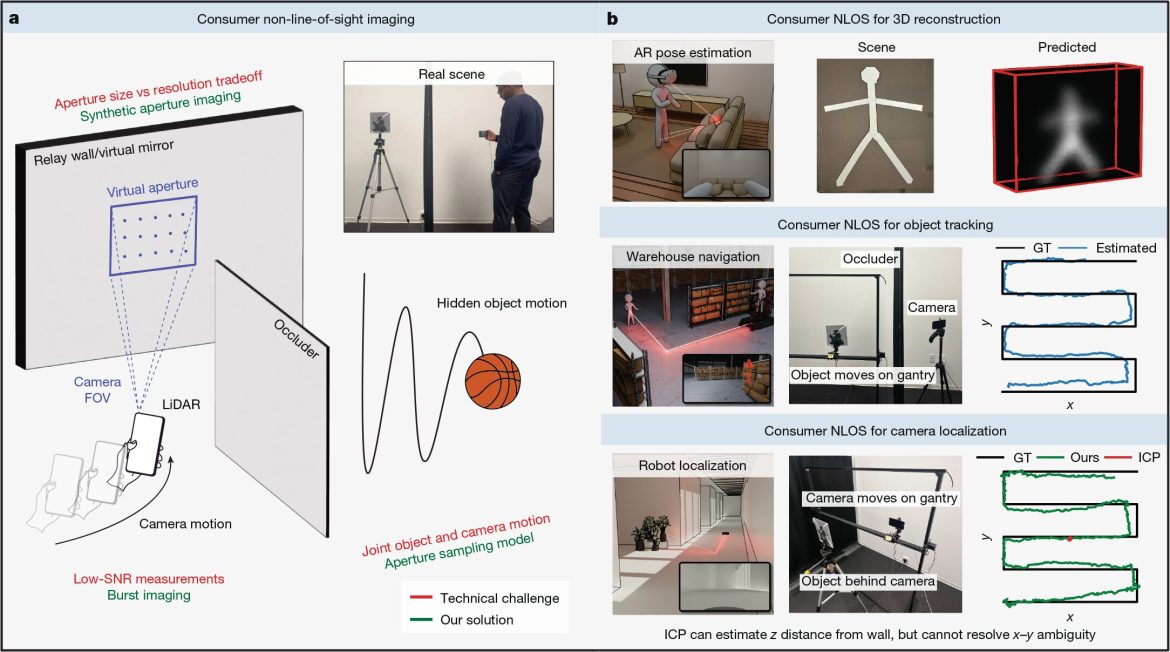
Typically, this type of non-line-of-sight (NLOS) capability is found in labs and relies on bulky, expensive research-grade hardware. But the team’s breakthrough makes it possible for consumer LiDAR sensors to peek behind obstacles.
Standard consumer LiDAR sensors work by sending out pulses of light and measuring the time it takes for those signals to reflect off an object and return to the device. This allows the sensor to calculate distances and map out a three-dimensional environment, but it’s limited to what is in its direct line of sight.
The MIT team overcame this limitation by changing how incoming data is processed. Instead of discarding incredibly faint, scattered light signals that bounce off walls and floors, the algorithm collects these weak reflections over multiple frames while the phone or an object moves. Then it combines that data from those different angles to pull together the shape and motion of a hidden object.
Testing the tech
To test their algorithm, the scientists used a standard consumer-grade LiDAR sensor costing less than US$100. Objects such as a moving mannequin, cardboard cutouts, and letters were placed behind walls and large partition dividers. In other words, out of the sensor’s direct line of sight.
The team then pointed the sensor at the floor or wall near the partition dividers. The algorithm successfully tracked the motion of the mannequin in real time and generated rough 3D reconstructions of the hidden objects.
“Our results represent a shift toward plug-and-play NLOS imaging, where anyone can image hidden objects with off-the-shelf hardware (for less than US$100) and no additional set-up,” wrote the MIT researchers in their paper.
Currently, the technology works best if the software knows or can approximate the basic shape of the object it is tracking. Next steps will include making it work with unknown or changing shapes. If successful, the algorithm could be used in a range of applications, including robots and wearable devices, as the team notes, “We believe democratization of such capabilities will advance consumer applications of NLOS imaging.”
Written for you by our author Paul Arnold, edited by Lisa Lock, and fact-checked and reviewed by Robert Egan—this article is the result of careful human work. We rely on readers like you to keep independent science journalism alive.
If this reporting matters to you, please consider a donation (especially monthly). You’ll get an ad-free account as a thank-you.
Publication details
Siddharth Somasundaram et al, Imaging hidden objects with consumer LiDAR via motion-induced sampling, Nature (2026). DOI: 10.1038/s41586-026-10502-x
Key concepts


© 2026 Science X Network
Citation:
Smartphones may soon be able to track hidden objects using LiDAR (2026, May 22)
retrieved 23 May 2026
from https://techxplore.com/news/2026-05-smartphones-track-hidden-lidar.html
This document is subject to copyright. Apart from any fair dealing for the purpose of private study or research, no
part may be reproduced without the written permission. The content is provided for information purposes only.
