
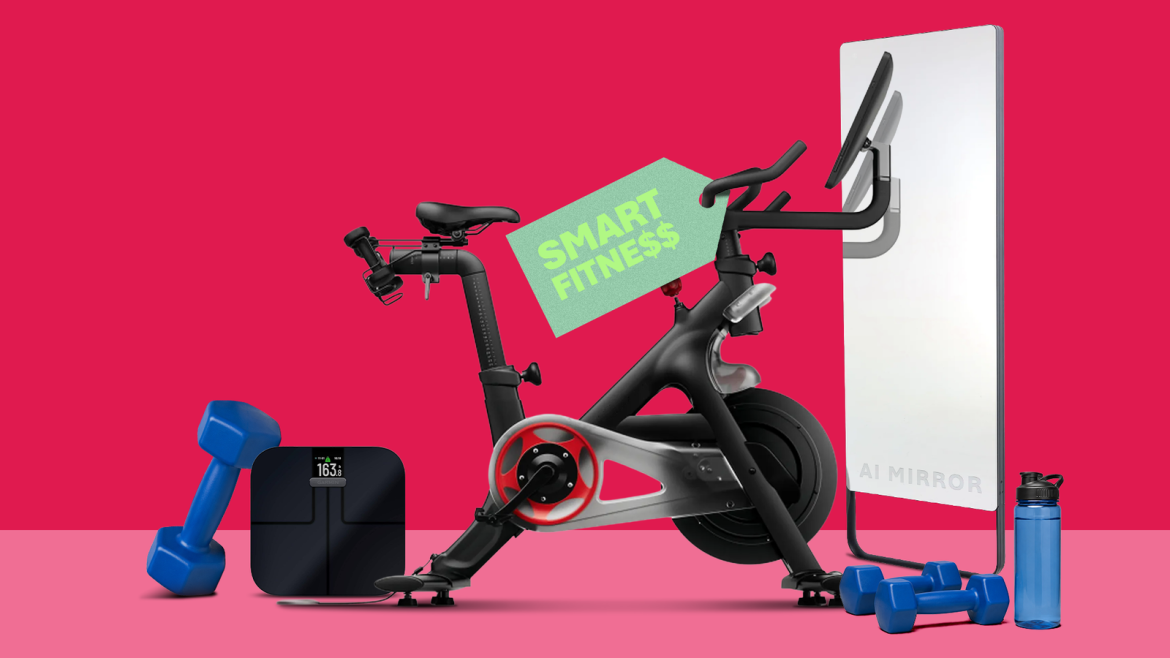
Somehow, I convince myself every year that if I spend good money on smart workout gear, I’ll be more motivated to do it.
And then I look at the price tag of these things.
The Peloton bike is on sale for $1,300, the Peloton treadmill is $2,700, and various other smart mirror brands are over $1,000 as well.
I just can’t stomach those prices. I still want to incorporate some smart workout tech into my life, but there’s gotta be a compromise.

Spotify’s Peloton partnership brings fitness content to your phone, desktop, and TV
Start your first class today
Smartwatches are everywhere
I’m just looking for motivation, I don’t need the premium model

The first one is a no-brainer. Smartwatches have been around for a long time now. I feel like every time I people-watch in the city, I see more and more.
I thought to myself, “I could use something to count my steps and estimate calories burned during workouts.”
So I go down the research rabbit hole, and I am bombarded with choices. Discouragingly, everyone was recommending brands that start at around $300 and go up into the thousands.
I’m sure if you’re an avid runner or dedicated athlete, they’re worth the money.
 Quiz
QuizSmartwatches and their history
Trivia challenge
From early digital wristbands to today’s health hubs — how well do you know the smartwatch story?
HistoryBrandsTechnologyFirstsDesign
Which company released what is widely considered the first commercially available smartwatch in 1994?
Correct! Seiko released the Ruputer in Japan in 1998, but its earlier wrist-computer efforts began in 1994 with the MessageWatch. Seiko has long been a pioneer in blending computing with wearable timepieces.
Not quite — it was Seiko. While Casio made impressive calculator watches, Seiko was the brand pushing wrist-worn computing into commercial territory in the early 1990s, ahead of most competitors.
The Pebble smartwatch became a landmark product partly because of how it was funded. How much did its 2012 Kickstarter campaign ultimately raise?
Correct! Pebble’s 2012 Kickstarter raised over $10 million, smashing its original $100,000 goal and becoming one of the most successful crowdfunding campaigns of its era. It proved there was real consumer appetite for smartwatches.
Not quite — Pebble raised over $10 million on Kickstarter in 2012. That staggering sum, against a $100,000 goal, signaled to the entire tech industry that the smartwatch market was real and ready to explode.
Apple Watch was first announced in September 2014, but when did it officially go on sale to consumers?
Correct! Apple Watch went on sale on April 24, 2015, nearly seven months after its announcement. The gap allowed Apple to refine the software and manufacturing before its highly anticipated launch.
Not quite — Apple Watch launched on April 24, 2015. Apple announced it in late 2014 but held off on release to polish the experience, a strategy that helped it debut to enormous demand and critical attention.
Which operating system powers the majority of Samsung’s modern Galaxy Watch lineup?
Correct! Starting with the Galaxy Watch 4 in 2021, Samsung switched from its own Tizen OS to Wear OS, developed in partnership with Google. This marked a major shift in Samsung’s wearable strategy.
Not quite — Samsung’s modern Galaxy Watch lineup runs Wear OS. Samsung used its own Tizen platform for years, but switched to Wear OS with the Galaxy Watch 4 in 2021 after a collaboration with Google was announced at Google I/O.
IBM and Citizen collaborated on an early smartwatch concept in the late 1990s. What was this wearable prototype called?
Correct! IBM and Citizen developed the WatchPad around 2000, a wrist-worn device that ran Linux and included features like a fingerprint scanner. It was a remarkable proof-of-concept decades ahead of mainstream smartwatches.
Not quite — it was the WatchPad. IBM and Citizen jointly developed this Linux-powered wrist device around 2000, complete with a fingerprint reader. It never reached mass production but showed remarkable ambition for its time.
The original Apple Watch was offered in multiple ‘Editions’ at launch. What material was the ultra-premium Apple Watch Edition casing made from?
Correct! The first-generation Apple Watch Edition featured an 18-karat gold case and was priced at up to $17,000. It was Apple’s bold statement that smartwatches could compete in the luxury fashion market.
Not quite — the original Apple Watch Edition used 18-karat gold. Priced as high as $17,000, it was Apple’s attempt to position the smartwatch as a luxury fashion item, not just a tech gadget. Titanium and ceramic came in later generations.
Fitbit is best known for fitness trackers, but it did release a full smartwatch. What was the name of its first true smartwatch, launched in 2017?
Correct! The Fitbit Ionic, released in 2017, was Fitbit’s first proper smartwatch, featuring onboard GPS, music storage, and third-party apps. It was an ambitious step up from Fitbit’s tracker roots, though it was later recalled due to a battery issue.
Not quite — Fitbit’s first true smartwatch was the Ionic, launched in 2017. While the Surge was a GPS fitness ‘superwatch,’ the Ionic was the first to support third-party apps and music. It was later recalled in 2022 over overheating concerns.
Which health-monitoring feature did Apple add to the Apple Watch Series 4, making it a milestone for the wearable health industry?
Correct! Apple Watch Series 4 introduced ECG capability in 2018, allowing users to take a single-lead electrocardiogram directly from their wrist. It was the first FDA-cleared ECG product available directly to consumers over the counter.
Not quite — it was ECG capability. Apple Watch Series 4 became the first consumer smartwatch cleared by the FDA to take an electrocardiogram reading in 2018. Blood oxygen monitoring came later with Series 6 in 2020, and blood glucose tracking remains unavailable.
Your Score
/ 8
Thanks for playing!
But I’m just a casual user looking for some numbers to keep me motivated, so I went and bought a Samsung Galaxy Fit 3 for around $42.
I can’t say it’s the most accurate. But what I can say is that it has kept me motivated throughout the day and gives me a nice snapshot of how much I have moved.
Maybe if I really get into the exercise lifestyle more, I’ll upgrade to something nicer in the future.
For now, this is the right amount of functionality for a great price.
I don’t think I’d walk 500 miles, but I’m sure I could do at least 5
With Netflix on, time flies

Are you getting your 10,000 steps in? Okay, maybe not all 10,000 — it is based on an arbitrary Japanese pedometer concept from the 1960s after all (look it up, it’s true!)
Regardless, there’s a lot of research out there talking about the benefits of walking for people of all lifestyles. So how can I get more walking in?
The answer “just go for a walk outside” comes to mind. And I hear you, I do. But I also experience awful seasonal allergies, restrictive weather, and occasional health issues that make it worrisome to be away from home.
Buying a treadmill is the obvious answer, right? That’s what I thought, until I saw the price of a smart treadmill. Even the cheaper brands were over a thousand dollars.
So, here’s my compromise on price and functionality: a walking pad.
You might’ve seen them advertised as something to use under your standing work desk during the day, but I much prefer mine in the living room.
Instead of a smart treadmill with a screen, why not position your walking pad near your TV? I watched a whole comedy special while striding along, and it was so easy.
There are tons of walking pads out there at different price points, but for something with just a little incline and a walking speed, you can easily spend less than half the cost of a full smart treadmill.
Tracking your food shouldn’t detract from your grocery budget
Have you seen the price of tomatoes lately?
Health isn’t just about exercise, especially if you’re looking to lose weight and gain muscle. It’s probably no surprise to anyone that our diet plays a massive part in getting healthier.
I’m quite picky about my food, so pre-made meals and meal kits were out of the question. I just needed to get better at tracking everything.
The best bang for your buck you’ll get is a kitchen scale. You can weigh and portion your food with precision, which is a lot harder to do than I thought.
I didn’t research any smart options because I already owned a simple $15 digital scale. I can’t imagine it needs to do much more than give you a measurement. I like the ability to change my weight units. I don’t need much more than that.
While we are looking at weighing food, there are a ton of great apps available for inputting your food and exercise data.
You can easily get sucked into the many subscription models and premium features, but hold strong! If you’re just looking for an easy way to track things and feel better, plenty of apps like Cronometer and MyFitnessPal have barcode scanning, goal-setting, and custom food inputs all for free.
The spectrum of physical ability and motivation is wide
I don’t know your health and fitness journey, or your budget

I’m approaching this from the perspective of a casual user who doesn’t want to make a significant financial investment. I’m not very active in my daily life, but I want to make a positive change.
If you are an athlete, bodybuilder, or have a passion for fitness, these takes may not resonate with you, which I completely understand, and if I level up my fitness game to the point of needing more sophisticated tech, I’ll be sure to write about my suggestions!
Until then, I just don’t see the value.
You don’t need to spend a lot to reap the benefits
Whatever your reasons are for working on your health, now is a great time in tech to incorporate some enhancements into your routine.
The sticker shock can be intense when you see the branded gear popping up in your search history.
Don’t panic! There are tons of options and competition, and you can meet your goals without emptying out your bank account.

- Display
-
1.6-inch AMOLED
- Battery Life
-
Up to 13 days
- Colors
-
Gray, Silver, Pink Gold
- IP rating
-
IP68
- Water Resistance
-
5ATM
The Samsung Galaxy Fit 3 is a great blend of budget and features. It’s stylish, has a great battery life, and provides simple fitness data through many popular apps. It’s a great smartwatch to keep you informed and motivated for under $50.
