
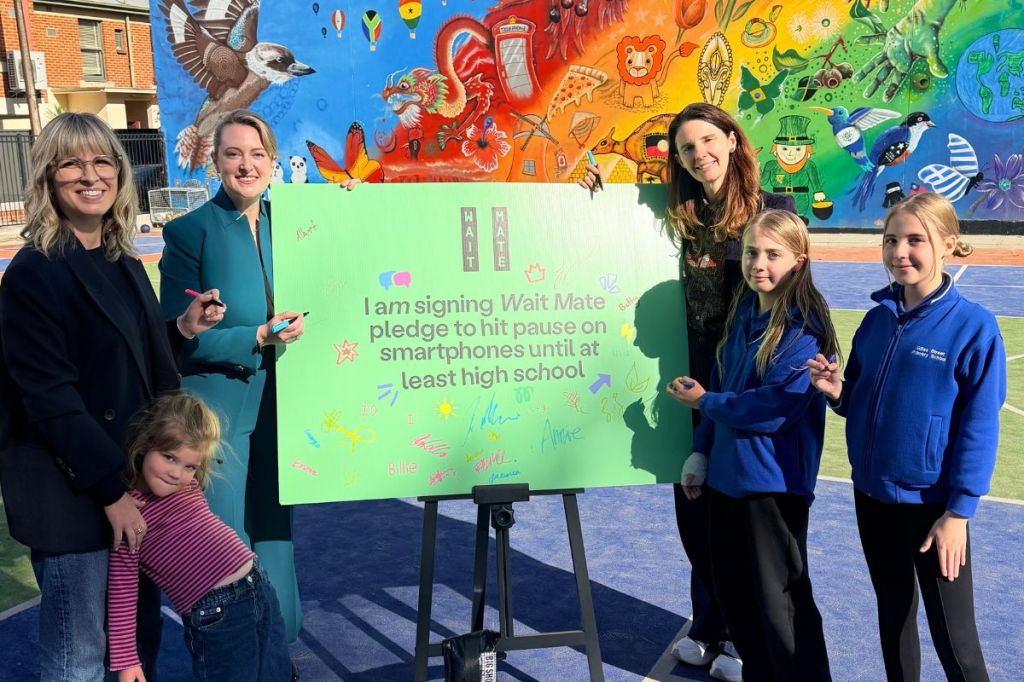
From term three this year, all SA primary schools can get new support in encouraging parents to hold off on giving their kids smartphones with a program called Wait Mate, Education Minister Lucy Hood announced today.
The Wait Mate program – inspired by a similar US program, Wait Until 8th – asks parents to sign an online pledge to delay giving their kids smartphones, with the project being introduced to the parents of primary school kids during 2026 and 2027.
The program is backed by $6.5 million in taxpayer dollars in a bid to tackle data showing students were at higher risk of being depressed, obese or being cyberbullied if they had smartphones earlier.
Hood has already signed the pledge to delay giving her own two children smartphones until year eight, along with around 1600 other families from 227 SA schools. Her children are aged ten and seven years old.
“We can all make changes to that, you can extend that time to year nine or 10 or beyond, and it’s all about families having that choice based on their child and also having that connection to other parents, so you can form a bit of a support group to be able to withhold your child from owning a smartphone,” Hood said.
The new program is part of the state government’s election commitment to get kids off screens, Hood pointing to research published in an international Pediatrics journal showing that children who own smartphones by the age of 12 face greater risks of developing depression, obesity, and lack of sleep.
It was based on the idea that children would instead be active, playing sport and connected to friends rather than “being solo on a smartphone”.
Wait Mate would be introduced to parents of primary school kids across the state in 2026 and 2027 and then high-school students in 2027 and 2028, in a bid to have parents to sign on, and backed by alternative strategies like bringing back the landline or a “stupid phone”.
Hood joined the Wait Mate SA Director Emily Harrison and Emma Beech, a mother of triplets at Gilles Street Primary School on Tuesday morning, one of more than 70 schools already on board with the initiative.
Beech has pledged to hold off on giving her 11-year-old triplets phones until they reach year 10, and was trying to set an example by going analog.
“I’m meant to be a grown adult with lots of self-control, and I have my [other] kids, who are six and seven, asking me to get off the phone and talk to me, so I’ve done that,” Beech said.
“When they were very young, I’ve got triplets; they fought so much over the TV that we just got rid of the TV, because I couldn’t handle the fights over the TV, and then that just extended into our whole life.”
Beech understood that some parents might think phones are essential for safety, or for communication for times like when children caught public transport alone but she believed “there’s a lot of different options”.
“They’ve brought back the stupid phones, which you can just text and call, and that’s all you can do,” she said.
Harrison said it was “clear parents are ready for this”.
“Wait Mate is about making it easier for families to delay smartphones by backing each other, and when your school reaches out, we’d simply encourage parents to rock up and be part of it,” Harrison said.
Gilles Street Primary Principal Angela Van Enkhuyzen said the school’s parent community was “very supportive” about delaying when primary school students began using smartphones.
“We believe it’s important that children of this age learn about respectful relationships and boundaries in a face-to-face environment as the world of online or social media communication can be very confusing for them,” Enkhuyzen said.
