
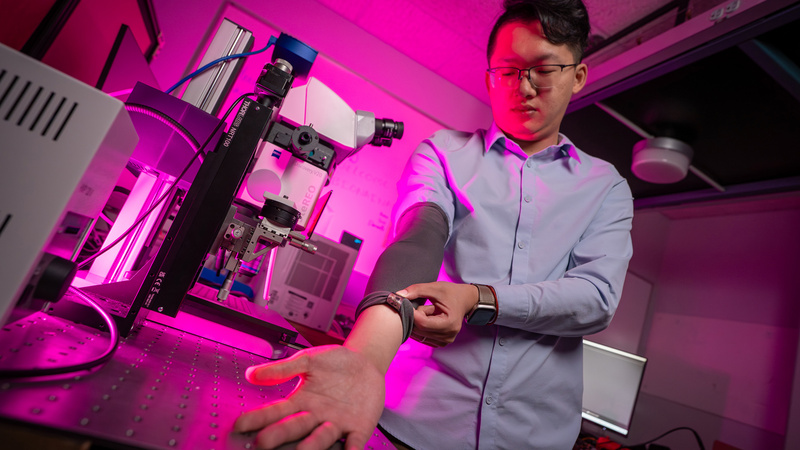
The device comprises a soft electronic patch glued onto a cloth armband. Motion and muscle sensors, a bluetooth microcontroller and a stretchable battery are integrated into a compact, multi-layered system.
The system was trained using a composite dataset of real gestures and conditions, from running and shaking to the movement of ocean waves.
Signals from the arm are captured and processed by a customised deep-learning framework that strips away interference, interprets the gesture and transmits a command to control a machine – such as a robotic arm – in real time.
Chen said: “This advancement brings us closer to intuitive and robust human-machine interfaces that can be deployed in daily life.”
The wearable was tested in multiple dynamic conditions: for instance, controlling a robotic arm while running, exposed to high-frequency vibrations and under a combination of disturbances.
The device was also validated using an ocean simulator, which recreated both lab-generated and real sea motion. In all cases, the researchers say the system delivered accurate, low-latency performance.
As such, they foresee the technology being applicable to a variety of settings. For instance, patients in rehabilitation or individuals with limited mobility could use natural gestures to control robotic aids without relying on fine motor skills.
Industrial workers and first responders could potentially use the technology for hands-free control of tools and robots in high-motion or hazardous environments. Similarly, divers could use it to control underwater robots.
Chen said: “This work establishes a new method for noise tolerance in wearable sensors. It paves the way for next-generation wearable systems that are not only stretchable and wireless, but also capable of learning from complex environments and individual users.”
The study, ‘A noise-tolerant human-machine interface based on deep learning-enhanced wearable sensors’, was published in the journal Nature Sensors.
