
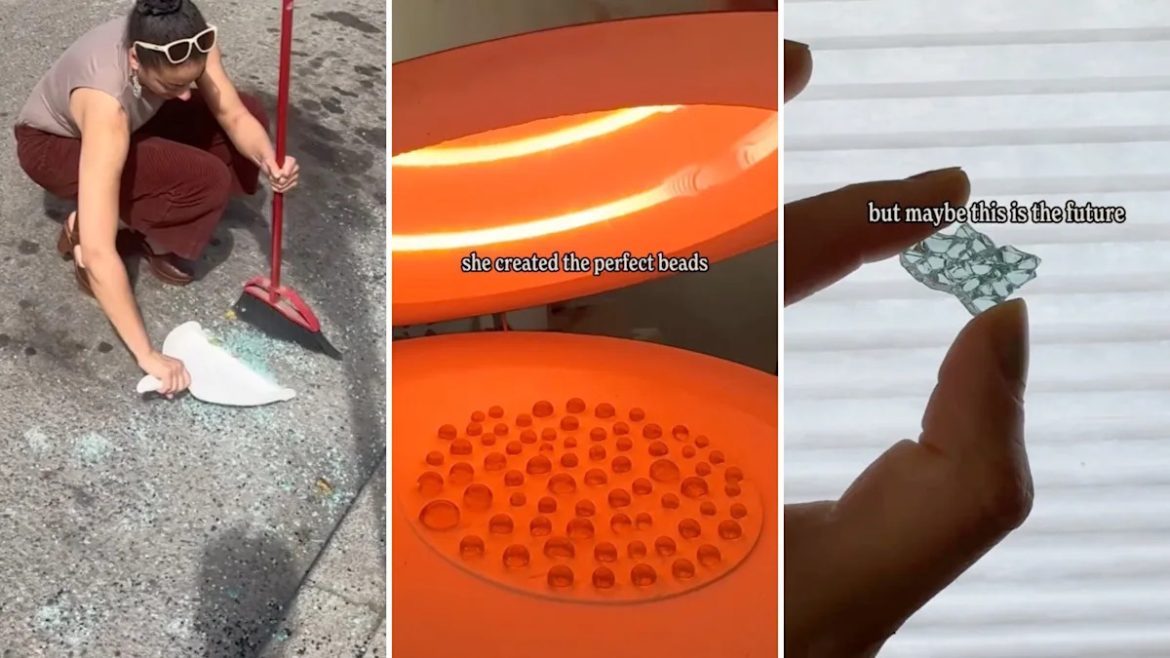
When Sydney Jones is walking around in her hometown of Oakland, California, it’s likely she’s focused on the streets to see if there are any glass remnants of a car break-in. Over the past few years, the creator has built her Odd Commodity Shop, where she sells jewelry, scented candles, and vases made out of car windows and old wine bottles.
What started as a way for Jones, 29, to get rid of leftover resin after working on some architecture school projects during COVID has evolved into a business that Jones recently left her day job to focus on full-time.
“Big, big, big changes all happening,” she told The Cool Down. “Very exciting changes.”
Five years ago, not wanting to waste resin, Jones started making earrings as gifts for her family and friends. Soon, more and more people started requesting them.
“I was like, OK, I guess I should make some kind of online portal to start selling the jewelry for people who had special requests or other jewelry I was making,” she said. “I called myself a little ‘odd commodity’ shop back then because I didn’t know what little odd commodity I’ll come up with next.”
Around the same time, Jones, who was minoring in sustainability, was taking a class where she learned how much glass ends up in landfills, which shocked her.
It made Jones think about “wish-cycling,” a misguided practice of putting non-recyclable items in recycling bins. Wish-cycling isn’t helped by single-stream recycling processes, which is the widely used practice of people putting any recyclable materials in one bin or bag, rather than separating and organizing them.
“We’re kind of told this idea that all of glass gets recycled,” she told The Cool Down. “It was jaw-dropping for me. And that was kind of where I started to shift to glass [instead of resin], because I thought, as much as this resource is recyclable, it was an interesting conversation point [that it’s not].”
In 2018, landfills received roughly 7.6 million tons of glass, and glass accounted for 4.2% of total municipal waste production. It’s estimated that 28 billion glass bottles and jars are buried in landfills every year — enough to fill two Empire State Buildings every three weeks, according to RoadRunner. Once in the landfill, this glass takes 4,000 to 1 million years to decompose.
Jones started collecting glass bottles and recreating them into candle holders, using her microwave kiln, a home appliance often used for small glasswork. Sometimes, the bottles would break, and she didn’t want to throw the pieces out since she knew it was going to end up in a landfill. That’s when she started melting the glass into jewelry pieces.
Friends and family members then began collecting their own glass bottles and handing them to Jones whenever they saw her. She recalled that a couple of friends really wanted to help her expand the Odd Commodity Shop, so they kept asking if she could only use glass bottles or if she could use anything made of glass.
“People were like, ‘Oh, we’re seeing you’re using glass — could you use window glass? Could you use this?'” she said. “I had a lot of people trying to offer me certain glass, and I had to learn a lot about how specific glass was made.”
One day, she was walking her dog with her partner in Oakland when Jones suddenly thought about sweeping up the “massive amounts of glass on our street.” While recent data shows car break-ins — or “bips” as known colloquially in the area — are down in the Bay Area, it’s reportedly rampant in areas like Oakland. (Jones named her jewelry line “Bips” as a tongue-in-cheek reference to the source.)
“I [felt] like I should start sweeping up the piles of glass we see on the street because we know the street sweeper just comes in and sweeps it off, and it ends up in the trash or just getting scattered down the road,” Jones said. “It’s not really resolving getting trash out of the streets. So I went home and got a little bucket in my room and started sweeping it up.”
Tempered glass is used for most car windows because it will break into small pieces with rounded edges, rather than large, sharp shards, which could be more dangerous. Tempered glass is usually not recycled because it has a high softening point (it does not melt) and a chemical composition compared to other common glass items.
Initially, because of Oakland’s reputation, Jones said she didn’t want to be open about the fact that she was getting the glass from cars.
“I don’t like highlighting the things that are going wrong, right?” she said. “But once I started getting less shy about where some of the glass is coming from, I did start telling certain folks, especially once I started having return customers, and they’re like ‘Oh my gosh, that’s incredible.'”
Odd Commodity Shop has grown into incorporating Oakland more and more. Jones works with local auto shops and wine stores, who she says are immediately happy to help her when she asks if they have leftover glass. She also points out that each glass is different — not all tempered glass from car windows will require the same melting process for products.
“Each firing ends up firing into a little creation,” Jones said. “Every single piece ends up a little bit unique.”
Get TCD’s free newsletters for easy tips, smart advice, and a chance to earn $5,000 toward home upgrades. To see more stories like this one, change your Google preferences here.
