
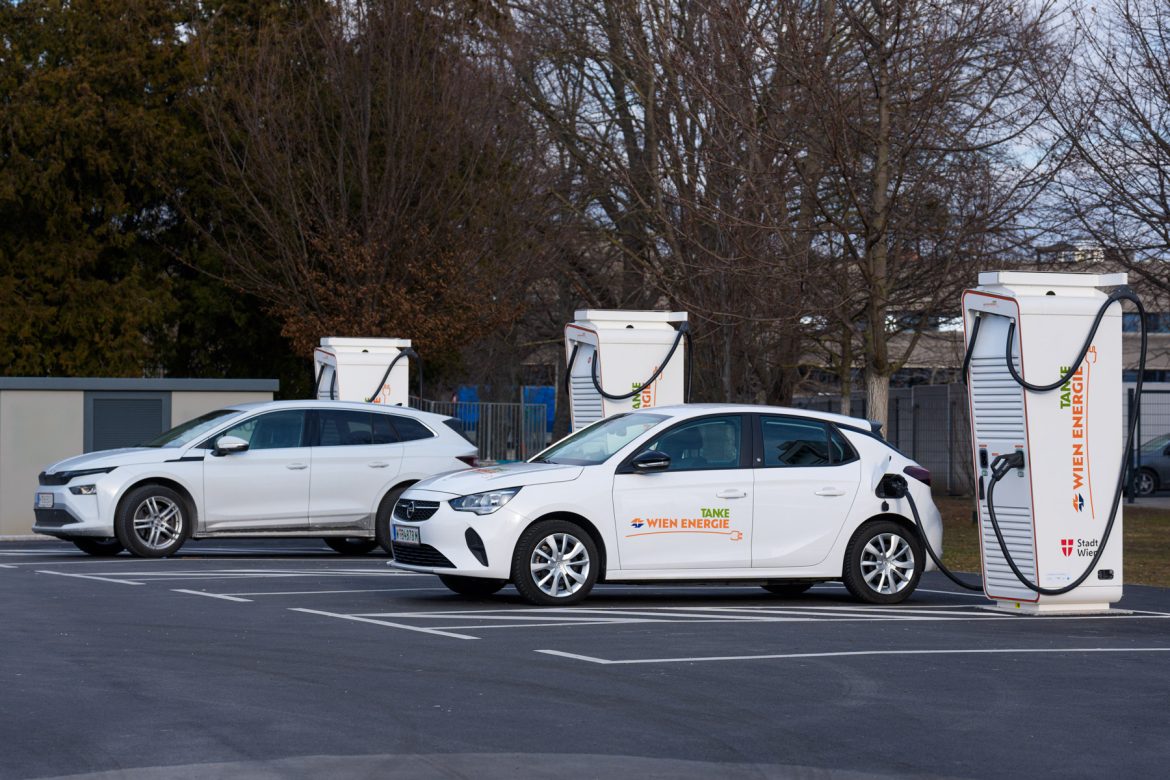
In Austria, the growth of electric mobility is reflected in the registration statistics provided by Statistik Austria. In June alone, 8,993 new battery-electric cars were registered, marking a 44 per cent increase compared with June 2025. This surge pushed the share of battery-electric cars in Austria above the 26 per cent threshold for the first time on a monthly basis (exactly 26.3 per cent). In May and April, the share had already exceeded 25 per cent, having previously hovered just above 20 per cent.
The Austrian overall market also experienced growth in the first half of the year, with 164,529 passenger cars registered — a 15 per cent increase compared with the first half of 2025. In June, total registrations were even 23 per cent higher than in the previous year. “The upward trend in new passenger car registrations has now persisted for a full year and gained further momentum in June 2026. […] Two-thirds of the cars registered in the first half of the year featured alternative drive systems,” comments Manuela Lenk, Director General of Statistical Methods at Statistik Austria.
More precisely, statisticians recorded 107,836 passenger cars with alternative drive systems (+27 per cent year-on-year). Alongside the 40,060 new battery-electric cars (+8,526; +27.0 per cent year-on-year), there were 60,910 petrol hybrids (+15,276; +33.5 per cent year-on-year) and 6,864 diesel hybrids (−819; −10.7 per cent year-on-year) registered between January and June. For completeness, two hydrogen-powered cars were also recorded. As usual, the statement from Statistik Austria does not specify how the hybrid figures are distributed among mild, full, and plug-in hybrids. Some hybrid variants are closer to conventional petrol cars than to battery-electric vehicles. It is worth noting that Statistik Austria defines the term ‘alternative drives’ quite broadly.
In contrast, purely conventional passenger cars have stagnated or declined. Petrol cars accounted for 40,509 new registrations in the first six months of the year, almost identical to the previous year’s figure. Diesel cars reached 16,184 registrations, an 8.3 per cent decrease compared with the first half of 2025. In terms of market share, the new passenger car market in the first six months of the year was dominated by petrol hybrids (37.0 per cent), petrol cars (24.6 per cent), and battery-electric vehicles (24.3 per cent). Diesel (9.8 per cent) and diesel hybrids (4.2 per cent) saw a decline in significance.
Focusing on June 2026, with its 34,256 new passenger car registrations (+22.9 per cent year-on-year), the following trends emerged: battery-electric cars increased by 44 per cent to 8,993 units, as did petrol hybrids (13,271 units; +44 per cent year-on-year), while diesel hybrids fell by 12 per cent to 1,241 units. Petrol cars accounted for 7,577 registrations (+1.4 per cent year-on-year), and diesel cars reached 3,174 (−10.5 per cent year-on-year). This resulted in the following market shares: petrol hybrids led with 38.7 per cent, followed by battery-electric cars at 26.3 per cent, and petrol cars at 22.1 per cent. Diesel (9.3 per cent) and diesel hybrids (3.6 per cent) now hold only single-digit shares.
Another interesting observation: in Austria, registrations in the first half of the year were split roughly one-third between private individuals (35.8 per cent) and two-thirds between legal entities, companies, and public authorities (64.2 per cent). Among private owners, battery-electric cars already accounted for 34 per cent of all registrations — 10 percentage points higher than the share across all owners.
In the ranking of the most popular brands for battery-electric cars in Austria during the first half of the year, Tesla led with a 10.6 per cent share of the battery-electric car market, narrowly ahead of Škoda (10.5 per cent), BMW (9.9 per cent), and BYD (9.8 per cent). Notably, some of the top 10 brands showed significant growth: Kia (+112 per cent year-on-year), Škoda (+63 per cent year-on-year), and Mercedes (+57 per cent year-on-year) recorded the largest increases in battery-electric car registrations in Austria.
statistik.at (PDF)
