
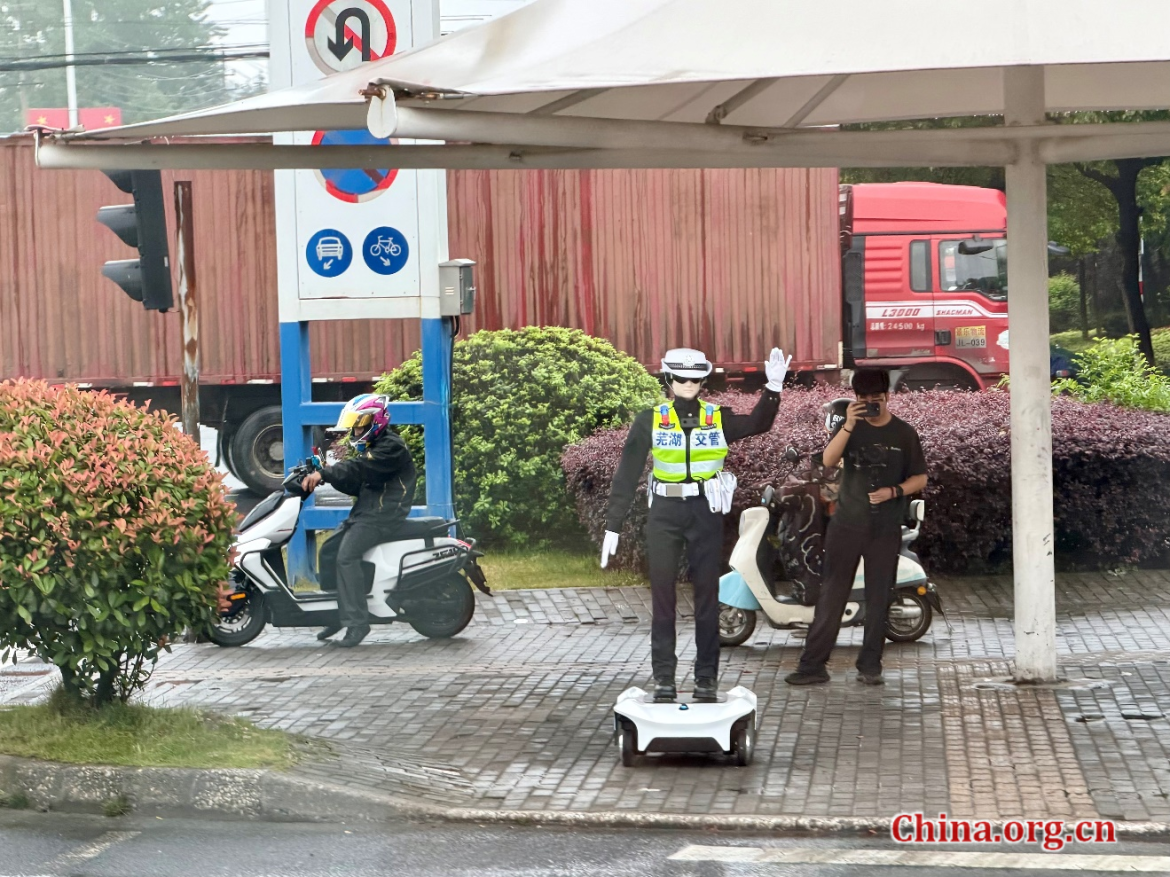
Amid the hustle and bustle of downtown Wuhu, eastern China’s Anhui province, a uniformed humanoid robot is being tested to assist with traffic monitoring and public services. Several blocks away, another humanoid robot is busy answering questions from passengers at a railway station.
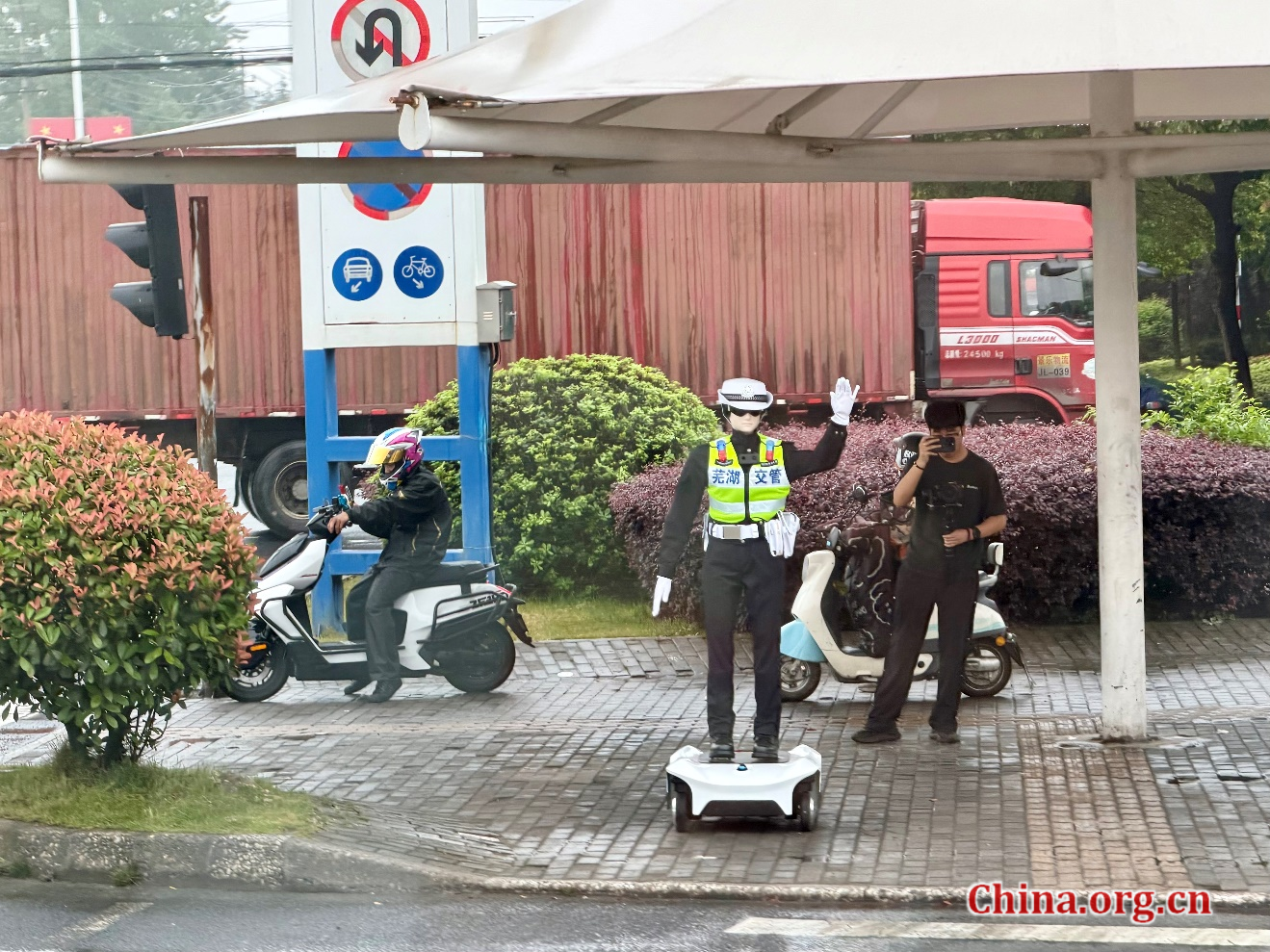
A humanoid robot helps monitor traffic and maintain order on a street in Wuhu, Anhui province, May 20, 2026. [Photo by Liu Jianing/China.org.cn]
These robots are developed by AiMOGA Robot, a company incubated by Chery Automobile, one of China’s largest automakers. Initially created for Chery’s own needs — which range from customer services at 4S dealerships to multilingual support in overseas markets — AiMOGA has since expanded its robots into smart healthcare, traffic guidance, and pedestrian assistance at intersections.
This development reflects a broader industrial shift taking place in Anhui province. In 2025, Anhui ranked first in China in total automobile output, new energy vehicle production, and automobile exports, demonstrating the province’s capabilities as one of the country’s major automotive manufacturing bases.
Headquartered in Wuhu, Chery has accumulated nearly three decades of manufacturing experience. According to Zhang Guibing, executive vice president of Chery Automobile and head of AiMOGA Robot, the company began exploring robotics after realizing that intelligent vehicles are, in essence, “large mobile robots.”
“That allowed us to integrate the two platforms together,” Zhang said. “Many robots in the past were still at the laboratory or prototype stage. But for robots to truly enter households and industries, they must evolve from experimental products into mass-produced commercial goods.”
Zhang said Chery’s strengths in research and development, manufacturing, supply chains, quality control, and global sales channels can all be transferred to robotics. The company is also introducing automotive-grade standards into its robotics development, including testing and lifecycle management systems traditionally used in vehicle manufacturing.
“We may have been among the first in China to shift an entire automotive supply chain toward robotics,” Zhang said, noting that many auto parts suppliers are now entering the robotics sector because they see strong growth potential in the industry.
He added that many existing automotive production lines can be adapted for robot manufacturing without requiring large-scale new investment, giving automakers an advantage in scaling up humanoid robot production.
At Chery, robotics has already become a core long-term strategy. “The investment in robotics has no upper limit,” Zhang said. “While the automotive industry is still developing rapidly, we also believe growth could eventually slow down. That is why, while developing automobiles, we are simultaneously laying out our robotics business.”
AiMOGA’s service-oriented robots show the visible side of Wuhu’s robotics push, while the city’s deeper robotics foundation lies on the factory floor.
In automobile production, welding, spraying, handling, and assembly all require speed, precision, and reliability. That demand has helped nurture industrial robot makers such as EFORT Intelligent Robot Co. Ltd., which grew out of Chery’s automobile system over a decade ago before becoming an independent company.
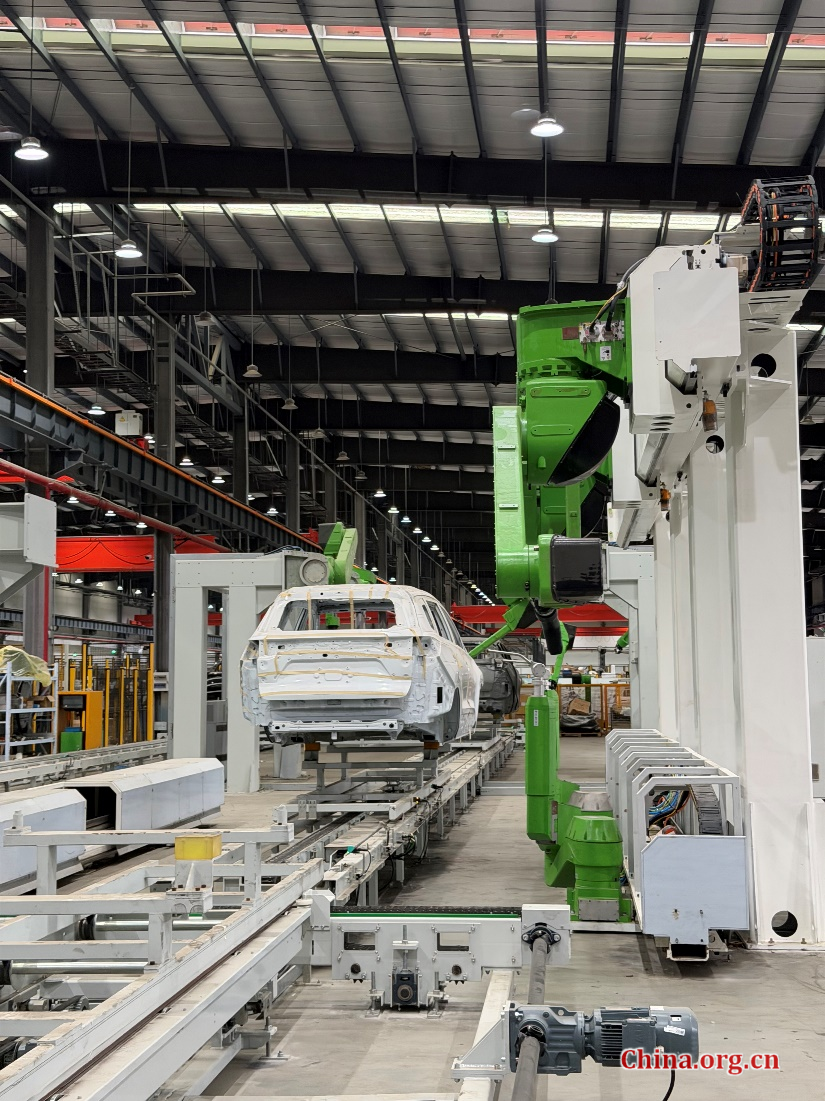
A robotic arm is tested on an automobile production line at EFORT Intelligent Robot Co. Ltd. in Wuhu, Anhui province, May 20, 2026. [Photo by Liu Jianing/China.org.cn]
Zhang Wei, deputy general manager of EFORT, said China’s industrial robot sector has grown rapidly over the past decade, driven by the expansion of Chinese manufacturing and the development of the industrial robot supply chain, especially key components.
Along with electronics as well as photovoltaic and lithium-ion battery manufacturing, automobiles are among the most important markets for industrial robots, which accounts for over 20% of all industrial robots in use, Zhang said.
“The next stage of industrial robotics will be defined by greater intelligence,” Zhang explained. “In the past, many robots followed fixed programs designed by engineers. In the future, more robots will be able to perceive their surroundings, make decisions, plan movements, and execute tasks with less human intervention.”
One example is robotic spraying. With visual sensors and better algorithms, a robot can scan the shape of a work piece, compare it with an expert database, generate a spraying path, and adjust the angle and coverage of the spray gun before completing the task with greater efficiency and precision. “This can be viewed as a ‘0.5 version’ of embodied intelligence in industrial settings,” Zhang said.
China produces over 30 million automobiles annually, a scale that Zhang described as relatively mature. “The next major growth track could be humanoid robots,” he said. “It could become another trillion-yuan market comparable to the automobile industry itself.”
Zhang said he believes the automobile industry could play a central role in the future humanoid robot market. China’s auto industry already possesses large-scale manufacturing capabilities, mature supply chains, and extensive real-world application scenarios — all critical advantages for the commercialization of humanoid robots.
“The next humanoid robot market could emerge from China’s automobile sector,” he said.
