
Article Summary
BMW is testing Figure 03 humanoid robots at its Spartanburg plant to handle automotive parts sequencing and logistics, following successful trials with earlier models that loaded over 90,000 parts for production of 30,000 vehicles. These AI-powered robots use cameras, touch sensors, and advanced AI systems to arrange parts in the order needed for vehicle assembly lines.
- Figure 03 robots stand 1.73 meters tall, weigh 61 kilograms, and can carry up to 20 kilograms of automotive parts
- The robots use cameras and pressure sensors in their fingertips (detecting forces as light as 3 grams) to handle parts with precision and adjust to container positioning variations
- Previous Figure 02 model successfully loaded over 90,000 parts across 1,250 operating hours, contributing to production of 30,000 BMW X3 vehicles with 37-second loading times
- The new design is 9% lighter than Figure 02, with actuators that move twice as fast and provide more torque, optimized for larger-scale manufacturing
- Robots operate on a 5-hour battery with wireless charging capability and feature Helix 02 AI that updates movement commands 200 times per second for precise task execution
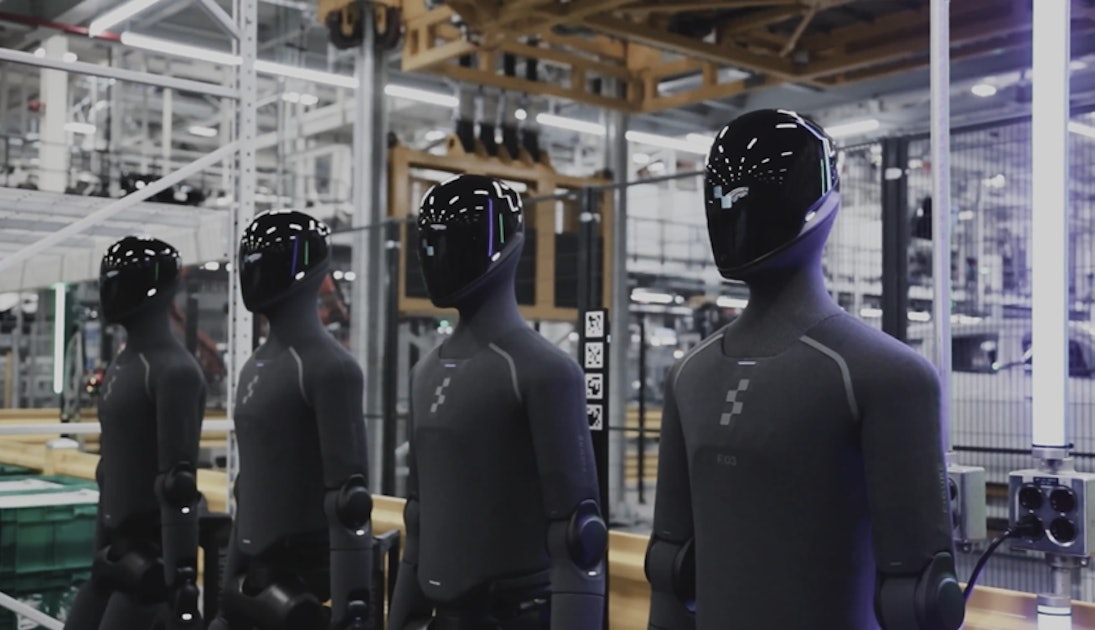
Humanoid robots that stands 1.73 metres tall, carry up to 20 kilograms and use cameras and touch sensors to handle automotive parts are being tested at BMW Group’s vehicle assembly plant in Spartanburg, S.C.
“Having already successfully completed a pilot with Figure 02 in our bodyshop, we are now looking forward to deploying Figure 03 for a sequencing use case in logistics,” said Ulrich Wieland, vice-president of production control and logistics at BMW Manufacturing.
The third-generation machines weigh 61 kilograms, travel at up to 1.2 metres per second and have a listed operating time of five hours. A 2.3-kilowatt-hour battery is built into its torso. Charging coils in its feet allow it to recharge while standing on a wireless charging platform.
The robot was developed by Figure AI, a California company producing general-purpose humanoid robots. Its first BMW assignment involves sequencing, the process of arranging parts in the order they will be needed on a vehicle assembly line.
Components arrive loose in large containers. The machine removes each part and places it in the correct slot on a trolley. An automated tugger or transport robot then carries the trolley to the assembly line.
The task requires the robot to recognize parts that may have shifted or rotated inside a container. It must also adjust when containers and trolleys are not placed in exactly the same position.
Cameras in its head identify the work area. Additional cameras in its palms provide a closer view when its hands, arms or a container block the head-mounted cameras.
Pressure sensors in its fingertips can detect forces as light as three grams. The sensors indicate whether a part is secure or beginning to slip. Softer fingertips provide more contact with objects of different shapes.
The machine can reposition its feet and torso while reaching, lifting or pulling. Demonstration footage shows it placing thin parts into narrow slots and pulling a large metal trolley on caster wheels.
Its Helix 02 artificial intelligence system combines information from the cameras, fingertip sensors and sensors that track the position of the robot’s body. The system then controls the fingers, wrists, arms, torso and legs together.
One part of the system interprets spoken instructions and determines the order of a task. Another updates full-body movement commands 200 times per second. A lower control layer manages balance and the individual motors 1,000 times per second.
The robot can also communicate through speech. Its exterior includes removable foam and textile coverings around some hard surfaces and potential pinch points.
The Spartanburg project follows BMW’s earlier work with Figure 02.
That earlier model was used in the factory bodyshop, the production department where stamped sheet-metal panels are positioned and welded together to form new vehicle bodies. It is not a collision repair facility.
The robot removed three sheet-metal parts from containers and placed them into a welding fixture. Fixed industrial robots then welded the pieces.
During the longer deployment, Figure 02 loaded more than 90,000 parts over 1,250 operating hours. Its work contributed to production of more than 30,000 BMW X3 vehicles.
The assignment had to fit within an 84-second production cycle. Loading the three parts accounted for 37 seconds. Some parts had to be placed within a five-millimetre tolerance in two seconds. Figure AI set a target of more than 99% successful placement during each shift without a worker resetting the robot.
Information from that deployment was used to develop the latest model.
The forearm was the most frequent source of hardware failures on Figure 02. Its wrist motors were connected to the main computer through a circuit board and moving cables inside the arm.
The new design removes that board and cabling. The wrist motor controllers connect directly to the main computer, reducing the number of components inside the forearm.
The latest robot is 9% lighter than its predecessor. Its actuators can move at twice the speed and provide more torque for their weight.
It was also redesigned for larger-scale production. More of its structure is made from cast, stamped and injection-moulded components instead of parts machined individually from solid material.
Figure AI’s first robot, Figure 01, took its first steps in 2023 and carried its battery in an external backpack. Figure 02 followed in 2024 with an integrated battery, more computing power and hands with 16 controlled movements each.
The current model is the company’s third design in approximately three years.
The releases did not provide the number of robots involved in the trial, its planned duration, a parts-per-hour rate, an intervention rate, a purchase price or operating costs.
