
By Denis Loktev
Published on
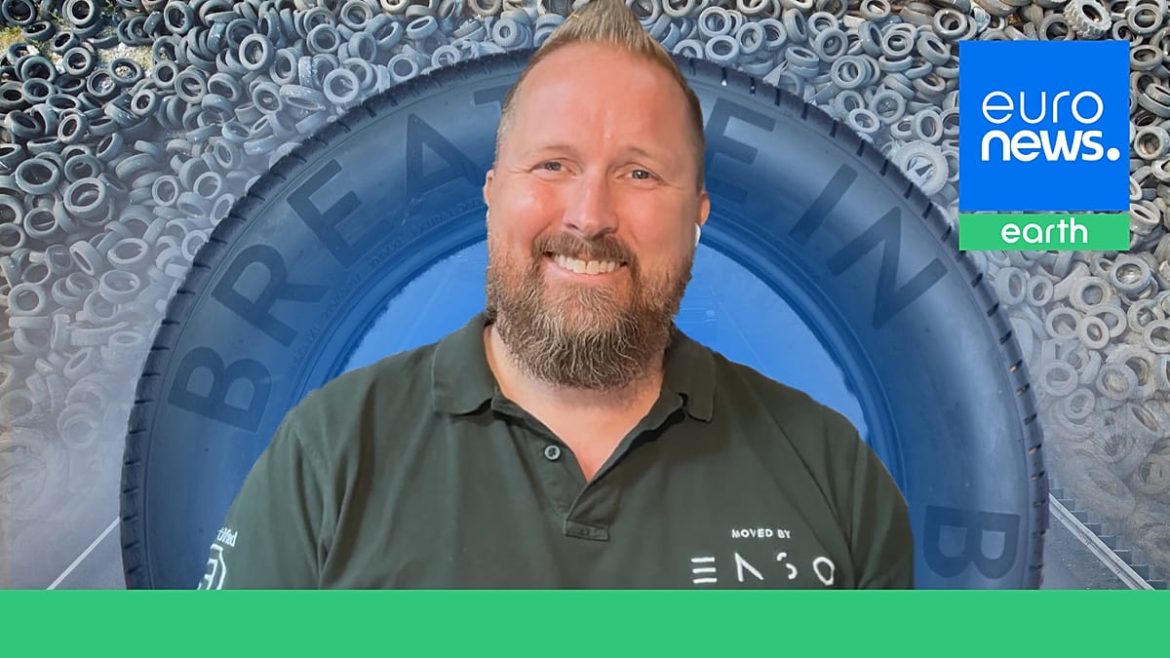
Electric cars are widely seen as the cleaner choice on the road. But according to Gunnlaugur Erlendsson, founder and CEO of technology company ENSO, there is a significant environmental cost hiding in plain sight: the tyres.

ADVERTISEMENT
ADVERTISEMENT
“Tyres are one of these really complicated products we don’t really see very often, even though they’re absolutely everywhere,” Erlendsson tells Euronews Earth. “The whole global economy runs on tyres.”
That ubiquity comes at a cost. Raw material extraction, energy-intensive manufacturing and the wear generated every time a vehicle stops, starts or turns all add up.
“Tyres are both a source of major air pollution, which is also a microplastic. So it’s one of the biggest sources of air pollution in cities. It’s also one of the biggest source of microplastic pollution in our oceans,” Erlendsson says.
Disposal adds another layer to the problem. “We actually burn almost two billion tyres every year because so few of them are actually recycled back into tyres again,” he explains.
ENSO was founded to address these impacts while supporting the shift to electric vehicles. “Our mission really is about enhancing electric vehicles while we’re addressing the problems that tyres cause,” Erlendsson says.
Why electric vehicles wear tyres faster
Electric vehicles might be cleaner to run, but according to Erlendsson, they place greater demands on tyres. “Electric vehicles are fairly unique because they’re really heavy. They have really high torque. So they tend to wear out tyres faster than traditional cars ever did,” he says.
Driving behaviour makes the issue worse. “They’re really fun to drive. People drive them more aggressively, which again wears tyres faster,” Erlendsson notes, adding that EVs are often used in cities, where frequent stopping, starting and turning generates more tyre pollution.
There is also a less obvious factor: efficiency. Erlendsson explains that electric vehicles convert around 90 per cent of energy into motion, compared with roughly 30 per cent for petrol cars.
“That efficiency gain with electric vehicles is positive, but it makes them incredibly sensitive to tyres,” he says. “If you don’t put a good tyre on an electric car, you lose a lot of range and you buy a lot more electricity.”
To tackle this, ENSO changed the raw materials, formula and construction used in its tyres, while also drawing on data collected from vehicle fleets. “When we deploy onto fleets, it means that we get data. We take that data, that insight, that knowledge, that know-how, and we put it back into the product again,” Erlendsson says.
Designed to handle the high torque and heavy battery weight of EVs, ENSO’s advanced polymer compounds and tread chemistry reduce tyre particulate pollution by up to 35 per cent compared to conventional tyres. They also improve overall energy efficiency and vehicle driving range by up to 10 per cent, according to the company.
Scaling up with major partners
ENSO has built its growth around partnerships with large-scale taxi and delivery fleets rather than individual consumers. The company already works with Uber, supplying tyres to electric vehicle drivers across the UK, with plans to expand beyond it.
“Ultimately, it’s about enabling these high mobility use cases that drive a lot to get better products,” Erlendsson says, noting that high-mileage vehicles see the greatest savings in energy, cost and pollution.
Recognition from the Earthshot Prize, where ENSO was a finalist in 2023, helped raise the profile of an issue Erlendsson believes the industry has long avoided.
“Tyre pollution has been this kind of industry topic that hasn’t really been addressed by, I would say, the mainstream industry. They don’t really want to talk about it,” he says. He credits Prince William’s involvement with bringing wider attention to the issue, calling it “really substantial in terms of highlighting… how we can actually use technology to enhance better air we breathe, reduce the microplastics in our oceans.”
Looking ahead, ENSO plans to keep expanding its fleet partnerships and broaden its range of tyre sizes to match new electric vehicle models entering the market, with the United States identified as its next major growth market.
“We want the rest of the industry to follow us,” Erlendsson says. “We just want to be the catalyst that makes the change happen.”
