
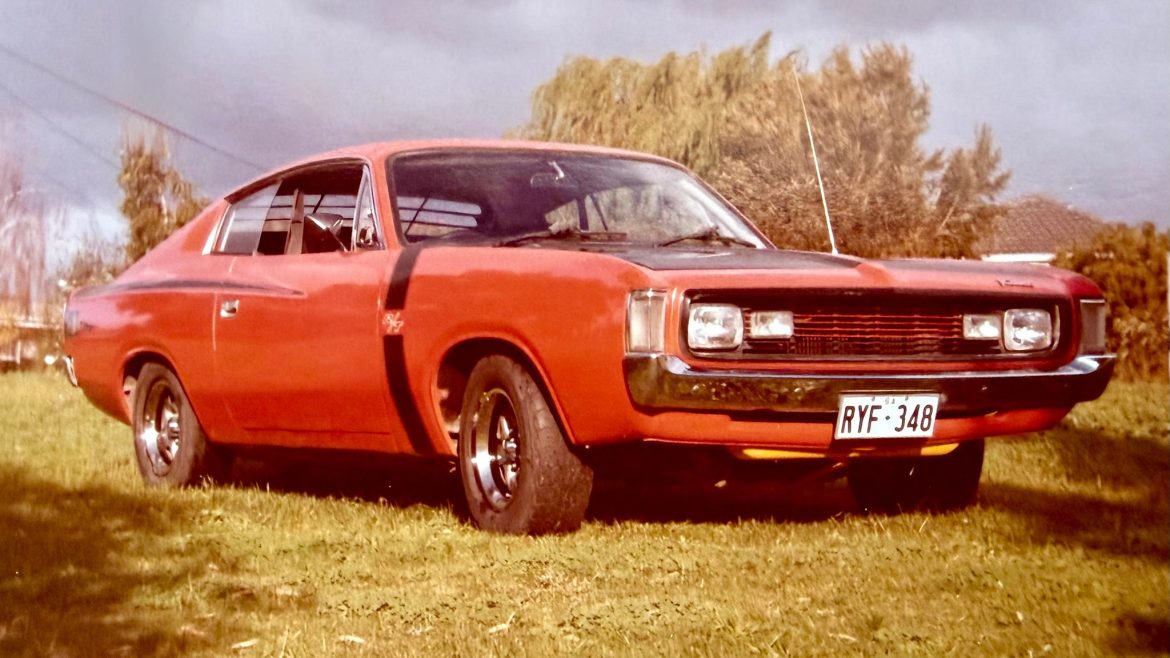
We’ve all owned them: the cars we wish we had never sold. The ones that got away. Me? I wish I still had the fire orange 1971 Valiant Charger R/T E37, which I flipped more than 45 years ago to buy my first Alfa Romeo GTV.
Say what? Yep. Valiant—not Dodge—Charger. I grew up in Australia, where GM, Ford, and Chrysler all made cars in the 1960s and ’70s. When the muscle car war erupted in the U.S., a second front opened Down Under in 1967, with hot Holdens, Falcons, and Valiants soon duking it out for bragging rights in the annual production car endurance race at Mt. Panorama, Bathurst. And 1971 was a vintage year for Aussie muscle.
ADVERTISEMENT – CONTINUE READING BELOW
Holden’s Monaro GTS coupe could be ordered with the 350-cubic-inch version of Chevy’s immortal small-block V-8 under the hood, hooked up to a Saginaw four-speed manual transmission. The Ford Falcon GTHO Phase III was basically a four-door Boss Mustang, right down to the 351 Cleveland V-8 under the hood, complete with shaker intake (Torino GT base and Boss Mustang scoop), decklid wing, and optional 15-inch aluminum wheels. It would run to 142 mph, the big old Cleveland nuzzling 6,750 rpm, making it one of the fastest four doors in the world at the time.

Chrysler was a little late to the Aussie muscle car party, and its Valiant Charger coupe, designed and engineered entirely at its Tonsley Park, South Australia, headquarters, was a unique take on the genre. The Charger was built on a shorter wheelbase than the regular Valiant sedan, and the hi-po R/T versions only had a straight-six engine under the hood, though it was an Australian-developed 4.3-liter straight-six with a Hemi head. It was derived from a stillborn 1966 proposal for a Dodge truck engine. The car’s aggressive styling, with sail panels like those on an XJS Jaguar sweeping back from the roofline to a distinctive Kamm-tail rear end, made it the looker of the bunch.
ADVERTISEMENT – CONTINUE READING BELOW
There were R/Ts, and then there were R/Ts. As in Detroit, you had to play the option game. The regular R/T Chargers had a single four-barrel carb. But if you ticked the box marked E37 or E38 on your order form, you got the Six Pack engine, which featured three 45 DCOE side-draft Weber carburetors bolted to a bespoke intake manifold. There were other changes: forged aluminum connecting rods, bigger valves, trick headers, a higher compression ratio, a baffled oil pan, and a wilder cam.

The E38 was the race-face version. It ran a 10:1 compression ratio; the rods were shot-peened, and the valve overlap was a rumpety-rump 48 degrees. In E38 guise the big Hemi six made 280 hp at 5,000 rpm and 318 lb-ft of torque at 3,700 rpm. It also came with the Competition package, which included aluminum wheels, a limited-slip diff, and a giant fuel tank with fillers on each sail panel.
ADVERTISEMENT – CONTINUE READING BELOW
My R/T was an E37. It had a milder cam (30 degrees of valve overlap) and a lower compression ratio (9.7:1). Output was 248 hp at 4,800 rpm, with 306 lb-ft of torque at 3,400 rpm. I also missed out on the Competition package goodies: My car had styled steel wheels, a smaller gas tank with a single filler at the rear (straight out of Chrysler’s U.S. parts pin), and a standard diff. I didn’t mind too much. It was still a cool ride for a 19-year-old.
I had come out of a year in military college at the end of 1976 and was looking to trade up from my 1968 Mini. I had a steady job, and I was living at home. I had money in my pocket and a desire to buy something fast. My uncle worked at Tonsley Park, and my dad—a mechanic—always liked the way the early Valiants seemed a cut above their Holden and Ford counterparts in terms of their engineering and durability. So I was drawn to a Charger rather than a Monaro or a Falcon GT. Dad and I must have checked out a dozen ratty, hard-driven R/Ts, including some E38s, before we found an immaculate fire orange E37. It belonged to a Greek guy who received it as a wedding present from his father-in-law. The car had covered just 35,000 miles.
