
Stay up to speed with stories written by drivers, for drivers.
Get automotive news, DIY tips, market trends, in-depth car profiles, and more right in your email inbox.
Modern supercars are up-up-up, as auctions in the first half of 2026 continue to illustrate. Elsewhere, however, we’ve seen a softening in some segments of the market since January. This week we’ve put affordable Japanese collector cars under the valuation microscope: The following five models have seen a dip in recent months, which is great news for enthusiasts wanting to get behind the wheel. In our analysis, we’ve looked at all models and trims covered in the Hagerty Price Guide for cars in #2 (excellent) condition.
1984–91 Honda CRX: -17%
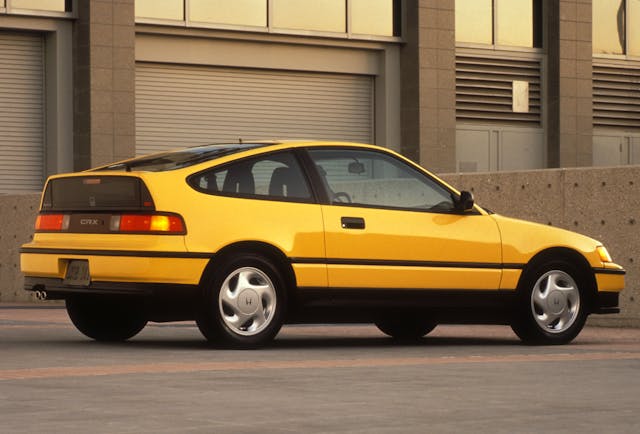
Honda’s lovable little two-seat hatchback arrived to much fanfare in 1984, and over the next seven years it got better and better. The lightweight ride was initially offered with a fuel-sipping, 60-horsepower, carbureted 1.3-liter four that got 51 mph, or a 76-hp 1.5 that was a bit more sporty. The 91-hp, fuel-injected Si arrived midway through 1985 and offered cheap thrills in the compact segment. A redesign for 1988 introduced the second generation, with a host of mechanical upgrades—including an all-new suspension—that improved the car in nearly every way. All three models got new engines as well—1.5s in the base and mpg-champ HF (with 16 and 8 valves, respectively), and a 1.6 in the Si, now making 105 hp. The CRX remained largely unchanged until production ceased, and the Del Sol replaced it.
Despite a sizeable production run (estimates peg it around 400,000 cars), CRXs are few and far between these days, likely because few people thought that the neighbor’s commuter might ever be anything to anyone in the future. Though all three models offer something interesting to potential buyers, the Si is the enthusiasts’ choice. After remaining fairly steady in the first half of the decade, they began to climb in summer 2024, before plateauing for most of 2025, where #2 (excellent) values for early ones sat right around $43,000. These days, we’re looking at $36,000, on average. Second-gen cars in similar condition command only a slight premium, now valued at close to $38,000.
1962–70 Datsun 1500/1600/2000 Roadster: -12%

Datsun first dabbled with the idea of an open two-seater with the S211 Fairlady of 1959 and the SPL213 Fairlady that followed in 1961—the first Datsun sports car exported to the United States. But the company truly found its footing in the segment with the introduction of the 1500 Roadster in 1962.
Whereas its predecessors were almost caricature-like in their proportions, the new Roadster was a larger, more fully formed attempt at gaining market share. The 1500 featured a 1488-cc four-cylinder making 85 horsepower and enjoyed a four-year production run before it was replaced by the 96-hp 1600 for 1966. Datsun built the 1600 built concurrently with the 2000, the latter a fierce little machine with 135 hp, a five-speed gearbox, and giant-killing chops. Both cars got a facelift in 1968. They were praised in period—and today—for their fine handling and balance, if not their sheer speed, and they excelled in amateur racing.
For many years, this trio of Datsun Roadsters enjoyed a life in the shadows of the market, even as other, more glamorous roadsters began to soar. That all changed about a decade ago, perhaps as enthusiasts went in search of the next affordable thing, and prices for great ones climbed accordingly, though there were still plenty of bargains to be found in fairly average drivers. These days, 1500s in #2 condition are around $25,000, while similar 1600 Roadsters from pre-1967 are right around the $30,000 mark; both are down about four grand from the start of the year. Post-facelift 1600s trade for a couple thousand less, while the ultimate performer of the bunch, the 2000, is now around $34,000, which is down about $4700 since January.
1974 Datsun 260Z: -7%
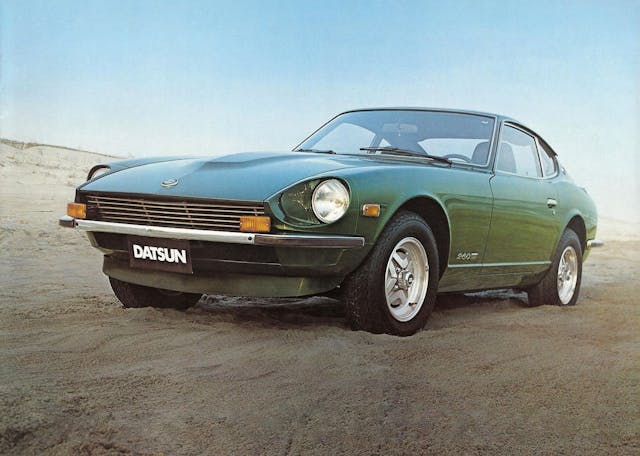
Another Datsun on a downward trend this year is the 260Z, that weird middle child of the Z-car’s 1970s adolescence.
Following the wide-eyed reception the 240Z enjoyed in 1970, things began to go downhill for the revolutionary little sports car. To be clear, it wasn’t the Z’s fault, but rather that of the performance-bungling emissions equipment being thrust upon it and every other car in the U.S.—namely, reduced compression and ignition timing. In an attempt to counteract some of that depleted spunk before the arrival of the fuel-injected 280Z in 1975, Datsun increased the stroke of the Z’s 2.4-liter overhead-cam inline-six, yielding a 2.6-liter motor now making 140 hp (against the 240’s 151 horses) but a bit more torque. The other significant change to debut with the 260Z—and it was substantial in the context of the little two-seater—was the addition of a 2+2 model.
The 260Z’s values began an upward trajectory about 10 years ago, roughly following those of the 240Z, peaked in 2022, and have trailed off since. Today, a #3 (good) example is a $20,000 machine on average, while a #2 car is more than twice that, at $42,000, though that figure is down about three grand since the start of the year. While far more practical, 2+2s have never been as valuable, and an excellent one should cost less than $28,000, which is down a couple thousand clams since January.
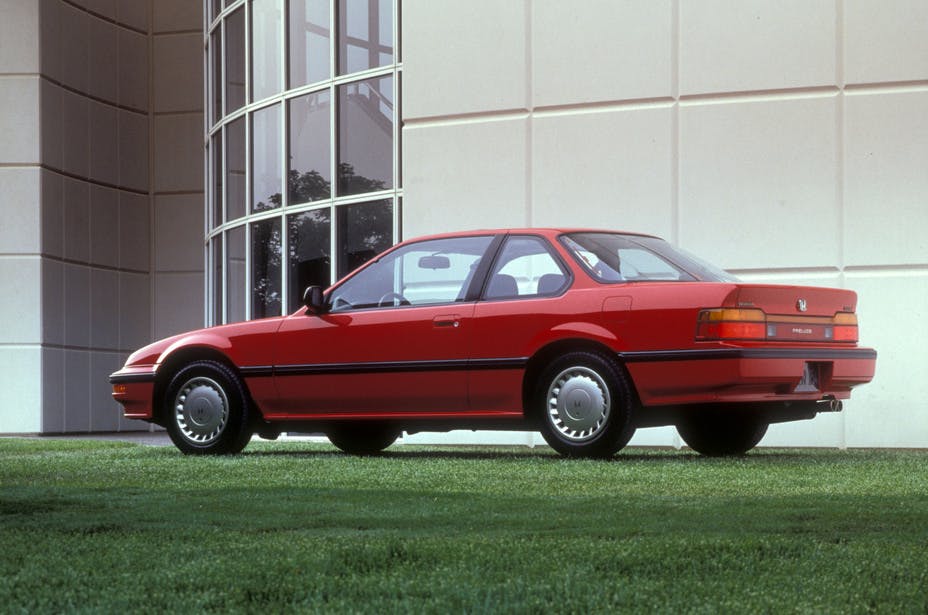
1988–91 Honda Prelude: -6%

Honda was at the top of its game by the late 1980s, and the third-generation Prelude was a suitable halo coupe for showing off its maker’s credentials. It took everything great about the car it replaced and turned up the dial. Available on the top Si trim was slick mechanical four-wheel steering (4WS), which utilized two linked steering boxes and offered tight city turning and easy maneuverability at speed. Beneath that super-low hood sat revvy 2.0-liter B20 four-cylinders—a carbureted 12-valve SOHC unit in the S trim and a fuel-injected 16-valve DOHC version making 135 hp and 127 lb-ft of torque in the Si.
The enthusiast’s choice is and always was the Si 4WS, though the “regular” Si was certainly a competent performer. In the market, these hot little Hondas enjoyed big gains over the last five years, with the Si in #2 condition enjoying a long spell at roughly $24,500, before dipping this year to its current $23,000. Expect a premium of roughly $4000 on the more tech-heavy Si 4WS.
1984–89 Toyota Pickup: -5%

Few things are as reliable as an old Toyota truck. The company began selling them in America, branded as the Stout, back in 1964. Subsequent generations, based on the worldwide Hilux and simply called the Pickup, or the Truck, or the even-more-on-the-nose Pickup Truck here in the U.S, gained size and features, including four-wheel drive in the third-gen trucks introduced in 1979. Toyota’s unkillable fourth-generation hauler garnered notoriety as the car of Marty McFly’s dreams in Back to the Future, and these were the first to be offered as XtraCab models. They swapped out a solid front axle for independent front suspension in 1986 and also modernized the trusty 2.4-liter four (22R) with fuel injection (22RE) and even turbocharging (22RTE), while a 3.0-liter V-6 (aka the “3.Slow”) also became available.
Toyota Pickups were offered in a dizzying array of configurations, including two- and four-wheel drive, regular and long bed, regular and XtraCab, and SR5 (Sport Runabout 5-speed), each available with the above engines. For a long time, these trucks simmered in the market as little more than used vehicles, but as older vintage 4x4s gained ground in the early 2000s and 2010s, their slightly newer counterparts, like these fourth-gen Toyotas, began a slow rise, starting about a decade ago.
After enjoying a big jump in values in late 2021, in the first half of this year, Toyota Pickup values for #2 trucks are down slightly across the board. A #2 condition 1985 long-bed with a regular cab and 2WD, for example, lost about $800 in value since January, down from $15,400 to roughly $14,600. An ’88 XtraCab SR5 with 4WD and the V-6, meanwhile, is down about $1500, from nearly $31,000 to $29,300. It once seemed like these trusty trucks would never lose their foothold in the market, so if you’ve been waiting, now’s the time.
