
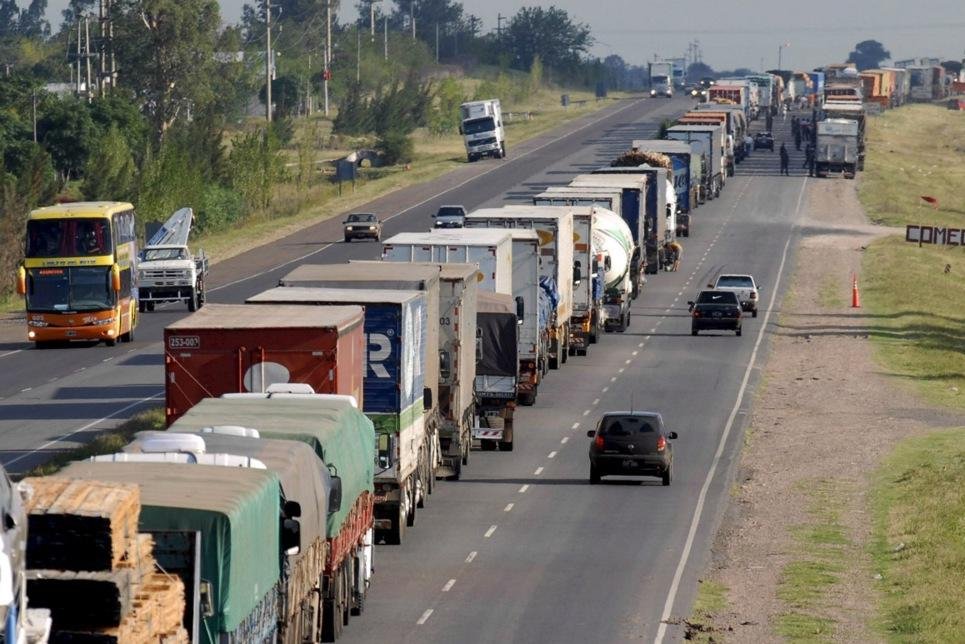
Argentina has nearly 16 million cars, with an average age of almost 15 years, which continues to support demand for replacement parts. File Photo by Enrique Garcia Medina/EPA
BUENOS AIRES, May 12 (UPI) — Argentina’s auto parts industry is facing a sharp downturn as vehicle production declines, imports rise and automakers use fewer locally made components in new models.
Industry leaders say the crisis also reflects a lack of domestic investment in some manufacturing segments and the trade liberalization policies promoted by President Javier Milei.
Sector activity fell 22.5% during the first two months of 2026 compared with the same period last year, according to a report by the Asociación de Fábricas Argentinas de Componentes, known as AFAC.
Vehicle production dropped 30.1% during the same period, while auto parts exports declined 14.7% year over year.
AFAC Executive President Juan Cantarella told UPI that Argentina has nearly 16 million cars, with an average age of almost 15 years, which continues to support demand for replacement parts. He warned that both the manufacturing and aftermarket segments are under pressure.
Cantarella said industry activity depends on two factors: the number of vehicles produced and the share of locally manufactured parts used in those vehicles. In addition to lower production volumes, newer models are assembled with far less local content, he said.
He added that the replacement parts market also showed signs of deterioration, falling between 10% and 12% during the first four months of the year.
Cantarella attributed part of the problem to a lack of investment in previous years. He said many of the imports entering the country today “reflect investments that were not made three, four or five years ago,” particularly in supply agreements with automakers.
He said the trade-opening measures introduced by the Milei administration worsened conditions in the replacement parts market, noting that Import deregulation allowed lower-priced foreign products, especially from China, to enter the market more easily.
AFAC data showed auto parts imports rose 11.6% in 2025, reaching about $10.32 billion. Imports from China increased 81% year over year to $1.46 billion. Brazil remains Argentina’s largest supplier, although the gap between the two countries narrowed significantly.
Cantarella said competition from Chinese products represents the industry’s main challenge.
He also compared Argentina’s position with measures adopted by the United States, Mexico, Canada and the European Union, which have raised tariffs and strengthened rules of origin requirements to increase regional content in products imported from China.
“If those countries are taking measures, it seems to make no sense for Argentina to be doing nothing about it,” he said.
Cantarella also warned about the labor impact of the crisis. He said the sector lost more than 4,000 jobs in 2025 and some companies are downsizing in an attempt to survive.
Among the measures requested by the industry, AFAC called for renegotiating the Mercosur automotive agreement, increasing regional content requirements and introducing incentives to help local manufacturers transition toward electric vehicle production.
Ernesto Mattos, an economics researcher and instructor at the University of Buenos Aires, told UPI that rising imports are displacing domestic production at a time of declining purchasing power and rising unemployment.
Mattos said trade liberalization is also contributing to slower economic growth and falling industrial output.
Meanwhile, Ricardo Delgado, president of consulting firm Analytica, told UPI the sector faces pressure from rising imports and weaker domestic demand.
“Added to this is a loss of momentum caused by stagnant wages and credit, along with exchange rate tensions during the second half of last year,” he said.
Delgado noted that the auto parts industry accounts for nearly half of all registered employment across Argentina’s automotive supply chain.
Between the third quarter of 2023 and the same period in 2025, the sector lost 23.6% of its jobs, equivalent to 10,210 positions, he said.
