
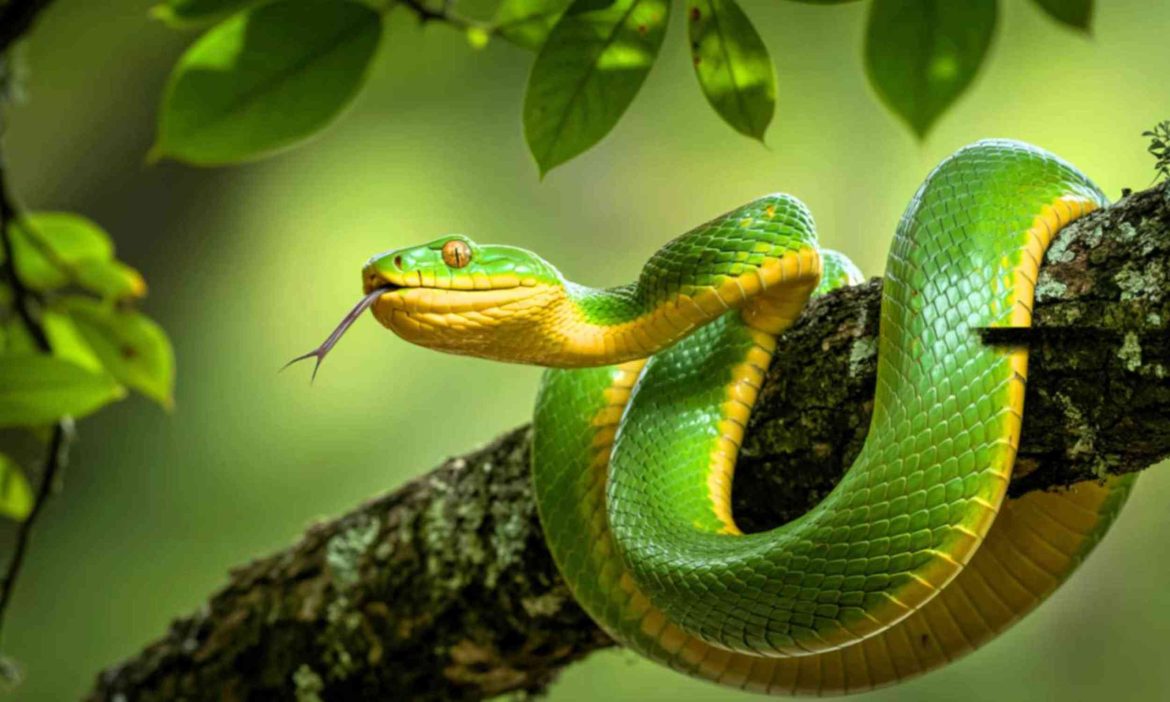
The world monitors the Amazon because its massive variety of life helps stabilize the global climate, but we still don’t fully understand where many of its species actually live.
A new study has mapped out the Amazon’s reptiles, revealing 14 local species centers and 22 distinct regions for snakes and lizards.

This finding is a wake-up call for conservationists. It redraws the map to show that several at-risk species are hanging on near the forest borders, where they are dangerously exposed and unprotected.
Mapping Amazon reptiles
Across museum collections and field records from Amazonia, 100,966 verified reptile records revealed patterns that broader forest maps had overlooked.
Using that archive, Marco Antônio Ribeiro-Júnior, a biologist at Tel Aviv University, showed snakes and lizards follow boundaries many forest-wide maps miss.
Those records covered squamate reptiles, snakes, lizards, and worm lizards, across 780 known species, including 536 found only in Amazonia.
That split forces conservation planners to look beyond famous forest blocks and track small ranges hidden inside them.
Richness tells differently
High species counts clustered near the Amazon River’s middle course, the Madeira and Purus rivers in Brazil, and the Guiana Shield, an ancient northern highland.
Vegetation drove much of that pattern, because dense forest cover creates cooler, wetter microhabitats where reptiles can feed, hide, and reproduce.
Warm, humid, productive areas held many species, while cooler foothills and outer margins held fewer total species.
Richness alone therefore gives a blunt map, because a crowded area can still miss rare local species elsewhere.
Rivers lose dominance
For decades, large Amazonian rivers were treated as hard borders that trapped animals on separate banks.
Reptile evidence weakened that idea, because most local-species centers crossed rivers or formed near headwaters instead of along main channels.
Earlier bird research had also found that rivers changed which birds lived together without neatly fencing off local species centers.
Rivers still shape which species live together, but they do not explain the hidden centers on their own.
Endemism clusters tightly
Local species centers stood out most near the Andes, South America’s western mountain chain, the Guiana Shield, and a few isolated border landscapes.
In these areas, endemism, the presence of species found only in one place, rose where rocks, slope, vegetation, heat, and rain changed over short distances.
Some centers held old lineages, while others held species that appear to have formed more recently in place.
That mix warns against protecting only the richest zones, because narrow-range species can vanish from overlooked edges.
Borders carry risk
Forest edges now carry much of the reptile warning, especially in southern Amazonia and the Andean foothills, lower slopes beside the Andes.
Deforestation has struck some of the hardest-hit reptile regions, where forest loss has climbed to roughly 18% to 30%.
A 2024 Amazon forest analysis found that 10% to 47% of forests could face combined disturbances by 2050.
Areas already past 20% forest loss need faster action, because tree death and drying can push damage outward.
Protection misses species
Protected areas strongly covered some of these refuges, with one remote highland region reaching more than 90% protection.
By contrast, Mantaro Valley, a valley in Peru, had no protected coverage, even though its reptiles formed a tight local cluster.
Because a global reptile assessment found more than one-fifth of reptile species threatened, these gaps carry global weight.
Thin coverage matters most where species cannot simply move, because forest loss removes the whole place they occupy.
Rare records matter
Scarce records often signal places where science has barely arrived, not places where species are safely absent.
The International Union for Conservation of Nature Red List (IUCN Red List), a global extinction-risk database, left 69 Amazonian squamates with too little information for a clear judgment.
Another 125 species had five or fewer records in Amazonia and no assessment in the team’s dataset.
Those thin files make field surveys urgent, because a species known from one hillside can disappear before anyone sees the decline.
Connected reserves help
A border-focused network would protect many local centers while slowing habitat loss before it reaches deeper forest.
Ecological corridors, protected strips that let wildlife and natural processes continue moving, can link reserves across political borders.
International corridor guidelines that connected reserves work better than isolated ones in fragmented landscapes.
For reptiles with small ranges, connection means fewer stranded populations and more chances for young animals to find suitable habitat.
Limits sharpen caution
Large maps can hide error, and the authors acknowledged limits in drawing species ranges across such a vast forest.
They used minimum convex polygons, simple shapes drawn around known records, because many rare species lacked enough points for finer models.
That choice can smooth over gaps, but it kept comparisons consistent across hundreds of snakes, lizards, and worm lizards.
Future discoveries may adjust borders, yet the broad warning should hold: reptile conservation needs verified records, not guesses.
Protecting all Amazon reptiles
Amazonian reptiles turned scattered museum records into a sharper conservation map, where species richness, local uniqueness, and forest risk no longer point to the same places.
Planning around that map could protect rare reptiles sooner, but it also demands more fieldwork in the border regions where knowledge remains thinnest.
The study is published in Nature Communications.
—–
Like what you read? Subscribe to our newsletter for engaging articles, exclusive content, and the latest updates.
Check us out on EarthSnap, a free app brought to you by Eric Ralls and Earth.com.
—–
