
Jennifer Lamb, a herpetologist at St. Cloud State University in Minnesota who was not involved in the paper. She adds that discoveries like this “help fill some of the gaps in our understanding, both in terms of what species fluoresce and in terms of the mechanisms likely responsible for that fluorescence.”

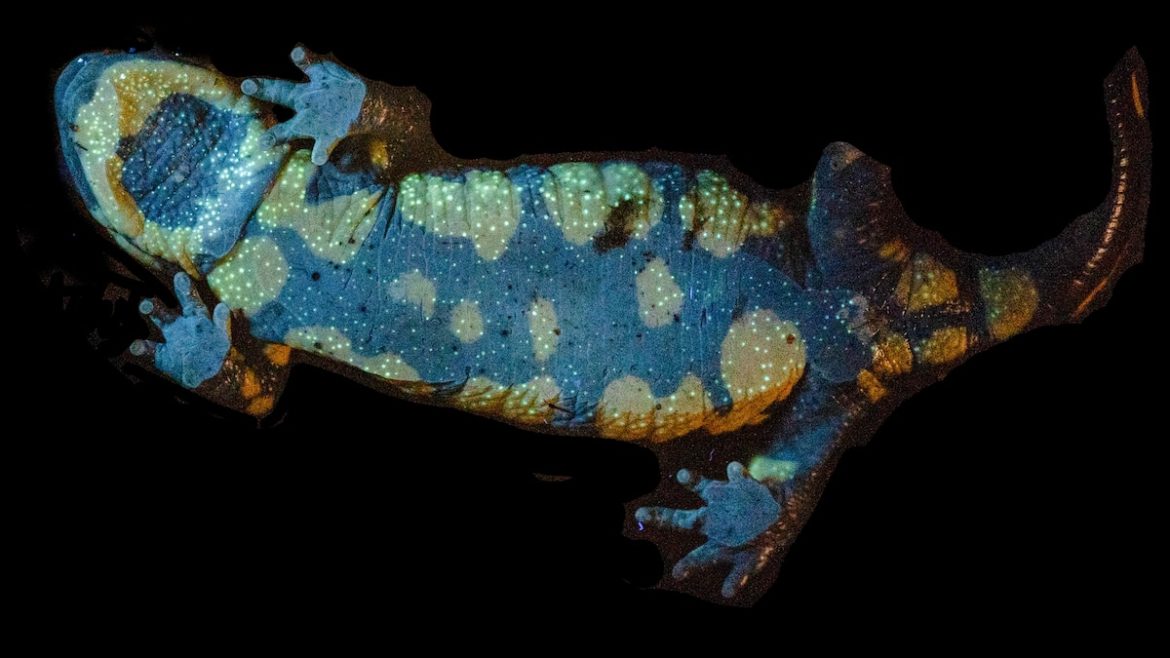
The biofluorescent fire salamander has the ability to absorb light at one wavelength and emit it at a different wavelength. Bernat Burriel-Carranza
Neon dots and glowing goo
Biofluorescence was once thought to be primarily restricted to marine invertebrates and arthropods like scorpions. But over the last two decades, new science has shed light on several groups of vertebrate animals that also reflect light at different wavelengths, including pink squirrels, platypuses, and sharks. In 2020, Lamband a colleague published the first evidence of biofluorescence in salamanders and other amphibians.
The uptick in biofluorescent amphibians inspired Bernat Burriel-Carranza, an evolutionary biologist at the Natural Sciences Museum of Barcelona and the lead author of the new study, to bring an ultraviolet (UV) flashlight with him into the field. Few of the critters he encountered had a hidden glow. But one rainy night while collecting in Spain, he tested a fire salamander that was crossing a road. “When we shone the UV light onto the animal, we could not believe how bright the fluorescence was along its flanks,” he recalls.
Burriel-Carranza was particularly surprised because fire salamanders have been in the scientific spotlight since Swedish naturalist and pioneering taxonomist Carl Linnaeus named the species in 1758. Over the centuries, researchers have studied many aspects of the salamander’s biology. Fire salamanders are also a textbook example of aposematism, a defensive strategy where toxic animals use eye-catching colors to deter prospective predators.
To examine this well-known species in a different light (literally), the team found several fire salamanders in forests in Spain and Germany. They photographed the amphibians under UV light and swabbed their skin to collect the poisonous secretions.
