
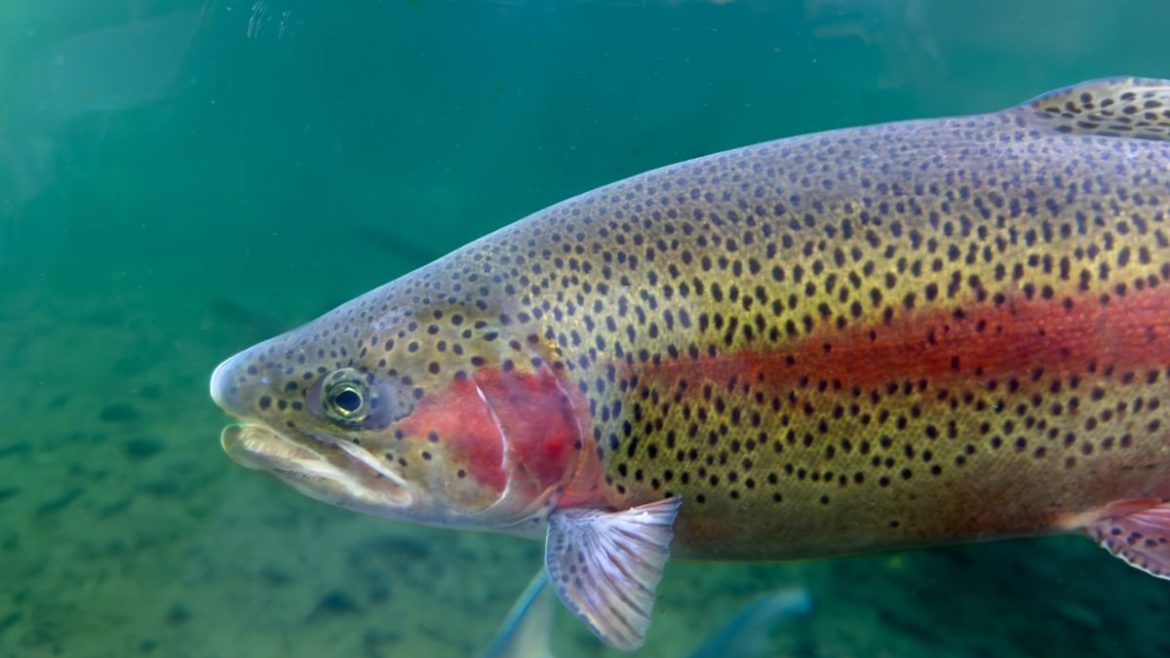
Humans have necks for a good reason: they keep our heads stable. While we can easily crane our necks and turn our heads to look around, fish and amphibians don’t have nearly the same range of motion as we do; that’s because they lack the anatomical neck of tetrapods — vertebrate animals with four limbs — that live on land. Yet, it may not be entirely accurate to say that fish and amphibians have no neck at all.
A research project recently presented at the Society for Experimental Biology conference in Florence, Italy, has begun to gather evidence to support the idea that fish and amphibians do indeed have a neck; it’s just that they don’t fit the classic definition of an anatomical neck — the bridge that connects the head to the torso in mammals and other terrestrial tetrapods.
Fish, for example, have a region of their bodies where vertebrae allow the head to move independently of the body. Redefining what constitutes a neck may grant researchers a better understanding of the unique ways fish move.
Read More: 275-Million-Year-Old Fossil With a Twisted Jaw Reveals an Unexpected Tetrapod
Rethinking Fish and Amphibian Necks
Necks in humans and most tetrapods consist of specialized vertebrae between the cranium and pectoral girdle, a bony structure that includes the clavicle (collarbone) and scapula (shoulder blade). The neck allows us to move our head three-dimensionally relative to the body and limbs.
Fish and amphibians don’t have this same anatomy, leading to the notion that they have no necks. While it’s true that they lack anatomical necks, these animals do have a region of vertebrae that can potentially function like a quasi-neck. Head movement in fish isn’t entirely limited, either. One 2021 study in Proceedings of the Royal Society B, for example, found that fish can flex up to two-thirds of their spine to lift their heads.
Studies like these — in both fish and amphibians like salamanders — have inspired researchers to rethink what a neck is.
“These findings suggest that the traditional assumption of an absent neck is not universally valid and may overlook functionally distinct anatomical regions,” said Roxana Taszuz, a postdoctoral research associate at the University of Liverpool, in a statement. “Our interest in fishes and salamanders came directly from this conceptual challenge and its broader evolutionary implications.”
Watching Salamander Spines
The new research project is taking the next steps in broadening the definition of a neck. To accomplish this, researchers are examining the morphology and function of the vertebral column across species, using X-ray videos of feeding behaviors and reconstructed 3D models to determine which vertebrae contribute to head and neck motion.
The researchers are particularly interested in how salamanders move their spines when feeding on land and underwater, which may provide insight into how these functions evolved during the transition of tetrapods from an aquatic to a terrestrial lifestyle.
A Variety of Vertebrae
Researchers are also taking a closer look at fish anatomy, using innovative tools to identify which vertebrae might help these animals move their heads.
“Studies going back to at least the 1940s have noted the vertebrae behind the head in fish can form a distinct anatomical region,” said Taszuz. “However, only recently with tools like X-ray video have we been able to show the functional neck of fish and demonstrate their ability to move the head independently from the body.”
Variation across fish species means that what could be a neck-like region in one fish may differ in another fish, depending on multiple factors. For example, a 2022 study in Ecology and Evolution found morphological differences in the internal shape of vertebrae between pelagic fish (which live in the water column) and benthic fish (which live on the seafloor).
Pelagic fish have a stiffer vertebral column that helps them excel at high-speed, continuous swimming, while benthic fish have a more flexible vertebral column that helps them quickly attack prey with rapid accelerations.
These kinds of differences hint at just how different fish “necks” may be between species.
Read More: A 113-Million-Year-Old Pterosaur Fossil Holds Chemical Clues to a Fish-and-Squid Diet
Article Sources
Our writers at Discovermagazine.com use peer-reviewed studies and high-quality sources for our articles, and our editors review for scientific accuracy and editorial standards. Review the sources used below for this article:
