
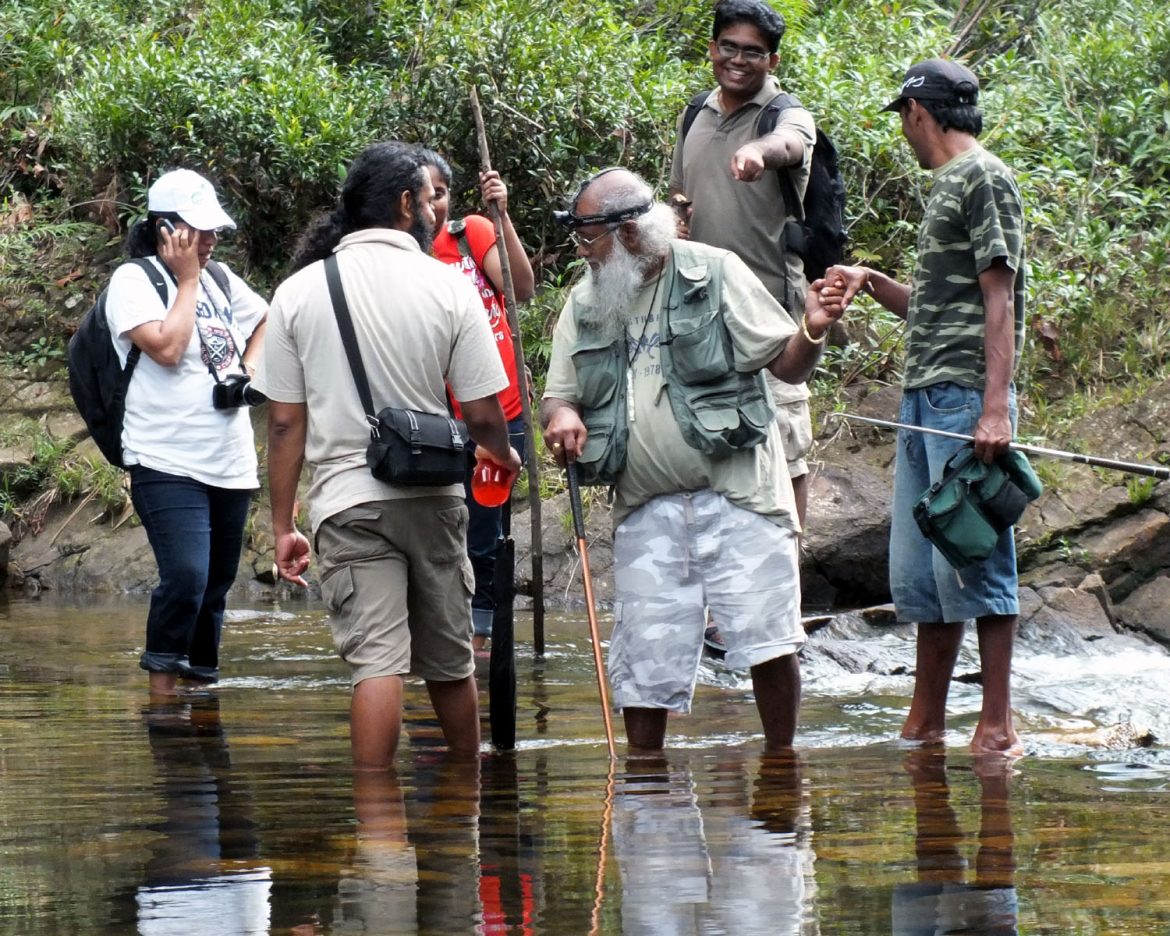
- Anslem de Silva, Sri Lanka’s pioneering herpetologist, has spent over six decades studying reptiles and amphibians while inspiring generations of conservationists through his work.
- He has authored more than 25 books and 350 scientific papers, shaping global understanding of Sri Lanka’s unique herpetofauna.
- From launching scientific journals such as Lyriocephalus to organizing international crocodile and herpetological conferences, de Silva has created platforms for research and conservation in Sri Lanka and beyond.
- At 86, he is preparing to host the world’s first ever snake conference in Sri Lanka, continuing his lifelong mission to advance snake conservation and awareness.
COLOMBO — Sri Lankan-born conservation biologist and National Geographic explorer Ruchira Somaweera is internationally recognized for his award-winning wildlife research, photography and storytelling. Despite his global achievements, Somaweera treasures an old journal copy containing a prophecy. When he was 13 years old, Somaweera received a copy of the research journal Lyriocephalus with a handwritten note which read: “One day you will be a great herpetologist,” signed by Anslem de Silva.
“Almost 30 years ago, I got hooked into herpetology after reading a series of newspaper articles written by de Silva on Sri Lankan snakes in a local science publication. Those articles inspired me to prepare a small booklet on snakes as my school science project. Most of the herpetologists of my generation were groomed by de Silva, and hundreds, if not thousands, of students have been inspired by him, just like I was,” Somaweera told Mongabay.

Anslem de Silva is widely regarded as as the father of modern herpetology in Sri Lanka, having dedicated more than six decades to studying the island’s reptiles and amphibians. His pioneering research, publications and conservation efforts have transformed scientific understanding of Sri Lanka’s remarkable herpetofauna.
Sri Lanka’s herpetofauna represents the island’s extraordinary diversity of reptiles and amphibians, including snakes, lizards, turtles, crocodiles, frogs, toads and caecilians, with many species found nowhere else on Earth. Unlike many specialists who focus on a single group, de Silva has contributed across the entire spectrum of herpetology, producing more than 350 scientific papers and over 25 books. His field guides have become essential references for generations of students, researchers and wildlife enthusiasts. Beyond his publications, he has continuously shared his knowledge through lectures, training programs, and public outreach — a commitment that continues even at the age of 86.
In recognition of de Silva’s contribution to conservation, IUCN honored him with the IUCN Sir Peter Scot Award of Conservation Merit in 2019.
De Silva spoke with Mongabay contributor Malaka Rodrigo, while guiding his team of organizers who are putting together the world’s first conference on snakes — World Snake Conference 2026 set to be held in October in the hilly city of Kandy in central Sri Lanka.
The following interview was lightly edited for length and clarity.
Mongabay: What influenced your interest in snakes and when did your fascination with reptiles begin?
Anslem de Silva: I was born in 1940 and grew up in Matara, a coastal town in southern Sri Lanka. My fascination with reptiles began during my school years at St. Servatius’ College. I rescued a rat snake [ptyas mucosa] that had been pelted with stones by senior students. I picked it up and released it into a nearby thicket. Looking back, it is interesting that I wasn’t scared, and the snake did not bite me. That experience got me hooked on snakes. After that, I reared several non-venomous snakes, a baby saltwater crocodile and a few sea turtles.

My original hometown was near the historic Matara Fort, where snake charmers often gathered. I spent hours watching them handle snakes to gather information. Through self-learning and field observations, I gradually developed my knowledge of Sri Lanka’s reptiles and amphibians.
Mongabay: You eventually became one of Sri Lanka’s leading authorities on herpetology. What was the field like when you entered it first?
Anslem de Silva: When I began studying Sri Lanka’s herpetofauna in the 1960s, there were very few people working in the field. Apart from established experts such as P.E.P. Deraniyagala, there were only three amateur herpetologists actively working in the country — Ranil Senanayake, P.B. Karunarathne and myself.
Over several decades, I am truly happy to see how the field has grown. Today, Sri Lanka has around two dozen expert herpetologists and more than three dozen beginners pursuing the study of reptiles and amphibians.
Mongabay: What prompted you to start creating opportunities for young herpetologists almost at the beginning of your career, which is somewhat rare?
Anslem de Silva: I realized that the best way to support the younger generation of herpetologists was to create opportunities for them to present their research and to exchange knowledge. I, therefore, organized the first one-day herpetological conference at the Medical Faculty of the University of Peradeniya in 1960s, with support from the Department of Wildlife Conservation (DWC). The response was tremendous.

Encouraged by its success, I organized the first three-day South Asian Herpetological Conference in 1966. Since then, I have been involved in organizing nearly 15 herpetological conferences. I also started the first Sri Lankan herpetological journal, d, providing a platform for researchers to publish and share their work.
Mongabay: You founded the Amphibia and Reptile Research Organization of Sri Lanka (ARROS), in 1990. Was there a need for an organization at that time. Wasn’t a network enough for Sri Lanka?
Anslem de Silva: There was a clear need for greater attention to amphibians, reptiles and their habitats. ARROS was established to promote research and conservation of these animals and their habitats. My work in amphibian conservation later led to my appointment as chair of the Declining Amphibian Populations Task Force of the IUCN in Sri Lanka. I currently serve as co-chair of the IUCN Amphibian Specialist Group.
Mongabay: You were also instrumental in bringing international crocodile experts to Sri Lanka in 2013. In what way was it beneficial to those with herpetological interest in Sri Lanka?
Anslem de Silva: Bringing the world’s leading crocodile experts to Sri Lanka for the IUCN Crocodile Specialist Group Working Meeting and the World Crocodile Conference in 2013 was an important milestone. It introduced a new generation of Sri Lankan researchers to the global scientific community and created opportunities for international collaboration, technical training and knowledge exchange.

Mongabay: At 86, you are now driving another major international event — the World Snake Conference 2026 in Kandy. What are you expecting from a dedicated international gathering of snake experts?
Anslem de Silva: Every four years, we have the World Congress of Herpetology, but snakes are only a small part of it. I wanted to have a conference specifically focused on snakes, because they have their own conservation needs.
The conference will bring together three IUCN Snake Specialist Groups, covering vipers, sea snakes and other snake species. I believe this will provide an important opportunity for scientists and conservationists to exchange knowledge and strengthen international collaboration.
Mongabay: What do you see as the biggest challenge facing snakes around the world?
Anslem de Silva: Fear and misunderstanding are among the biggest challenges. People who cannot identify snakes often kill any snake-like creature, because they cannot distinguish between species. Therefore, I take every opportunity to raise public awareness about snake identification through the forthcoming conference.

Mongabay: Compared to the early years, how has awareness improved in Sri Lanka?
Anslem de Silva: People now understand that although Sri Lanka has more than 100 species of snakes, only about five species can cause fatal bites. This shows the success of our awareness efforts over the years. But this needs to continue at scale.
Mongabay: You have spent decades communicating about reptiles and amphibians. But there is another side to you that most people may not know about such as being a magician? Could you please explain?
Anslem de Silva: Yes. I was a magician before becoming a herpetologist. I won several magic competitions and even published 22 papers on magic, including my first international publication in an American journal.
Communicating the value of conservation to the public is an art; a matter of good storytelling. I believe my experience as a magician helped me to reveal the true magicians of nature — reptiles and amphibians.
Mongabay: After six decades of studying reptiles and amphibians, what do you consider to be your greatest contribution?
Anslem de Silva: For me, it is not only about the species I have studied or documented. I am especially happy to see the growth of herpetology in Sri Lanka and the younger generations who are now continuing this work. Creating opportunities for researchers to meet, exchange knowledge and publish their findings has been an important part of that journey.
At 86, my passion for reptiles remains as strong as ever. There is still much to discover, and I hope the next generation will continue exploring and protecting Sri Lanka’s remarkable reptiles and amphibians.
Banner Image: Anslem de Silva has been a mentor and role model to generations of Sri Lankan herpetologists, nurturing many of the country’s leading reptile and amphibian researchers. Image courtesy of Anslem de Silva.
Cite this article
Malaka Rodrigo (2026). Inspiring young herpetologists in Sri Lanka: Interview with Anslem de Silva. Mongabay Conservation news. DOI: https://doi.org/10.66709/news-327246

