

Metamorphosis, that profound transformation enabling certain animals to shift between habitats such as from an aquatic to a terrestrial environment, is generally viewed in terms of its benefits. A team of researchers from the University of Liège has now demonstrated that it also entails a direct and immediate cost for the individuals undergoing it, a cost that varies by sex and could influence long-term evolutionary trade-offs. The study is published in the journal BMC Biology.
Paedomorphosis in the palmate newt
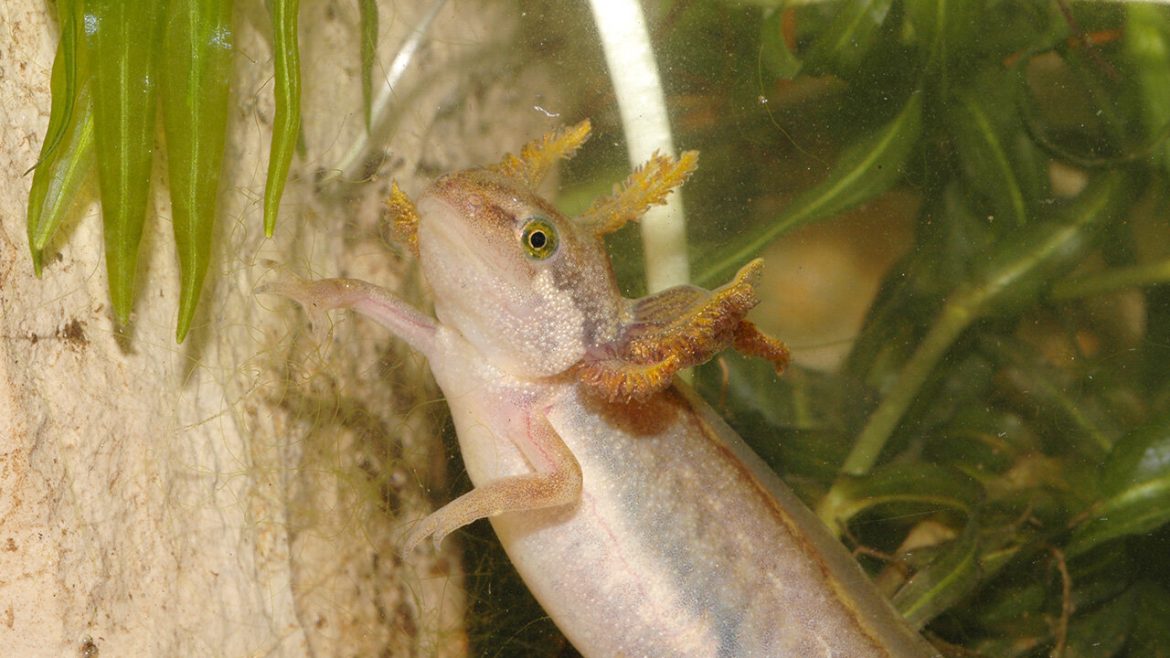
In many amphibian species, some individuals retain their gills and aquatic lifestyle into adulthood without ever undergoing metamorphosis; this is known as paedomorphosis. In the palmate newt (Lissotriton helveticus), this process is optional: depending on environmental conditions, a single individual may remain in a paedomorphic state or undergo metamorphosis.
This plasticity makes it an ideal model for studying the direct consequences of metamorphosis, as it is possible to compare individuals at the same stage of their life cycle (reproductive adults) depending on whether or not they undergo this transition.
A unique model for comparison
The team led by Prof. Mathieu Denoël, Director of the Laboratory of Ecology and Conservation of Amphibians (LECA) at the University of Liège, has taken benefit of the exceptional properties of the palmate newt (Lissotriton helveticus).
“In this species, paedomorphic adults, which have gills and are capable of reproduction, can still, under certain conditions, undergo metamorphosis,” explains Denoël. “This unique trait allows us to compare individuals at the same biological stage depending on whether or not they undergo metamorphosis, while avoiding the confounding effects associated with reproductive development that would arise when studying larval forms. Here, the individuals are already adults and capable of reproduction, which allows us to isolate the direct cost of metamorphosis.”
Experimental setup and weight loss
Eighty adult paedomorphic newts were placed in experimental conditions varying in water level and temperature, in order to induce or prevent metamorphosis and thus replicate the variations in conditions observed in the natural environment. Their weight was monitored individually over 85 days.
“The results are quite clear,” the researcher continues, “all individuals that completed metamorphosis lost a significant amount of weight, whereas those that remained paedomorphic did not experience any net weight loss.”
This loss of mass cannot be explained solely by internal physiological changes; newts approaching metamorphosis also reduce their food intake, even when food is available in abundance. The transformation process therefore involves both a costly bodily reorganization and a reduction in energy intake.
Sex differences and climate stakes
The study also highlighted significant differences between males and females. Females begin to lose weight earlier, lose more weight and complete their metamorphosis later. These results shed further light on the “male escape” hypothesis.
“If males are more frequently observed undergoing metamorphosis in natural populations, it is likely partly because this transition costs them proportionally less. Taking the sex of individuals into account is essential for understanding their developmental trajectories and population ecology,” explains the researcher.
These findings take on added significance in the face of current climate disturbances. The gradual drying up of shallow wetlands, exacerbated by droughts, is driving more and more individuals to metamorphose. However, in doing so, they lose their energy reserves, which could compromise their reproductive success in the following season.
The study therefore calls for the cost of the transition itself to be incorporated into evolutionary models that assess the trade-offs between aquatic and terrestrial life, and more broadly into analyses of the impact of global change on amphibian populations.
Publication details
Mathieu Denoël et al, The direct cost of amphibian metamorphosis: insights from body weight loss in facultative paedomorphs, BMC Biology (2026). DOI: 10.1186/s12915-026-02608-5
Provided by
University de Liege
Who’s behind this story?

Citation:
Metamorphosis in newts proves costly, with one sex paying a heavier price (2026, May 8)
retrieved 10 May 2026
from https://phys.org/news/2026-05-metamorphosis-newts-sex-paying-heavier.html
This document is subject to copyright. Apart from any fair dealing for the purpose of private study or research, no
part may be reproduced without the written permission. The content is provided for information purposes only.
