
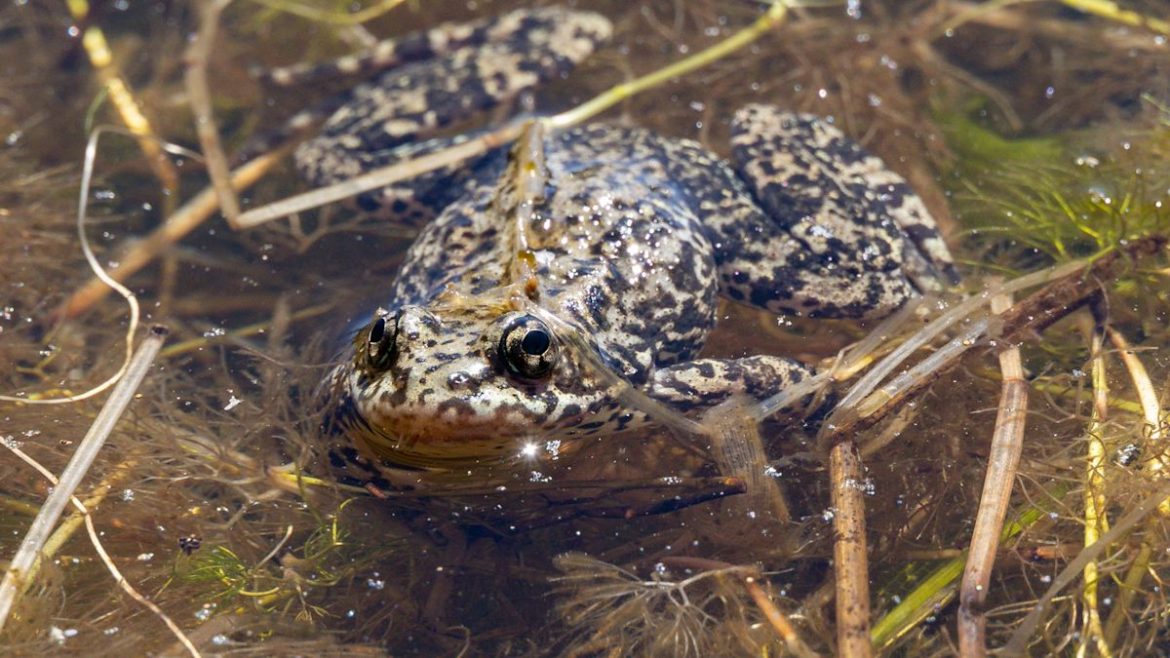
Mountain yellow-legged frogs used to be the kings of the mountain. Specifically, the Sierra Nevada mountains, where they were once the region’s most common amphibians only. But their reign has since plummeted dramatically. Now 92 percent of their historic range is void of the colorful animal.
“These frogs used to be quite abundant. In the Sierra Nevada mountains, there are reports of showers of frogs jumping as scientists walked along a lake bank, and even of it being difficult to take a step without landing on a frog,” Tali Hammond, a recovery ecology researcher at the San Diego Zoo Wildlife Alliance, tells Popular Science. “It’s hard to say when, exactly, this was last true. We know that throughout the species range, populations have been declining since the late 1960s/early 1970s.”
There are two species of mountain yellow-legged frogs: Rana muscosa, the southern mountain yellow-legged frog, and Rana sierrae, the Sierra Nevada mountain yellow-legged frog. Both species are classified as Endangered by the IUCN Red List.
Specifically, experts estimate that fewer than 200 adult southern mountain yellow-legged frogs remain in their native habitats, according to the San Diego Zoo Wildlife Alliance. The species is threatened by common menaces such as disease, introduced predators, wildfire, and drought. But the team at the San Diego Zoo Wildlife Alliance is on a mission to change all that with shocking numbers of their own, though not currently in the Sierra Nevadas.
This year, they reintroduced over 3,000 southern mountain yellow-legged frogs and tadpoles into the San Bernardino and San Jacinto mountains in California. Overall, they reintroduced more than 10,000 of the little amphibians into these high-elevation mountain habitats.

A mountain yellow-legged frog leaps into a new life. Image: San Diego Zoo Wildlife Alliance.
Ken Bohn
But the amphibians aren’t left completely on their own. Conservation teams are monitoring the frogs to keep an eye on their health, survival, and success. One of this year’s reintroduction sites is Bluff Lake in the Big Bear area (not far from a particularly famous bald eagle nest), where experts waded into the water and gently encouraged the frogs to hop out of their clear containers.
San Diego Zoo Wildlife Alliance and others have been protecting the species for 20 years, and 2026’s efforts are part of a decades-long mission to restore the amphibian’s populations across its historic range. Returning these ruling frogs to their kingdom, if you will.
“What began as a rescue effort has grown into a comprehensive conservation program focused on breeding, genetic diversity, disease management, reproductive research and reintroduction,” the zoo wrote in an e-mailed statement.
