
SINGAPORE – Reports of crocodile sightings in the vicinity of Pulau Ubin were raised in early April, but residents were unfazed by the news of the elusive reptile as they went about their daily lives.
Chinese-language daily Lianhe Zaobao reported on March 31 that some residents had spotted the reptiles in mangroves and swampy areas.
However, shopkeepers, visitors and residents in the main village told The Straits Times they have not adopted any precautionary measures nor encountered any crocodiles on the island before.
Mr Lim Chye Hee, who runs a bicycle rental shop near the jetty, said he has never seen a crocodile during his years growing up on the island and working by the sea.
“What is there to be afraid of? The crocodiles here will probably run away first when they see you,” joked Mr Lim, 70. “It’s very hard to spot crocodiles here, but maybe the fishermen or crab catchers might have encountered them.”
He added that he had not heard of any crocodile encounter from his customers, including those who went fishing around the island.
“If you see a crocodile, you’ve probably struck the lottery,” he said.
Taxi van driver Lim Cheng Tek, 68, was also sceptical about the crocodile sightings on Pulau Ubin, especially since there have been no photos or videos to back up the claims.
He had lived on Pulau Ubin for around 40 years before moving to the mainland, but regularly travels to the island. “I’ve been here for almost 70 years and I have never seen a crocodile,” he said.
When ST visited Pulau Ubin on April 21, multiple signs warning the public to be cautious of crocodiles had been erected along the coastlines of the island and near the mangroves.
Though no crocodiles were spotted that day, the National Parks Board (NParks) said in response to queries that it assesses the risk posed to public safety when reptiles are sighted around Singapore, in addition to broader measures to mitigate risks from the country’s wild crocodile population.
More recently, a crocodile was sighted near Keppel Bay on April 29, with NParks stating it was monitoring the situation and advising people to be cautious when planning water activities in the area.
Simply Science takes a look at what you need to know about Singapore’s saltwater crocodiles.

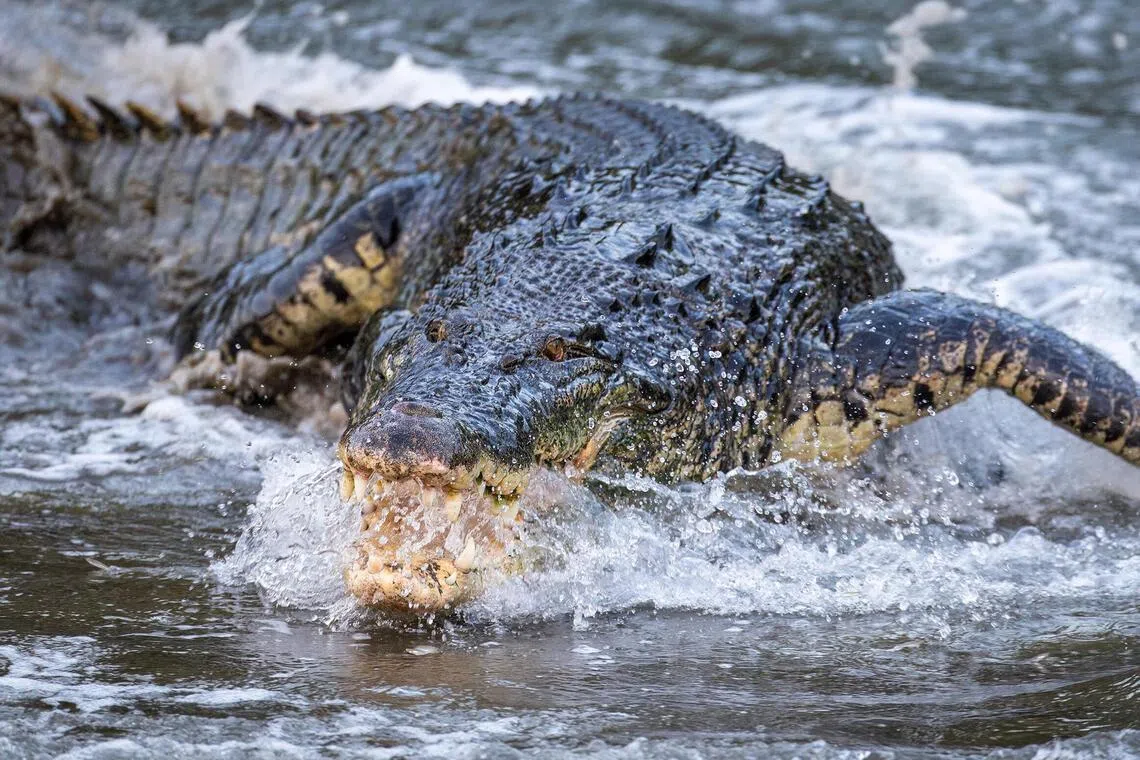
Also known as estuarine crocodiles, saltwater crocodiles (Crocodylus porosus) are native to Singapore and the only crocodile species found in the wild here.
These crocs are the world’s largest living reptiles, with adult males capable of reaching lengths of more than 6m and weighing more than 1,000kg.
Saltwater crocodiles have the strongest bite of any animal on earth, and are able to slam their jaws shut with 260kg per sq cm of force – almost 25 times stronger than humans.
They inhabit the Strait of Johor and are typically found in brackish and freshwater environments, said Mr How Choon Beng, NParks group director for wildlife management.
The saltwater crocodile inhabits mangrove swamps and river deltas stretching from India’s east coast to northern Australia, where more than 100,000 of the creatures can be found.

Saltwater crocodiles have the strongest bite of any animal on earth, and are able to slam their jaws shut with 260kg per sq cm of force.
ST PHOTO: LIM YAOHUI
It is likely that saltwater crocodiles found in Singapore are a mix of those hatched here and those that have swum here from other countries, as the reptiles can travel long distances to find suitable habitats, said Herpetological Society of Singapore (HSS) president Kannan Raja and scientific officer Law Ingg Thong in an e-mail reply to ST.
They pointed out that although saltwater crocodiles are listed as being of least concern on the International Union for Conservation of Nature’s Red List of Threatened Species, they are considered critically endangered locally in the Singapore Red Data Book.
On its website, NParks noted that crocodiles play a crucial role in regulating animal populations in Singapore’s coastal and mangrove habitats, serving as indicators of environmental health in these wetland ecosystems.
“Largely nocturnal hunters, they feed primarily on fish, though their diet may also include mammals, birds and carrion,” said NParks’ Mr How.
“As apex predators, estuarine crocodiles are stealthy and opportunistic, and are known to be capable of attacking humans.”
CrocAttack, a database of crocodile attacks on humans, reported at least 1,236 attacks by crocodiles on humans between 2015 and 2024 in Malaysia, Indonesia and Papua New Guinea. About 700 of these attacks were fatal.
The last known incident of people being killed by a crocodile in Singapore occurred in 1962, when ST reported that a crocodile was shot dead at a fishing village near Upper Serangoon Road after apparently eating two men.
The last reported attacks by crocodiles on humans here were in 1989, when a 31-year-old Thai worker was attacked by one of the reptiles at a river off Lim Chu Kang. In another incident that year, a crocodile trainer had part of his left cheek torn off by a female croc at the Jurong Reptile and Crocodile Paradise.
Still, despite their size and power, saltwater crocodiles are usually wary of humans and will go out of their way to submerge and swim away from them, said HSS.
“So a crocodile could be spotted in a place frequented by people if it has accidentally turned up there, or if it has to pass through there because other more suitable places and routes are blocked or unavailable,” the society said.

Measures taken by NParks to mitigate risks posed by crocodiles include fencing at Sungei Buloh Wetland Reserve to keep crocodiles off footpaths, as well as advisory signage near sighting locations.
ST PHOTO: JASEL POH
When crocodiles are deemed to pose a significant risk to the public, efforts will be made to trap and relocate or rehome the animal where possible, said NParks’ Mr How.
Relocation options are carefully evaluated given their strong homing instinct, he said, adding that crocodiles will be humanely euthanised in the interest of public safety if there is no suitable option.
In 2023, a wild crocodile found near Marina East Drive was culled because of its significant risk to public safety, with then Senior Minister of State for National Development Tan Kiat How explaining that relocation to Sungei Buloh was not feasible because of the reserve’s large existing crocodile population. Measures taken by NParks to mitigate risks posed by crocodiles include fencing at Sungei Buloh Wetland Reserve to keep crocodiles off footpaths, as well as advisory signage near sighting locations.
People should stay calm and back away should they encounter a crocodile, said Mr How, adding that they should not approach, provoke or feed the animal.
They can also contact NParks on 1800-476-1600 to report an encounter, he added.

