
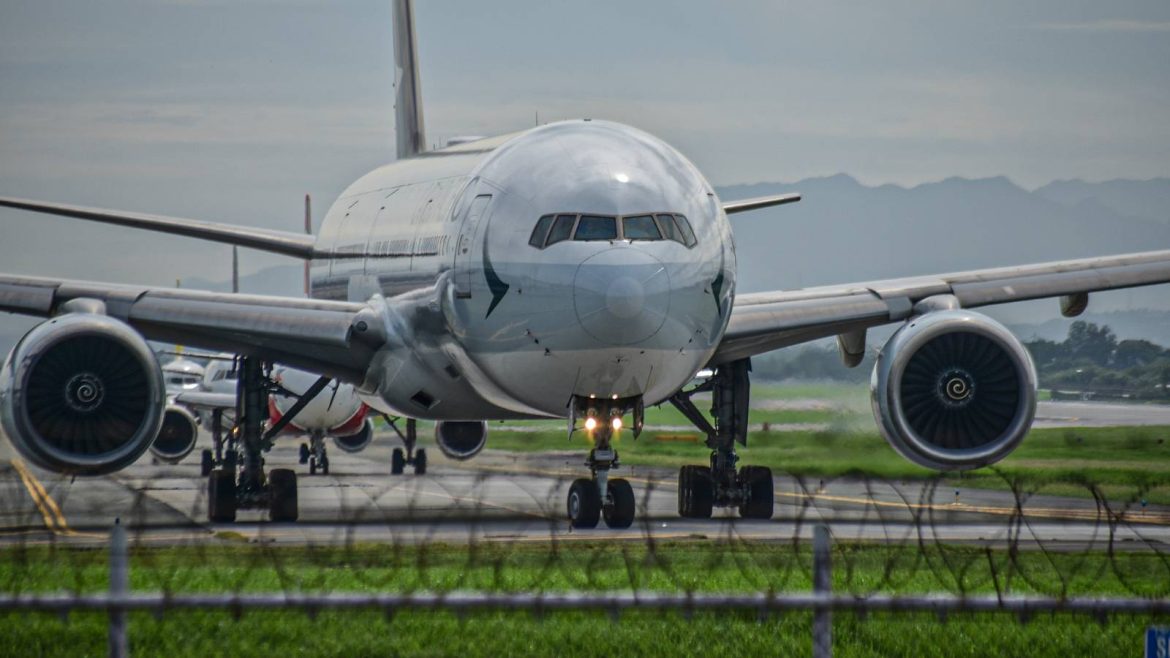
For decades, Pratt & Whitney was one of the three dominant names in large commercial aircraft propulsion. Its PW4000 family powered hundreds of widebody aircraft, including early Boeing 777s, Airbus A330s, Boeing 767s, and Boeing 747s, making it a familiar sight at airports around the world. Today, however, the competitive landscape looks dramatically different. Every new-generation passenger widebody entering service is powered exclusively by either GE Aerospace or Rolls-Royce, leaving Pratt & Whitney absent from an entire generation of flagship aircraft.
The shift happened gradually, making it easy to overlook. While public attention has focused on Pratt & Whitney’s successful geared turbofan (GTF) engines for narrowbody aircraft, the company has quietly stepped away from developing new engines for twin-aisle jets. That strategic decision has allowed GE Aerospace and Rolls-Royce to divide the modern widebody market between them, while Pratt’s once-important PW4000 business revolves around maintaining an aging installed fleet. According to industry analysis, this consolidation has effectively created a GE-Rolls-Royce duopoly across today’s newest widebody platforms, fundamentally changing airline purchasing power and long-term competition. At the same time, Pratt & Whitney’s dominance in the narrowbody engine market started to grow exponentially.
Pratt & Whitney Once Competed Head-To-Head In The Widebody Market

During the 1990s and early 2000s, airlines purchasing new widebody aircraft often had three engine manufacturers to choose from. Pratt & Whitney competed directly against General Electric and Rolls-Royce on major aircraft programs, particularly the Boeing 777 and Airbus A330, giving carriers meaningful leverage during negotiations over pricing, maintenance packages, and long-term support.
The company’s flagship PW4000 family became one of the most recognizable high-bypass turbofan engines in commercial aviation. Developed in multiple fan sizes for different aircraft types, the engine powered everything from Boeing 747-400s and Boeing 767s to Airbus A300s, A310s, MD-11s, A330s, and early Boeing 777 variants. For many airlines, the PW4000 earned a reputation for dependable long-haul operations and accumulated millions of flight hours over several decades.
Despite those successes, Pratt & Whitney never achieved the same level of market penetration on the Boeing 777 as its rivals. Fleet data analyzed by Cranky Flier shows that among the 629 Boeing 777-200, 777-200ER, and 777-300 aircraft still flying today, only 81 are powered by Pratt & Whitney engines. GE commands roughly 70% of the active fleet, while Rolls-Royce accounts for around 18%, leaving Pratt with the smallest share. That relatively weak position on one of aviation’s most successful long-haul aircraft would ultimately become an early indicator of the company’s gradual withdrawal from the modern twin-aisle engine market and a shift towards the narrowbody market.
Modern Widebodies Became A Two-Company Market

The transition to today’s generation of widebody aircraft fundamentally reshaped the competitive landscape. Rather than continuing the traditional three-way rivalry, Airbus and Boeing each selected engine arrangements that ultimately left Pratt & Whitney without a place on any newly developed passenger widebody.
Airbus chose Rolls-Royce as the exclusive engine supplier for both of its newest twin-aisle programs. The Trent XWB powers every Airbus A350 delivered since the aircraft entered service, while the Trent 7000 exclusively powers the Airbus A330neo. These exclusive agreements mean that airlines ordering either Airbus widebody have no alternative engine choice, cementing Rolls-Royce’s position across Airbus’ modern long-haul portfolio. According to industry analyses, such as EPlane’s, the Trent XWB has become one of the manufacturer’s most successful commercial engines, helping Rolls-Royce secure a dominant presence in the long-haul sector.
Boeing’s latest aircraft tells a similar story, although with greater emphasis on GE Aerospace. The Boeing 777X will enter service powered exclusively by the GE9X, an engine producing up to 134,300 pounds of thrust, making it the most powerful commercial aircraft engine ever built. Meanwhile, the Boeing 787 Dreamliner is primarily powered by the GEnx, although Rolls-Royce also supplies the Trent 1000 for part of the fleet. Pratt & Whitney is absent from both programs, meaning every new passenger widebody currently in production relies entirely on either GE or Rolls-Royce.
The implications extend far beyond engine sales alone. Airlines historically benefited from having multiple engine manufacturers competing for business, allowing them to negotiate purchase prices, maintenance agreements, spare engine support, and long-term service contracts. With Pratt & Whitney no longer participating in the newest widebody programs, that competitive dynamic has narrowed considerably, effectively reducing airlines’ bargaining power while strengthening the long-term market positions of GE Aerospace and Rolls-Royce.
Why Pratt & Whitney Chose Narrowbodies Instead

Pratt & Whitney’s absence from modern widebody aircraft was not about losing competitions. Instead, the company decided to concentrate its engineering resources and investment on a different segment of commercial aviation: narrowbody, single-aisle aircraft. That strategy centered around the geared turbofan architecture, which promised significant improvements in fuel efficiency, lower emissions, and reduced operating costs for the world’s largest airline fleets.
The geared turbofan became the exclusive focus of Pratt & Whitney’s commercial engine strategy during the past decade. Today, the PW1000G family powers thousands of Airbus A220s, Airbus A320neo family aircraft, Embraer E2 jets, and other regional aircraft around the world. Although the program has faced well-publicized durability challenges requiring large-scale inspections and engine removals, it has also positioned Pratt at the center of one of aviation’s fastest-growing markets, where airlines continue to place record orders for narrowbody aircraft. Instead of spreading development resources across multiple expensive engine programs, Pratt effectively concentrated on defending its leadership in the single-aisle segment.
That decision carried significant opportunity costs. Commercial aircraft engines generate relatively modest profits at the point of sale, with manufacturers expecting to recover their investments over decades through maintenance, repair, and overhaul (MRO) services. Industry experts frequently describe engine manufacturing as a business where aftermarket support is substantially more valuable than initial hardware sales. Missing an entire generation of widebody aircraft means forgoing not only engine deliveries, but also 25 to 30 years of lucrative maintenance revenue attached to every aircraft produced. The LinkedIn industry commentary notes that this structural characteristic explains why today’s widebody market has become strategically important despite lower production volumes than those of narrowbody aircraft.
Catch what other flight trackers miss
Emergency squawks, holds, NOTAMs — live signals, no signup.
Open tracker
Catch what other flight trackers miss
Emergency squawks, holds, NOTAMs — live signals, no signup.
Open tracker
The PW4000 Lives On Through Maintenance Rather Than New Aircraft

Although Pratt & Whitney no longer powers the latest generation of passenger widebodies, the PW4000 remains an important commercial product because thousands of engines are still in service. Instead of competing for new aircraft orders, the company’s widebody business has effectively become an aftermarket operation focused on maintenance, repair, overhaul (MRO), spare parts, and life-extension programs. This is a common transition for mature engine families, but it also highlights how dramatically Pratt’s position has changed since the PW4000’s heyday.
The installed base is still substantial. According to Market Intelo’s market research, more than 3,200 PW4000 engines remain active worldwide across passenger aircraft and freighters, supporting a global market valued at approximately $4.8 billion in 2025. Those engines continue powering Boeing 767s, Boeing 777s, Boeing 747s, Airbus A330ceos, MD-11 freighters, and several other aircraft types that are expected to remain in service for years, particularly in the cargo sector. The aftermarket surrounding these engines, therefore, remains commercially significant, even though Pratt is no longer winning positions on newly developed aircraft.
However, maintaining an aging engine family presents different challenges from launching a new one. Many airlines report difficulties sourcing replacement components for older PW4000 variants as production volumes decline and supply chains prioritize newer engine families. Rather than expanding alongside new aircraft deliveries, Pratt’s widebody business now depends on supporting a shrinking global fleet whose maintenance requirements become more complex every year. In many respects, the company is harvesting decades of prior success rather than building the next generation of long-haul propulsion.
Parts Shortages Show The Risks Of Leaving A Market

The long-term consequences of Pratt & Whitney’s strategic shift have become visible in airline operations. Supporting an aging fleet becomes more difficult as production slows, suppliers leave the program, and replacement components become harder to manufacture economically. Recent developments at United Airlines illustrate how these challenges are now affecting real-world fleet planning.
In late 2025, United retired its first Boeing 777-200, registration N777UA, after approximately 30 years of service. While aircraft retirements are routine, industry reporting linked this decision directly to Pratt & Whitney’s reduced production of PW4000 replacement parts. As maintaining older engines became much more difficult, United concluded that continuing to operate some of its Pratt-powered 777 fleet was becoming economically unsustainable.
PW4000’s Position Compared With Today’s Widebody Market
|
Engine family |
Primary aircraft |
Current production status |
Market position |
|
Pratt & Whitney PW4000 |
Boeing 767, 777 Classics, Airbus A330ceo, 747, MD-11 |
Legacy engine |
Large global MRO business with ~3,200 active engines |
|
Rolls-Royce Trent XWB |
Airbus A350 |
In production |
Exclusive engine for A350 |
|
Rolls-Royce Trent 7000 |
Airbus A330neo |
In production |
Exclusive engine for A330neo |
|
GE GEnx |
Boeing 787 |
In production |
Dominant 787 engine |
|
GE9X |
Boeing 777X |
Certification/entry into service |
Exclusive engine producing up to 134,300 pounds of thrust |
The issue extends beyond a single aircraft. Cranky Flier reported that shortages of PW4000 components forced United to reduce flying on parts of its Boeing 777 fleet because engines could not be returned to service quickly enough. Those operational constraints demonstrate an often-overlooked reality of commercial aviation: engine availability can determine fleet utilization just as much as aircraft availability. When airlines cannot obtain critical engine parts, schedules suffer, maintenance costs rise, and retirement decisions are accelerated.
How Pratt & Whitney Found Success Outside The Widebody Engine Race

Pratt & Whitney’s absence from today’s newest widebody aircraft should not be viewed as a retreat. Instead, it reflects a deliberate shift toward the fastest-growing segment of commercial aviation: single-aisle aircraft. As global airlines increasingly prioritize narrowbody fleets for both short-haul and longer “thin” routes, especially with the super popular Airbus A321XLR, Pratt positioned itself where future production volumes were expected to be the highest rather than competing for a comparatively smaller widebody market.
That strategy centered on the geared turbofan (GTF), one of the most significant commercial engine innovations in decades. The PW1000G family powers the Airbus A220, Airbus A320neo family, Embraer E-Jet E2 family, and other modern aircraft, giving Pratt & Whitney a presence across thousands of deliveries and one of the industry’s largest aircraft segments. While the GTF program has faced well-documented durability challenges that required inspections and accelerated maintenance, airlines have continued ordering GTF-powered aircraft in large numbers, underscoring the long-term confidence in the engine’s fuel efficiency and operating economics. By concentrating engineering resources on this platform instead of funding an all-new widebody engine, Pratt established itself as one of the dominant players in the narrowbody market.
The long-term outcome illustrates that success in commercial aerospace cannot be measured solely by participation in every aircraft program. GE Aerospace and Rolls-Royce now dominate the current generation of passenger widebody engines, while Pratt & Whitney has built its future around a different part of the market with far greater production volumes. As airlines continue taking delivery of thousands of new single-aisle aircraft over the coming decades, Pratt’s strategic bet on narrowbodies positions the company to benefit from decades of engine deliveries and aftermarket revenue. Pratt & Whitney chose to focus where it believed it could create the greatest long-term value, instead of competing head-to-head in every segment. This strategy has reshaped its role in commercial aviation rather than diminished it.
