
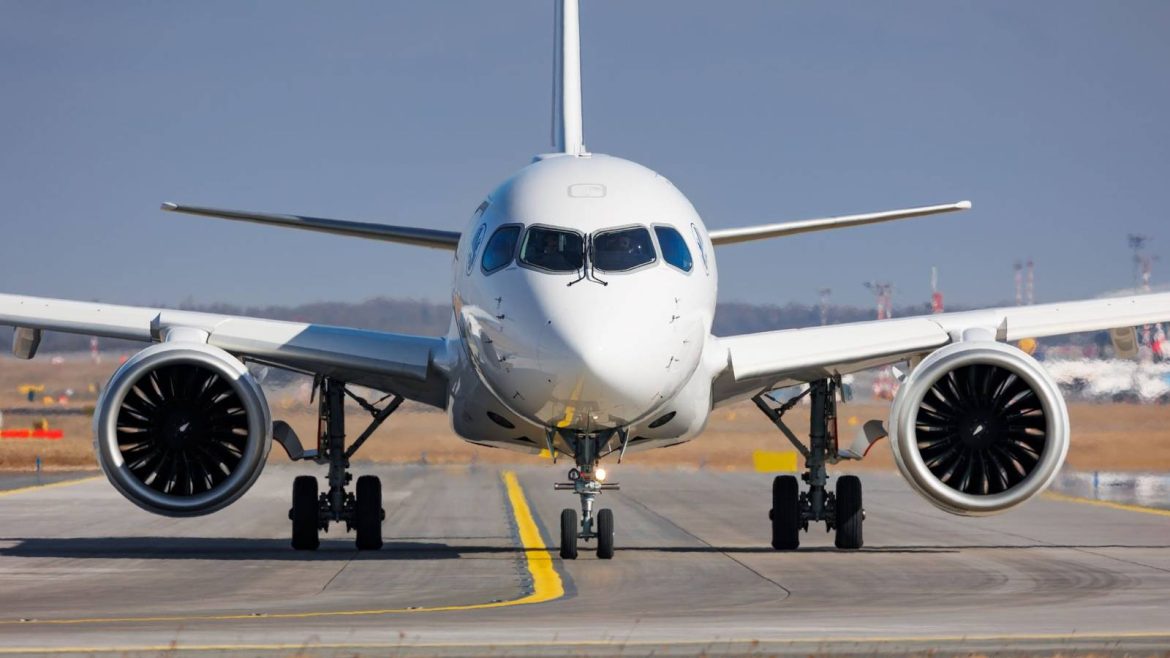
For much of this year, industry attention has focused on the possibility of Airbus unveiling a stretched version of its A220 family, informally known as the A220-500. The aircraft is widely viewed as the next logical step in the evolution of Airbus’ smallest jetliner family, potentially offering seating for around 175–180 passengers while bridging the gap between today’s A220-300 and the larger Airbus A320neo. Yet despite growing anticipation, Reuters insiders report the manufacturer appears reluctant to commit to a formal launch timetable.
The hesitation comes at a time when the A220 program itself is reaching important milestones. Airbus has now delivered more than 500 A220 aircraft worldwide, while the family has accumulated well over 900 firm orders from airlines and leasing companies. Even so, the manufacturer continues to face pressure to improve profitability, increase production efficiency, and navigate ongoing supply-chain and engine-related challenges before taking on another major development project.
Airlines Want More Seats, But The Details Matter

The proposed A220-500 is attractive because it would allow airlines to carry roughly 15–20% more passengers than the current A220-300 while preserving many of the aircraft’s efficiency advantages. Industry estimates suggest the stretch could reduce operating costs per seat by about 10%, a meaningful benefit for carriers seeking to maximize profitability on busy short and medium-haul routes.
However, adding seats is only part of the equation. Several airlines are closely examining whether a larger A220 can maintain the range and operational flexibility that have made the existing family successful. For network carriers, performance limitations could restrict route options and reduce the aircraft’s appeal despite lower unit costs.
Another consideration is the aircraft’s position within Airbus’ own lineup. A220-500 capacity would move closer to the lower end of the A320neo market, creating questions about product overlap. Some leasing companies remain cautious because a new model could affect residual values of existing A320 family aircraft, which represent a substantial portion of global narrowbody leasing portfolios. Aviation analyst Rob Morris told Reuters:
“Airlines are possibly sold on the economics, but not necessarily the performance.”
Airbus Still Has Work To Do Before Expanding The A220 Family

Although the A220 has become one of the most popular aircraft in the 100–150 seat category, the program has not yet reached the financial performance Airbus originally envisioned. Since taking control of the aircraft from Bombardier in 2018, Airbus has invested heavily in production improvements and supplier negotiations aimed at reducing manufacturing costs. Industry analysts have long argued that higher production volumes are essential if the program is to consistently generate healthy margins.
Production growth has proven more difficult than expected. Airbus previously targeted an A220 manufacturing rate of 14 aircraft per month, but later revised that objective to approximately 12 monthly units as suppliers struggled to keep pace with demand. Engine availability and component shortages have continued to affect delivery schedules across the industry, creating additional pressure on manufacturers and airlines alike.
Catch what other flight trackers miss
Emergency squawks, holds, NOTAMs — live signals, no signup.
Open tracker
Catch what other flight trackers miss
Emergency squawks, holds, NOTAMs — live signals, no signup.
Open tracker
The company’s broader commercial aircraft business is performing strongly, with Airbus targeting around 870 deliveries in 2026, up from 793 in 2025. However, executives appear focused on stabilizing existing programs before committing resources to a new variant. As it stands, insiders have indicated that Airbus is exploring a more straightforward ‘cabin stretch’. This approach would leave the aircraft subject to some performance limitations.

Why The Airbus A220 Is Becoming One Of The Most Profitable Narrowbodies In North America
Airbus is on the rise again, this time with its acquisition A220 program, where airlines across North America are realizing its potential.
Long-Term Demand Suggests The A220-500 Is Still Likely

Despite the uncertainty surrounding timing, market demand for a larger A220 remains evident. Airbus began actively discussing the concept with airlines and leasing firms earlier this year to gauge support and potentially secure sufficient commitments to make a launch decision. The initiative reflected growing confidence that a stretched variant could attract significant interest across multiple regions.
One of the strongest endorsements came from AirAsia, which placed a firm order for 150 A220 aircraft and secured options for an additional 150 A220-500s should Airbus proceed with development. The airline has publicly stated that it would be prepared to become the launch customer for the larger model, highlighting the level of confidence some operators have in the concept.
For Airbus, the challenge is no longer proving that airlines want the aircraft. Instead, the company must determine whether current market conditions justify launching it now. With a commercial aircraft backlog reaching 12 years of production and demand for efficient narrowbody jets remaining strong, many analysts believe the A220-500 remains part of Airbus’ long-term roadmap. The latest signals suggest the manufacturer is postponing a decision rather than abandoning the project.
