
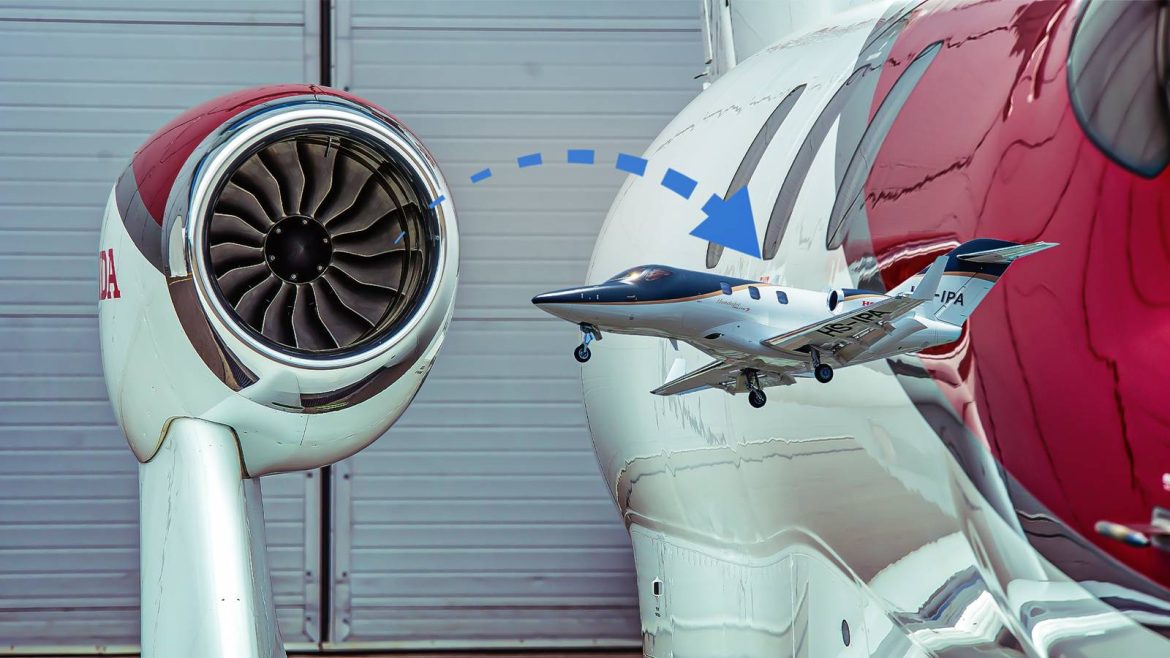
The typical business jet in 2025 has its engines mounted high at the rear of the fuselage. Simply put, the idea behind this position is to preserve smooth airflow over the wings for aerodynamic lift. The HondaJet, however, breaks the mold with its innovative Over-The-Wing Engine Mount (OTWEM).
Typical private jets require large support structures inside the fuselage for the rear-mounted engines. With the HondaJet’s engines placed above the wings, these supports are eliminate and deliver a more spacious cabin area.

Separating the engines from the fuselage also has added benefits like reducing the noise and vibration in the cabin, giving passengers a quieter and more comfortable ride.
The OTWEM arrangement also has an aerodynamic benefit. At high speeds, airflow over the wing can create shockwaves. By putting the engines in the slower airflow, those shockwaves and drag is minimized. This allows for higher cruise speeds and improved fuel efficiency.
In October 2024, the Honda Aircraft Company received a special sustainability award:

Honda Aircraft Company has been recognized with Tier-6 Sustainable Flight Department Accreditation by the National Business Aviation Association (NBAA) in the Flight category. This Tier-6 accreditation is the highest level of recognition offered by the NBAA…”
Natural Laminar Flow (NLF)
Laminar airflow occurs when the boundary layer over a surface – like a wing – remains smooth, resulting in lower skin drag compared to the turbulent airflow. To harness these benefits at high speeds, Honda shaped the nose and wing following the Natural Laminar Flow (NLF) design.
Design elements on both the wings and nose are shaped to minimize the turbulent airflow, improving air speed and fuel efficiency over its competitors.

The HondaJet design carefully minimizes rivet and other surface protrusion to avoid airflow disruption. Integrally machined aluminum skin on the wings mitigates most. This approach delivers a smoother external surface and helps maintain laminar airflow.
The HondaJet’s fuselage employs robust yet lightweight carbon composites. To create the airframe, Honda developed a unique process that integrally co-cures two panel types into a single structure – honeycomb sandwich panels and stiffened panels.

This approach minimizes overall weight and enhances stiffness while contributing to an appealing exterior appearance. Thanks to integral carbon composites, the HondaJet airframe maintains structural integrity under all conditions, allowing higher operating altitudes.
At high altitude, the atmosphere thins and cabin pressurization becomes an important feature. The interior air expands outward in the low-pressure environment and the fuselage experiences great stress which is why the strong and light fuselage structure is very valuable.
The thinner air at high altitudes reduces drag, enabling faster air speeds and smoother flight because it avoids most turbulence. A lighter airframe further boosts fuel efficiency and provides notable performance gains at all altitudes.
The ultra-compact, lightweight and high-performance HF120
The HondaJet uses two HF120 engines from GE Aerospace in a design that balances compact size with powerful thrust output. In terms of sustainability, the HF120 meets or exceeds all emissions limits set by the Committee on Aviation Environmental Protection (CAEP). The same is true for its noise levels compared to the Code of Federal Regulations (CFR) Part 36 Stage 4.
Despite measuring only about 53.8 cm at its widest point, the HF120 produces a very high thrust output. This powerful yet lightweight power plant is a core element of how the HondaJet achieves its flight speed and fuel efficiency.

According to GE Honda Aero Engines, “Two of the world’s most respected names in propulsion have come together to design and manufacture engines for the next generation of very light jets. The joint venture, known as GE Honda Aero Engines, combines the strengths of two industry leaders recognized for delivering high performance and reliability.”
Mounting the already low-noise engines away from the fuselage also helps ensure a quiet cabin interior, elevating passenger comfort beyond standard business jets.

Examined: 6 Different HondaJet Variants
The small provate jet by Honda has various evolutionary variants.
Avionics and cabin technology
HondaJet incorporates a refined cockpit designed for single-pilot flying, complemented by a cabin that delivers great comfort and relaxation in flight. The cockpit’s layout prioritizes ergonomic and human-factor points, offering the pilot ample space.

The excerpt from JAL’s charter page paints a picture: “The cabin space is the largest in its class among small aircraft. The seats have ample seat pitch even when seated facing each other, and passengers can move smoothly when boarding and disembarking or when getting up to go to the toilet.”

The HondaJet has a large windshield for optimized visibility, and efficiently positioned instruments and control interfaces. The superlight jet has a Full Authority Digital Electronic Control (FADEC) system for better efficiency and reduced pilot workload.

Equipped with the Garmin G3000 all-glass cockpit, the flight deck has three 14-inch high-resolution displays and dual touch-screen controllers. The avionics suite, combined with the cockpit’s layout, delivers an ideal single-pilot flying experience.
Beyond efficiency, the HondaJet’s cabin provides features like fully adjustable executive seating, a private lavatory, and a thoughtfully crafted interior design. The small jet caters to travelers looking for a comfortable, efficient and convenient space while they soar through the sky.
What Is The Cost Of A HondaJet Elite Business Jet?
The HondaJet is a popular very light business jet.
Historical Progression and Milestones
Honda’s path to launching the HondaJet spanned decades, beginning with conceptual studies. The development of this unique aircraft be outlined in the milestones below:
1986 – Early Research Initiation
Honda began studying small aircraft design at its Fundamental Technology Research Center, adapting manufacturing approaches used in automobiles for aircraft.
1993 – First Experimental Flight
Engineers produced a six-seat jet aircraft, the MH-02, which offered a foundation for advanced aerodynamic testing.
1997 – OTWEM Conceptual Breakthrough
Michimasa Fujino changes the course of the HondaJet with his idea for the Over-The-Wing Engine Mount (OTWEM).

As quoted on GE Aerospace, “I still have my original sketch of our business jet,” said Michimasa Fujino, the aeronautical engineer, inventor, and founding president and CEO of the Honda Aircraft Company.
“The idea came to me in the middle of the night. I couldn’t find any paper, so I grabbed a calendar, tore the cover off and drew them on the back cover.”
2003 – Successful Proof-of-Concept Flight
The HondaJet with its HF118 engines makes its first flight.
2005 – Public Reveal at EAA AirVenture Oshkosh
An enthusiastic reception by aviation communities and potential customers. Deposits were offered, spurring momentum for commercialization.
2006 – Creation of Honda Aircraft Company
Corporate leadership established a dedicated aviation subsidiary in Greensboro, North Carolina – Honda Aircraft Company.
As the the HondaJet Elite II, the newest model of Honda Aircraft Company’s award-winning and innovative very light jet, rolled out in 2024 it also wont the distinction of being named the “Coolest Thing Made in NC.”
2015 – FAA Type Certification
After submitting extensive documentation (estimated over two million pages), the HA-420 received official approval.
2018 – HondaJet Elite Introduction

In 2024, HACI reached a major milestone when Michimasa Fujino became the first Japanese person to receive the American Institute of Aeronautics and Astronautics (AIAA) Daniel Guggenheim Medal.
Since 2015, HondaJets have been delivered to North America, Europe, Latin America, Southeast Asia, China, the Middle East, India, and Japan. A total of 250 aircraft have been delivered as of February 2024. No other aircraft with Over-The-Wing Engine Mount technology has been brought to market to compete with the HondaJet yet.
Engine Collaboration with GE
Honda’s foray into aircraft engine production led to the establishment of GE Honda Aero Engines. According to GE Honda Aero Engines, Honda and GE Aerospace‘s joint engineering has resulted in the next generation of lightweight, affordable, and efficient jet engines for the business class.

This joint venture began in 2004, leveraging Honda’s small engine expertise and GE’s extensive aviation engine experience. The HF120 turbofans integrate a sophisticated compressor and advanced materials in the hot section, keeping weight down and performance high.
Engineers balanced fan diameter with drag concerns, focusing on rapid spool-up times and minimal thrust loss with altitude gain. The HF120’s high pressure ratio helps preserve climb performance.
According to flight tests, the HondaJet can climb higher than commercial airline traffic within a few minutes, avoiding congested flight levels. This capability provides operational benefits for business missions, allowing for more direct routings and cutting travel time.
Technical Specifications and Performance
According to the Honda Aircraft Company, the HondaJet itself offers the best fuel efficiency in its class. The active fleet currently surpasses 250 delivered units worldwide, covering North America, Europe, and parts of Asia. Here are a few of the key figures for the revolutionary light jet.
HondaJet specs
- Overall length: 42.6 ft (12.99 m)
- Wingspan: 39.8 ft (12.12 m)
- Height: 14.9 ft (4.54 m)
- Cabin length: 17.8 ft (5.43 m)
- Cabin width: 5.0 ft (1.52 m)
- Cabin height: 4.8 ft (1.47 m)
- Maximum cruise speed: 483 mph (422 knots)
- Maximum range: 1,643 mi (2,661 km)
- Cruising altitude: 43,000 ft (13,106 m)
With the release of the latest and greatest, HondaJet Elite II, the official statement reiterates: “Honda Aircraft continues to be committed to improving lives through personal mobility, while living in a sustainable society.”
