
A pair of U.S. Air Force F-16s tears into the afternoon sky on June 4, 2023, streaking southwest from Joint Base Andrews. They’ve just scrambled from the southern Maryland air base, taking to the skies just before 3 p.m. on a hunt for a suspicious civilian jet.
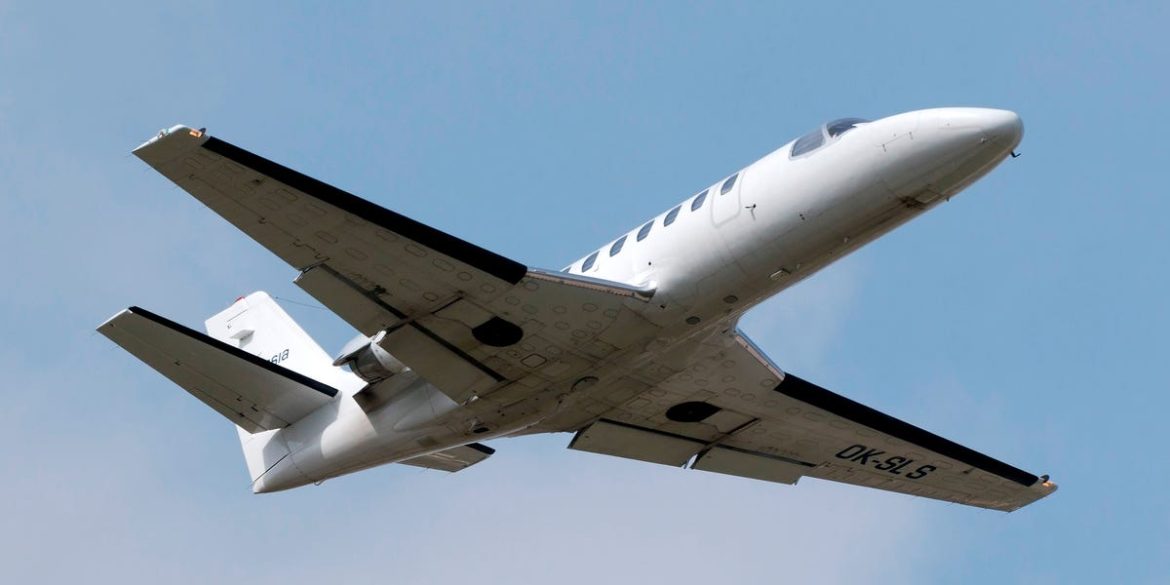
The intruder is a Cessna Citation 560, a 41-foot-long, two-engine business jet, tail number N611VG. The Citation departed from Elizabethton, Tennessee, bound for Long Island’s MacArthur Airport. Instead of landing there, the aircraft abruptly turned around over its destination, still at 34,000 feet, and began flying on a high-speed, southwest heading.
Air traffic controllers haven’t been able to reach the Citation by radio since 1:30 p.m., and the cockpit is still silent as the business jet crosses over Washington, D.C., more than an hour later. A crisis is unfolding in the air over Virginia, and it’s unclear whether it poses a national security risk. A private airplane could be used as a terroristic weapon, spraying chemical or biological weapons or crashing into buildings. On the ground, officials worry that a suicidal pilot with a political grievance or violent delusion could put passengers and residents of the city below at deadly risk.
A large swath of D.C. is designated as a Federal Aviation Administration (FAA) no-fly zone, but only up to 18,000 feet. The Citation is flying well above this declared protective dome at a steady 34,000 feet. Still, with no radio contact, Capitol police have put the entire building complex on elevated alert until the Citation passes overhead.
With F-16s en route, officials on the ground search for clues. They learn that the Citation is being flown by 69-year-old Jeff Hefner. They also find that it’s owned by John and Barbara Rumpel, whose company, Encore Motors, purchased it two months earlier. On board is the couple’s daughter, luxury real-estate broker Adina Azarian, 49; her 2-year-old daughter, Aria; and family nanny Evadnie Smith, 56.
As tense minutes pass, it appears that the Capitol is safe, but there’s still a jet mysteriously imperiled as it soars southward along the Eastern Seaboard. The only ones who can reach the errant business jet to intervene are Air Force National Guard pilots.
In addition to the two F-16s from Joint Base Andrews responding to the Citation, another pair of F-16s, from the more distant Atlantic City Air National Guard Base, are also on the way. The jets continually receive radar information about the Citation from the Eastern Air Defense Sector, gathered from military and civilian ground-based radars. As the fighters approach D.C., the Citation is still 100 miles in the distance and flying away from them.
To catch up, the pilots go supersonic. While flying over the capital, two jets engage their afterburners, and the pilots feel 29,000 pounds of thrust pushing them into their seats. The Air Force won’t share the timeline of this interception, citing operational security. But people tend to notice fighter jets blasting through the sound barrier. As the noses of the jets cut through the air at more than 700 mph, they create shock waves that bring sudden air pressure changes when they combine and sweep across the ground.
Just after 3 p.m., a sonic boom rattles thousands of residents below. “Felt in in [sic] the eastern DC suburbs,” Leo Shane, deputy editor for the Military Times, posts on X (formerly Twitter) that afternoon. “Thought a truck hit my house.”
The first fighter jets reach what appears to be the business jet at around 3:20 p.m. The pilots take a moment to confirm that the aircraft’s course matches the ground radar data delivered by the Eastern Air Defense Sector. Even from a distance, it’s recognizable as the Citation they’ve been chasing—a low-wing monoplane design with a T-tail. The Citation isn’t responding to the F-16s’ shortwave radio calls on frequency 121.5 any more than it did air traffic controllers’ long-range attempts.
Now the F-16s move into position for a close look. (U.S. military officials declined to identify the pilots by name or call sign.) One fighter drops menacingly behind the Citation as the other pulls parallel to the jet, matching its speed and heading. The plane’s registration number is visible. This is indeed N611VG.
A passing visual inspection reveals no signs of airframe trouble: no holes, missing windows, or doors. There’s no frosting on the passenger windows, and the shades are open—there’s no smoke or water vapor swirling in the air inside. The lead F-16 aligns its cockpit with the Citation’s, looking for a response from inside. An intercepted aircraft is supposed to rock its wings to acknowledge that they’re aware of what’s happening. But the business jet’s wings remain still. The F-16 pilots can see the Citation pilot slumped in his seat, dead or unconscious. From the doubled-over position, it’s impossible to tell if he’s wearing an oxygen mask or radio headset.
Whether the pilot is alive or dead, the business jet is not under human control and may have been flying that way for more than an hour. Its arrow-straight flight path supports the idea that the jet is on autopilot; the sharp turn for home over Long Island likely was instigated by the flight control computer. In the absence of any other prompts, the autopilot has apparently taken control and is steering the plane back to Tennessee as the pilot had previously programmed.
There’s also no sign of motion from passengers—and who wouldn’t peer out the windows to gawk at the warplanes if they could? An incapacitated pilot could be a sole medical emergency, but an entirely silent airplane hints that the aircraft suffered from a decompression that disabled everyone on board.
A pinhole leak in the fuselage or a worn door seal can cause such a subtle decompression, with effects that would sneak up on everyone on board. The lack of pressure at 35,000 feet would sap the passengers’ and pilot’s lungs of their ability to process oxygen, clouding their judgment and eventually knocking everyone unconscious. The condition is called hypoxia, and it can be fatal after six minutes.
Hypoxia is a well-known killer. In 1999, professional golfer Payne Stewart and five others died when a Learjet depressurized, flew off course for four hours, and crashed in a South Dakota field. In 2005, a Helios Airlines 737 crashed in Greece, killing 121; a pressurization panel had not been reset after a ground inspection, incapacitating the pilots. Nine months before this 2023 disaster in Virginia, an incommunicado Citation II crashed in France and killed all four on board, with hypoxia being the most likely cause.
In late 2025, Aviation Week counted 21 fatal U.S. general aviation (i.e., not military or commercial airline flight) accidents related to hypoxia since 1999. Most of them involved slow leaks, not dramatic decompressions, caused by routine things like a loose door seal or untightened valve. The lack of warning signs makes this a dangerous possibility—if the pilot of N611VG is hypoxic, there’s little to be done to wake him.
Desperate, the F-16 pilots try to snap the Citation’s pilot awake anyway. The lead F-16 surges ahead, making a sharp climbing turn as close as 500 feet from the business jet. One thumb works the Countermeasures Management System button to manually trigger the F-16’s intensely bright anti-aircraft flares, which were developed to thwart enemy heatseeking missiles. Sparkling streaks of light arc through the air. The F-16 pilot then peels away, hoping the Citation follows. But the civilian jet remains on course, unresponsive.

Two F-16s from the 121st Fighter Squadron, fly over Washington, D.C. The jets, based at Joint Base Andrews in nearby Maryland, are equipped for both air-to-air and air-to-ground operations, providing rapid defense of the U.S. capital and surrounding areas.
Now comes the hard choice. The U.S. military is authorized to shoot down unresponsive aircraft, especially if they violate national security airspace or threaten people below. All civilian pilots know an interception is serious business. “If subjected to a military intercept, it is incumbent on civilian aviators to understand their responsibilities,” the FAA writes in its official air traffic procedures. “Noncompliance may result in the use of force.”
But the Citation is no longer over the capital and is traveling over largely unpopulated terrain. When it runs out of fuel, it should crash into an empty patch of Virginia’s Blue Ridge mountains. There’s little downside to hoping the Citation’s pilot will miraculously wake up and save the lives of himself and the three passengers.
The F-16 pilots try to reach the pilot until the business jet’s engines begin to fail. The autopilot tries to hold altitude and keep the plane on course. When this becomes impossible, the Citation begins a sharp, spiraling descent.
The first report to the Virginia State Police of an airplane crash in the forest outside the town of Montebello arrives at 3:50 p.m.
Rescue teams launch a search even as details of those in jeopardy develop. It takes four hours for a team of local police and firefighters to locate the crash. As feared, there are no survivors. It’s now up to investigators with the National Transportation Safety Board (NTSB) to piece together exactly what happened.
Being on the duty rotation as part of an NTSB “Go Team” is to live with uncertainty. There’s no warning of when or where an airplane will crash, making advance planning hard to do. Go Teams, made of specialists from various aviation disciplines, typically only prepack the field gear they know they’ll need no matter what the circumstance: steel-toed boots, eye protection, and hard hats.
From the first glimpse of the Cessna Citation’s remains, the NTSB investigators know the odds of an easy explanation are against them. The mountainous region is challenging enough, logistically. But even worse, judging from the depth of the crater, the pattern of broken tree limbs, and the compact debris field, the airplane nosedived into the ground and then burned. One engine, nearly intact, rolled 100 feet downhill from the scorched ground. Otherwise, the crash obliterated nearly every piece of physical evidence.
The airplane was not equipped with a flight data recorder, but its cockpit voice recorder, which is mandated by the FAA, is missing, presumably immolated. Without it, investigators don’t have a definitive view from Hefner’s seat, illuminating when he may have lost consciousness and why.
The pilot’s experience is beyond question. Hefner started flying as a crop duster, 40 years before his fatal flight, and went on to fly Boeing 737s for Southwest Airlines. He retired after 25 years of airline captaincy but maintained a commercial pilot’s license, which required regular medical checks. FAA investigators in their final report will include records from his last primary-care visit, about four months before the accident. Hefner was prescribed a few medications, none of which are considered impairing or would have precluded Hefner from flying. The crash’s intensity makes any autopsy or postmortem toxicology testing impossible, but the pilot’s medical history seems unlikely to have factored into the crash.
While medical examiners look into the health of the Cessna pilot, NTSB investigators turn to the plane itself, where they find further evidence pointing to hypoxia. According to the plane’s maintenance records, disclosed in the FAA’s final report on the crash, five maintenance items were overdue on the date of the accident. Most notably, a mechanic making avionics repairs in the cockpit on May 10 noted that the pilot-side oxygen mask was not installed.
At 34,000 feet, unless an aircraft has a pressurized cabin, humans get giddy with hypoxia, pass out, and can eventually die. Without an emergency cockpit oxygen tank, there wouldn’t be much Hefner could do even if he’d recognized that he was suffering from hypoxia. He’d only be able to try a quick emergency descent before passing out. That is, if oxygen deprivation even enabled him to think clearly. At that altitude, according to the FAA, dangerous effects of hypoxia would cloud Hefner’s judgment within a minute. There is no radio message or telltale altitude change to indicate that he recognized any danger.
The NTSB issues an “Aviation Investigation Final Report” in May 2025. In the report, the NTSB “determines the probable cause(s) of this accident to be: Pilot incapacitation due to loss of cabin pressure for undetermined reasons. Contributing to the accident was the pilot’s and owner/operator’s decision to operate the airplane without supplemental oxygen.” The lack of physical forensics limits investigators’ ability to determine what might have caused the plane’s depressurization.
“Okay, we’re at 25,000 feet.” The voice of Glenn King arrives over the helmet’s intercom, interrupting the rhythmic noise of my own breath inside an oxygen mask. “Take off your masks and start your hypoxia worksheet.”
To better understand the effects of hypoxia, I’ve traveled to the National Aerospace Training and Research Center (NASTAR) in Southampton, Pennsylvania, which provides simulations for companies paying for extra safety training. Inside the compound’s hypobaric chamber, five commercial pilots are undergoing testing with me. King, the director of training here, has sealed us in a steel box to experience being inside a slowly depressurizing airplane at altitude.
Despite the role hypoxia plays in aviation fatalities, the FAA only requires pilots flying above 25,000 feet to get classroom training on hypoxia risks (though it does offer optional training at a facility in Oklahoma, using hardware built by NASTAR). That only goes so far, argues King. “You don’t know your symptoms until you experience them,” he says. “These accidents are preventable.”
Inside NASTAR’s chamber, oxygen is being pulled from the air to simulate what pilots would experience flying at 25,000 feet. King directs us to remove our oxygen masks and then start on a problem-solving worksheet he’s given us. It’d be easy work for a fifth grader: basic math, followed by a word-match game and a couple of mazes.
A minute later, a monitor on my finger shows that the oxygen level in my blood has already dropped 13 percent. I feel like I am breathing fine as I pencil in an awkward path through a maze. But the chamber’s low pressure won’t let the oxygen pass through the cellular lining of my lungs. Hypoxia is setting in and making me dopey. On one of the math questions, I write that 35 divided by 7 is 7.
The next thing I remember, I’m busy looking for my pencil. The safety officer has it and he’s looking at me with clinical amusement. That’s when I realize the mask is back on my face, pressurized air again feeding my oxygen-deprived body. I don’t remember putting it there. The last reading of my blood oxygen-saturation level that I recorded, after five minutes off-mask in the chamber, was 70 percent. NASTAR’s chart of hypoxia impairment for 25,000 feet starts a “critical stage” at 69 percent—and that’s the part that includes cardiovascular collapse, circulatory failure, convulsions, and death.
I was on the way to passing out and dying, with no clear memory of it happening. That’s how hypoxia murders—soft, easy, and final. Pilots are supposed to represent the last resort in an emergency, but when it comes to hypoxia, the human body is the weak link.
Aviation manufacturers have recognized this and are developing avionics with automatic emergency descent and landing systems to thwart a hypoxic disaster.
On December 20, 2025, a Beechcraft Super King Air took off from Aspen, Colorado, when it experienced a rapid decompression while climbing through 23,000 feet. The two pilots donned oxygen masks and, to be extra safe, engaged the airplane’s automatic landing system, which worked as if the pilots were incapacitated. The flight software communicated automatically with air traffic control and navigated the stricken airplane to a runway at Rocky Mountain Metropolitan Airport. Garmin, which makes the safety system, confirmed that the event was the first real-world activation of its Autoland feature. Had the Cessna Citation that crashed in Virginia been equipped with such a system, it might have returned safely to Tennessee.
This may be a glimpse of the future of aviation safety, but the high costs mean it could be decades before this lifesaving technology is broadly adopted. Until tools like Garmin’s Autoland become ubiquitous, it still falls on the pilots inside cockpits to recognize the first signs of a potentially deadly condition.
Every airplane flight may be a celebration of human ingenuity, but they are also direct challenges to the planet’s complex environment, brief invasions into places our species has not evolved to handle. Like Icarus of Greek myth, the higher people go, the bigger the risk. And every so often, like 34,000 feet over Virginia in 2023, human frailty reasserts itself at the worst possible time, and an airplane tumbles from the sky.
