
The multiday celebration of Anusha’s wedding to Pranav last May began with a welcome party on the beautiful Athenian Riviera. At the hotel overlooking the deep blue Aegean Sea, round tables draped in soft ivory linens were paired with Chiavari chairs and lavish flower centerpieces in peach, pink, soft blue and cream, while crystal chandeliers hanging from curved black frames added a striking touch above the outdoor reception.
The wedding day began with an unforgettable baraat (the groom’s wedding procession, a very important and lively tradition in Indian weddings) at a prestigious hotel in the area. The groom arrived by boat, setting the tone for the traditional Hindu ceremony that followed under a stunning pink ombre mandap (traditional wedding tent) framed by white wisteria, pink roses, white hydrangeas and lush green foliage that added movement, volume and a romantic garden feel to the setting.
‘Gold birdcages’
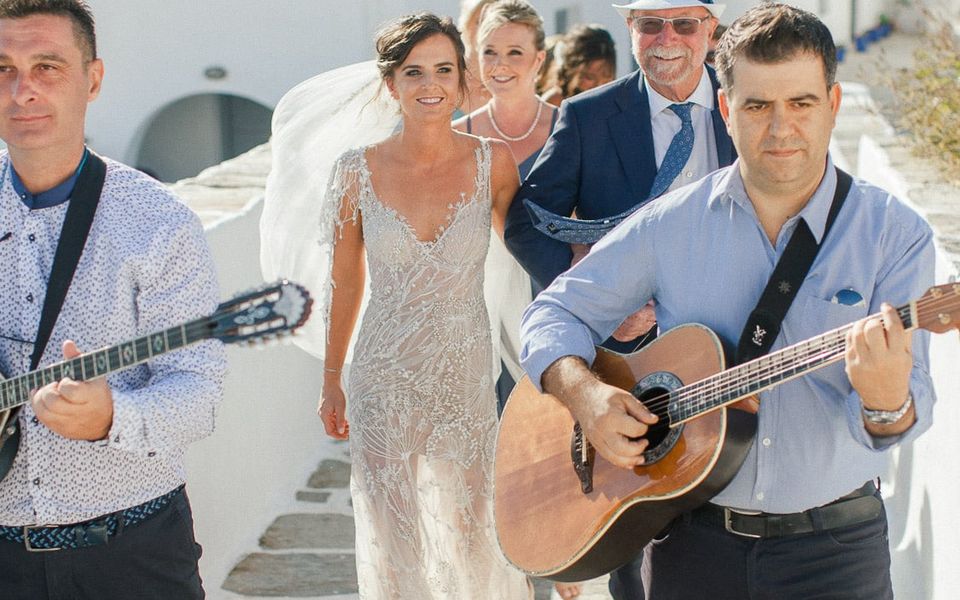
Rachel from the United Kingdom is also thrilled with her wedding on the island of Zakynthos last September. “The organizers made planning as easy as possible with lots of guides and manuals and a support group on Facebook. I always panicked that there was more to do, but in reality there wasn’t – it was simple and everything was in our hands. The organizers were brilliant – they helped us with the rehearsals and made sure everything was organized down to the smallest detail. The venue was the most dreamy setting I could have imagined. I was blown away when I walked in. It was beautifully decorated with gold birdcages and honestly exceeded anything I could have dreamed of. We had a gyros meal upon arrival, and the meze menu for our main meal was delicious – everyone commented on how much they loved the food. The entertainment was incredible and the plate breaking was so much fun, such a release of energy! I highly recommend the Greek dancers, they set the atmosphere of the evening and everyone had a great time.”
You may have noticed scrolling through Instagram that destination weddings are the absolute trend. From famous influencers to next-door couples, more and more people are choosing to have their wedding abroad, giving a special tone to the event. In 2024, the value of the global honeymoon tourism market was estimated at €43 billion, with forecasts pointing to more than €160 billion by 2029, recording an increase of more than 279% in just five years.
To a large extent, the trend was triggered by the skyrocketing cost of a wedding. For example, if for a wedding in San Francisco the couple is asked to pay $100,000, why not travel to Thailand where the cost will not exceed $15,000? That way they will also be able to reduce the number of guests and take nice photos for social media – isn’t that the point nowadays?
According to a study by Destify, a specialized destination wedding planning service that acts as a bridge between couples and all-inclusive resorts, based on Instagram data, Santorini is the sixth most photogenic wedding destination (Istanbul is at No. 1) with 9.4 million related hashtags, while, according to the TikTok Wedding Destination Index 2025, Greece has almost 5,000 posts with the hashtag #GreeceWedding, surpassing many Mediterranean competitors. Greece is a destination for newlyweds and one of the most popular internationally.
“Greece is in a truly exceptional position – and in many ways it still remains underutilized,” Alina Krupenina and Daria Neretina, founders of the famous online platform WedVibes, which specializes in the wedding industry, told Kathimerini. “It is among the top six destinations worldwide and stands firmly next to Italy as one of the main choices of couples. What makes it so attractive is its emotional power – the light, the landscapes, the sense of place. It offers an authentic beauty that deeply touches modern couples.” According to them, one of the country’s advantages is that it is one of the strongest cultural brands in the world. “‘Mamma Mia’ has been generating tourism for 18 years without advertising expenses.”
At the same time, however, compared to countries such as Italy or France, Greece lags behind in terms of infrastructure and accessibility. “Italy has developed a highly organized ecosystem of wedding destinations, with thousands of licensed venues – from historic villas to rural estates – supported by a regulatory framework that allows the operation of historic properties. Correspondingly, France has a wide network of chateaux that are actively used for international weddings,” the WedVibes team explains.
“In Greece, many of the most impressive properties – neoclassical, private estates and historic buildings – remain largely inaccessible for events due to ownership and licensing restrictions. This is not so much a limitation as an opportunity. The demand is already there – what is missing is the infrastructure to fully exploit it. This is, in our view, the next step for Greece.” Greece’s challenges also include legal complexity, as civil marriages are limited to town halls or specific venues, as well as strong seasonality. There is an over-concentration of wedding events in Santorini and Mykonos in the summer, while other areas remain untapped.
The conference
All of this is expected to be discussed in detail on April 29 at Aigli Zappeiou, in Athens, where the first Destination Weddings Tourism Forum-Greece 2026 will take place, It is the first thematic forum for wedding tourism in the country, organized by the Greek Destination Planners Association (GDPA), the official professional body of destination wedding organizers in the country.
The vice president of GDPA is Helena Chaviara, founder of RockPaperScissors Events, who has been working almost exclusively with clients from abroad for 15 years. “We have interest from all over the world, from expatriates to people who simply love Greece and would like to get married there,” she tells Kathimerini. “In one case, we had a Lebanese couple living in Canada who split the distance in Greece. Egyptians, for example, choose Greece because it is cheaper. Instead of inviting 1,000 people to their wedding there, they do something more intimate here.”
But Greece is not considered a cheap destination for a wedding. “Especially with the price increases, the minimum cost has gone up a lot. We once had a wedding with very beautiful flowers for €6,000, which has become €15,000. In the past, someone would come and tell you that they wanted to have a wedding for €40,000 and that was possible – now it’s impossible.”
But the wedding planning services must also be paid properly. “For the level of weddings we organize, we have to coordinate with 20-30 vendors for each one. For a wedding we are preparing for July 5, I have a total of over 1,300 emails. That’s why I usually tell couples that before you marry each other, you will ‘marry’ me,” Chaviara says.
Precisely because of the number of vendors involved, the economic footprint of wedding tourism is much larger than is believed and more widespread than classic tourism, say Krupenina and Neretina. “A wedding can channel $50,000 to $500,000 into the local economy – to florists, caterers, musicians, transportation, accommodations and small businesses.”
Dimitris Fragakis, former secretary-general of the Greek National Tourist Organization and current president of New Metropolitan Attica, estimates that the revenue of destination weddings for Greece is €150 million per year. “With the climate, the locations and the professionalism of the people involved, we could reach three times that. Wedding tourism is a huge asset for our country. It is an activity that brings in a lot of people, quality people, people who are wealthy, and not only during the high season, but also in May, June, September, October.”
He says the wedding is the occasion for the trip, but the guests, who amount to 100-120 people on average, often choose to stay in Greece longer.
Content for social media
The long-term tourism value of a wedding abroad is great, say the co-founders of WedVibes. “It has been found that 30-40% of guests return to the same destination within five years,” while the latest trend is for weddings to last a week. “Nearly half of destination weddings in 2025 extended to a full weekend or even a five- to seven-day stay. Many are now calling it a ‘wed-cation,’ a term that perfectly captures the evolution of the concept. The ceremony is no longer the central event, but the culmination of a series of shared experiences – from dinners on boats and cooking classes to hikes at dawn and farewell brunches. It’s about connecting, exploring and creating shared memories in a destination,” say Krupenina and Neretina.
And by memories, nowadays we mean content. “Content has become a core part of planning, not just an afterthought. Nearly a third of couples plan to create content on their wedding day with social media being a priority. Searches for wedding content creators increased by 586% in 2025 alone. Couples are now thinking not only about how the day is experienced in the moment, but also how it will be experienced by those watching from a distance,” they explain.
The influence of social media is decisive: the lighting, the time of the ceremony, the flowers, the table height, even colors – everything passes through the “how will look on camera” filter. “Influencer Madeleine White’s wedding in Santorini is a prime example: one event, one TikToker with five million followers, and within 48 hours, international media and thousands of creators were producing content for Greece – for free. This is the power of content-first design.”
Perhaps the most disadvantaged are the guests, who usually bear the costs of travel and accommodation – though they also get a gift!
