
Your curated wrap-up from The Southeast Asia Desk.
Welcome back. The Desk Briefing paused last week for a string of national holidays and joint leave in Indonesia — Eid al-Adha, Vesak Day, and Pancasila Day.
But the news never stopped.
This edition captures stories of a region finding its own voice: in music, in travel, in education, and in the quiet infrastructure of passports that determines who can move freely — and who cannot.
Here is your news in focus:
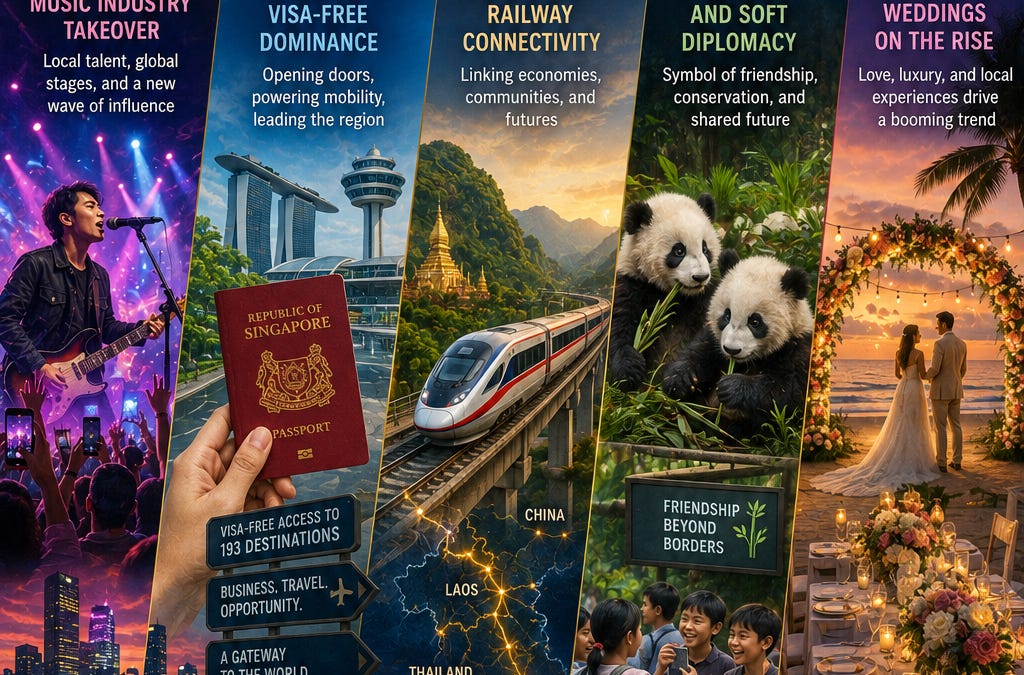
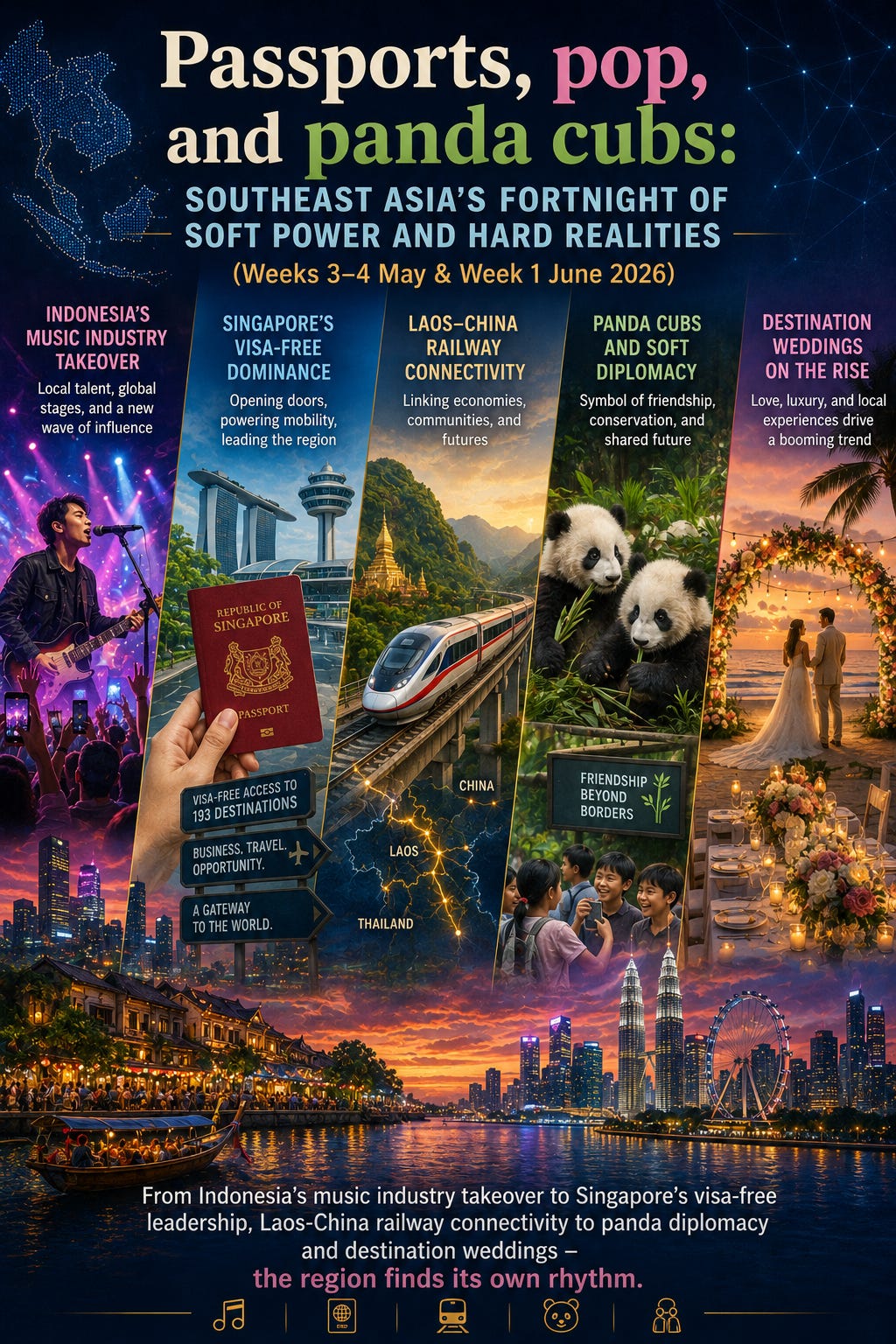
Indonesian songs now command 78% of Spotify Indonesia’s weekly streams, up from 60% in 2023. Over the same stretch, K-Pop’s share shrank in near-perfect inverse proportion — a correlation of r = -0.79. That’s not coincidence; it’s a structural shift in listening culture. A Jakpat survey confirms the mood: 74% of Indonesian listeners now prefer local artists. Only 40% express interest in K-Pop — down sharply from the genre’s recent peak. Even more striking: Indo Pop’s share of Malaysia’s Spotify charts moved from 18% in 2023 to 22% in 2026, while K-Pop fell from 18% to 13%. Indonesian music is becoming a regional export — quietly, without a government push or a manufactured campaign.
Read more:
https://www.thesoutheastasiadesk.com/p/the-k-pop-era-is-over-indonesia-writes
Your passport can quietly determine where you can travel, study, work, and sometimes how easily you can dream bigger. According to the 2026 Henley Passport Index, Singapore now has the world’s strongest passport, with visa-free access to 192 destinations. Meanwhile, Myanmar sits near the bottom of the regional rankings with access to only 42 destinations. For many Southeast Asians, international travel isn’t just about booking a ticket — it also means expensive visa fees, complicated applications, uncertainty, and a high risk of rejection. A weak passport acts like a hidden tax on opportunity. Same region, very different realities.
Listen:
https://www.thesoutheastasiadesk.com/p/s26e17-mind-the-gap-the-great-southeast
The Laos-China Railway is reshaping how Southeast Asia moves — and not just people. The high-speed rail link, now fully integrated into regional logistics networks, is accelerating cross-border trade, tourism, and people-to-people exchanges between Laos, China, Thailand, and beyond. For landlocked Laos, the railway has become a transformative economic artery, positioning the country as a regional logistics hub and deepening ASEAN-China connectivity under the Belt and Road Initiative.
Read more:
https://www.thesoutheastasiadesk.com/p/laoschina-railway-drives-asean-connectivity
New Dentsu research shows AI, economic pressure, and digital saturation are reshaping how travelers plan their journeys. The Consumer Navigator study of 3,000 respondents across APAC reveals that 57% use AI for travel planning, but 53% rate AI recommendations as generic, and 42% say it makes them more likely to stick with familiar brands. AI is functioning less like a discovery engine and more like a validation filter. In Malaysia, 67% rely on social media for inspiration yet remain deeply skeptical of it. In Vietnam, 31% have postponed trips — the highest in APAC — while remaining the most experience-oriented travelers in the region. The future of travel marketing will be won by emotional credibility, not visibility alone.
Read more:
https://www.thesoutheastasiadesk.com/p/southeast-asias-travelers-are-choosing
From oceanfront vows to elegant rooftop celebrations, the region is becoming a powerhouse wedding destination. Vietnam’s Amanoi (hidden between Nui Chua National Park and Vinh Hy Bay) offers cinematic cliffside ceremonies. Cambodia’s Anantara Angkor Resort offers Khmer elegance from $18,600. Singapore’s Grand Park City Hall features a lush rooftop Sky Garden with an iconic wrought-iron dome. Thailand’s InterContinental Koh Samui offers a private overwater pier for intimate ceremonies. And Bali’s Renaissance Uluwatu Resort boasts a stunning glass wedding pavilion surrounded by tropical forest. The best venue isn’t always the grandest — sometimes it’s a private beach at sunset.
Read more:
https://www.thesoutheastasiadesk.com/p/top-5-destination-wedding-venues
From AI to Arts: Southeast Asia Shines on Global Stage – The region’s creative industries are gaining international recognition, from visual arts to digital innovation.
Remembering Nakba in Jakarta: Memory, Solidarity, and Diplomacy – A commemorative event in Jakarta reflected on the ongoing Palestinian experience of displacement, drawing connections between shared histories of colonization and contemporary solidarity across Southeast Asia.
Indonesia’s First Giant Panda Cub Debuts – A historic moment for conservation and soft power diplomacy, as the cub becomes a symbol of Indonesia-China cooperation.
Beyond the Test: How TOEFL Reflects Southeast Asia’s Education Ambitions – English proficiency remains a gateway to global opportunity, and test scores reveal where the region is catching up — and where it’s falling behind.
This fortnight’s stories share a single thread: Southeast Asia is no longer just consuming global culture — it is creating its own.
Indonesian pop has overtaken K-Pop at home and is crossing borders into Malaysia. Singapore’s passport is the most powerful on the planet, while other ASEAN citizens face visa walls.
Travelers are turning inward, choosing familiarity over discovery, and using AI not to explore but to confirm what they already trust.
The region is finding its own rhythm — in music, in mobility, in love, and in the quiet decisions of where to go and why.
The holidays are over. The news never paused. And neither does the region’s momentum.
✨ Stories to linger over, one weekend at a time.
(ELS/QOB)
