
Poole Week 2026, In Association With Haven Knox-Johnston Overall
by David Harding 29 Aug 12:44 BST
23-28 August 2026
A Windy Way To End The Week
Friday was going to be windy. Everyone knew that. The question was just how windy, especially as many of the forecasts had under-estimated the strength on Thursday.
When the time came for the race officers to make the all-important decision – racing or no racing – at least it wasn’t a marginal one. The wind had been building all morning, and by 1pm it was already over 20 knots on the Parkstone Platform, with gusts approaching 30. The flags went up (AP over A), and that was that. The wind continued to rise, averaging 27 knots and gusting 35 a couple of hours later. Nobody was heard to say they wished they had gone out. The anemometer on a yacht in the marina recorded one gust of 45 knots.
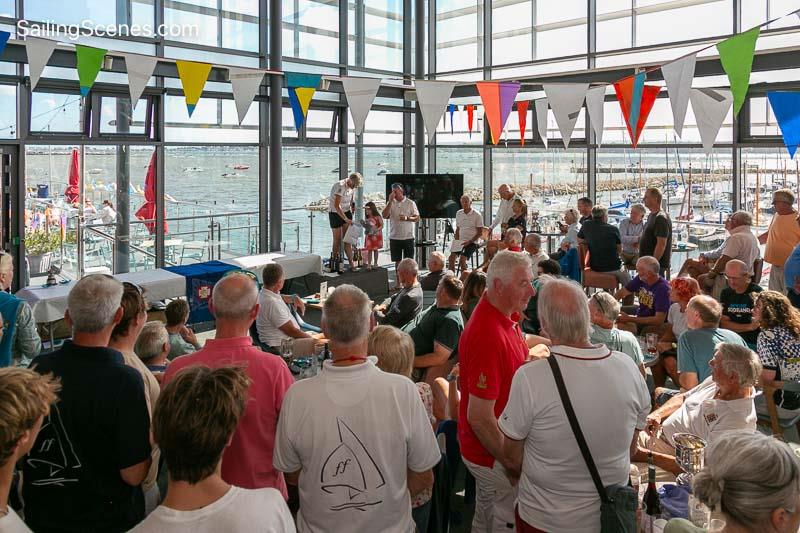
Arrangements for the day were changed, bringing the prize-giving forward to 14:30 to save everyone hanging around.
It was a shame not to have had the final scheduled races, but few would disagree that the previous five days had been pretty good. The sun had shone, the wind had blown and racing had been challenging, intense and competitive in fleets large and small. Most importantly, however, the spirit of Poole Week prevailed: everyone was there there to enjoy themselves.
Everyone was also reminded at the prize-giving that Poole Week doesn’t happen without an army of volunteers together with the staff of Parkstone Yacht Club and, of course, the sponsors: Haven Knox-Johnston, Charles Stanley, Preston Redman and Badger Beers, with prizes provided by Sailteck, Optimum Time, Marlow Ropes and Harken.
Brett Lewis from TracTrac, and the week’s on-the-water coach, Adam Bowers, ran post-race analysis in one of the training rooms for different fleets every day, allowing competitors to see where they had gone wrong – or right as they case may be.
As for the results – well, ultimately they’re just names and numbers on a list. It’s easy to run through who won what, but that doesn’t do justice to the effort involved. As every sailor knows, winning involves pre-race preparation, hard hiking (or uncomfortable crouching), split-second tactical decisions, studying the course (some of them needed a fair bit of studying) and much more. Competitive sailing is known to be one of the most demanding sports in the world for good reason. Behind every win in Poole Week was a story of 1,000 critical moments. Those who did win were deservedly pleased with their results – all of which, because of the cancellation of Friday’s racing, were the same as at the end of Thursday. Things might have changed in a few instances had an extra discard kicked in, but sometimes’s that’s just the way it is.
One winner who has to be mentioned is Roger Yeoman who, with Mike Moss and Bruce Grant in XOD 50, won the Britannia Cup for Boat of the Week. The calculations take into account the results in every race – no discards – and the size of the fleet among other factors. It’s a seriously tough one to win.
Family crews were often in the prizes this year, and there were a good number of them. Neil Davies won the slow handicap fleet in a Mirror, crewed by his young daughter, Holly. In the Dolphins, Nigel Yeoman sailed to victory helped by various younger generations of his family. Ian Linder, 2nd overall in the highly competitive Flying Fifteens, raced on some days with his son Michael and on others with his wife, Kim. In the RS200s, Poole Week’s chairman, Peter Loretto, with his daughter Lucy as crew, only sailed in a few races but won two of them.
In other fleets, parents were crewing for their sons or daughters, including Roger O’Gorman with daughter Sophia in an RS Feva. Then we had father-and-son Scroggies in a Merlin Rocket, and Daniel Blackburn, crewed by his father, Simon, in their Melges 15 that they brought all the way from the Royal Harwich Yacht Club. Daniel had won a competition run by Melges, in which the prize was free entry to a regatta of the winner’s choosing.
Wherever they finish, it’s the mix of family crews and race-hardened veterans that makes Poole Week what it is, combined of course with the top-notch race management, a lovely harbour to sail in and superb organisation from an efficient, friendly and hospitable club. That accounts for the numbers: 161 boats and 366 competitors representing 24 classes of boat from 22 clubs. That doesn’t happen by accident.
For those who had an ‘if only’ regatta, there’s always next year. Not many people will need an excuse to come back for Poole Week in 2027.