
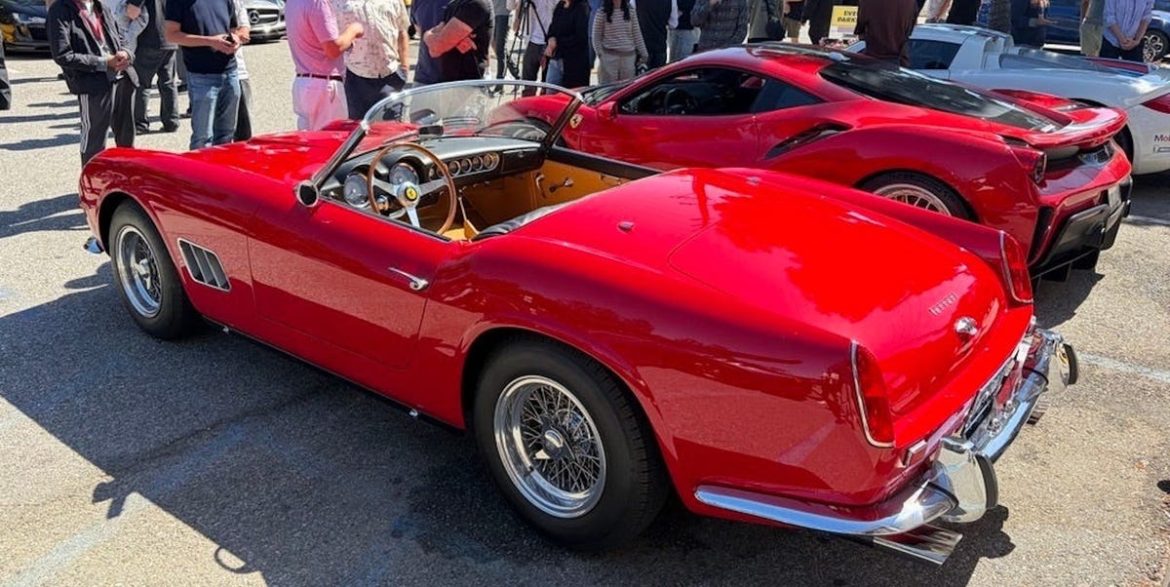
If you had to pick someone that you’d want to be the guy to collect all the Ferraris in the world, you’d want to pick David SK Lee. And he does have, seemingly, all the Ferraris in the world.
He just bought a 1962 Ferrari 250 GTO Bianco Speciale in January for a very reasonable $38.5 million. A good price considering most GTOs have been going for twice that lately. And then last month he bought a 1963 Ferrari 250 GT SWB California Spyder for $18.5 million.
Before that, he’d purchased what he calls the “Big Five” great Ferrari supercars: the 288 GTO, F40, F50, Enzo, and LaFerrari Aperta. And not just once, but twice, one set in yellow, and one in red. (Mustard and ketchup, he calls them. His green cars he calls “relish.” The white GTO is Mayo. The blues and blacks are classified as the Slurpee Collection. Hahaha.)
In all, he has over 30 cars, maybe well over 30. Those include, but are not limited to, a 250 GT Lusso Competizione, 296 Speciale, 275 GTB, 330 GTS, F12 TDF, 488 Pista Aperta, 812 Competizione Aperta, and an F2002 F1 car driven by Michael Schumacher.
But having a collection of cool cars is one thing. Lots of people have those. Well, not “lots,” but there are many significant collectors around the world. Not all of them take the same philosophical approach to it as David SK Lee.

What is that philosophy? It’s three parts: appreciate it as something beautiful to look at; drive it because it was meant to be driven and almost all of them are extraordinarily fun; and share it with the public, because we all want to see them.
“I think Jay Leno and I have the same philosophy, that’s why we’re such good friends,” Lee said when we saw him at Art Center’s Design Invitational, where he’d brought an SP3 Daytona. “He doesn’t care what the car costs, he drives it.”
How much does Lee drive his cars?
“Just this weekend, my (250 GT SWB) California Spyder, I drove from Walnut to Burbank, where Jay Leno is. I filmed a Jay Leno episode, we drove it around, then I drove it from there. So that was an hour drive. Then Jay was another hour, and then driving down to Newport in traffic was two hours. And then Saturday morning I drove where I saw you (at one of his Cars & Chronos car shows), drove another hour to my store, where I have the event, and I just drove it.”
It all fits into the philosophy.

Cars & Chronos last weekend at Lee’s Hing Wa Lee Jewelers in Larchmont Village.
“I see it in three parts. There’s the beauty of the car, the art part of it, and it (the California Spyder) is beautiful, designed by Pininfarina. Then there’s the driving experience. And then the sharing of it is another, having people understand what it is, and sharing it. This is a great car. Those are the three parts.”
Doing only two of those or, God forbid, only one, would be wrong in Lee’s philosophy.
“I think, if you just have it, and you keep it in your garage, and you never show it, you’re losing out on two thirds of the enjoyment of owning the car.”
Likewise, the driving. And, by the way, what’s it like to drive a California Spyder?
“I bought a 250 Lusso Competition, 275 GTB four-cam, 330 GTS, 365 Daytona Spider, and the Dino. So I understand how all those cars drive. And so I’m thinking, before I got the short wheelbase, I’m thinking, ‘Why is it so expensive? Why did it win all the races? There must be something to it.
“So, then, after I’d driven it, I realized why it is so good. It’s very light. It’s very nimble. It’s short wheelbase, that helps make it very nimble. The steering is very direct and very exact, and power is instant. It’s a three-liter, and even though it was 179 horsepower, it feels very fast in that car. The sound’s very good. And it was just quite powerful, it just exits out of corners very well. It’s not the same feeling you get with the other ones that I mentioned. The driving is superior. And of course, the look is amazing, just beautiful. Really the design of the short wheelbase is incredible.”

Cars & Chronos at Hing Wa Lee Jewelers in San Gabriel
And the GTO? Is that as good as its legend suggests? When they delivered it to him after the Mecum Auction January 17, as soon as they backed it off the trailer, he got right in it and drove off.
“Again, you ask yourself, ‘Why was it so expensive? Why did it win all those races from ‘62 to ’64?’ And there was a reason for it.
“I mean, it’s beautiful, but it also works. They hired Pisa University to design the aerodynamics, which they applied for the first time.
“But a lot of the performance and technology that they used at that time in racing was ahead of its time. And so, as you drive it, as you’re on the road, you get the benefit of having all that technology: those disc brakes, the V12, the outer body, how it’s constructed with the transmission and the shocks and everything, it’s quite amazing; how it handles the road, how much acceleration and power it has, and just how it performs. It was really amazing, because back then, with the zero-to-60 at five seconds was amazing. And this car did that. So it’s also in a different league of driving experience compared to the road Ferrari cars.”

The GTO at Mecum
And that’s coming from someone who understands and appreciates all of them.
If you want to see Lee’s cars, check him out at Instagram under https://www.instagram.com/ferraricollector_davidlee/. If you want to see some of the cars in the sheet metal, follow the Cars and Chronos Instagram page https://www.instagram.com/carsandchronosevents/, to find out when the next in the series of car shows held at his jewelry stores around Southern California.
If you can’t wait for the next one of those, go to Sunday’s San Marino Motor Classic, where he’ll be showing the 250 GTO. Go say hello, he’ll be happy to talk to you. It’s part of the philosophy.

Mark Vaughn grew up in a Ford family and spent many hours holding a trouble light over a straight-six miraculously fed by a single-barrel carburetor while his father cursed the Blue Oval, all its products and everyone who ever worked there. This was his introduction to objective automotive criticism. He started writing for City News Service in Los Angeles, then moved to Europe and became editor of a car magazine called, creatively, Auto. He decided Auto should cover Formula 1, sports prototypes and touring cars—no one stopped him! From there he interviewed with Autoweek at the 1989 Frankfurt motor show and has been with us ever since.
