
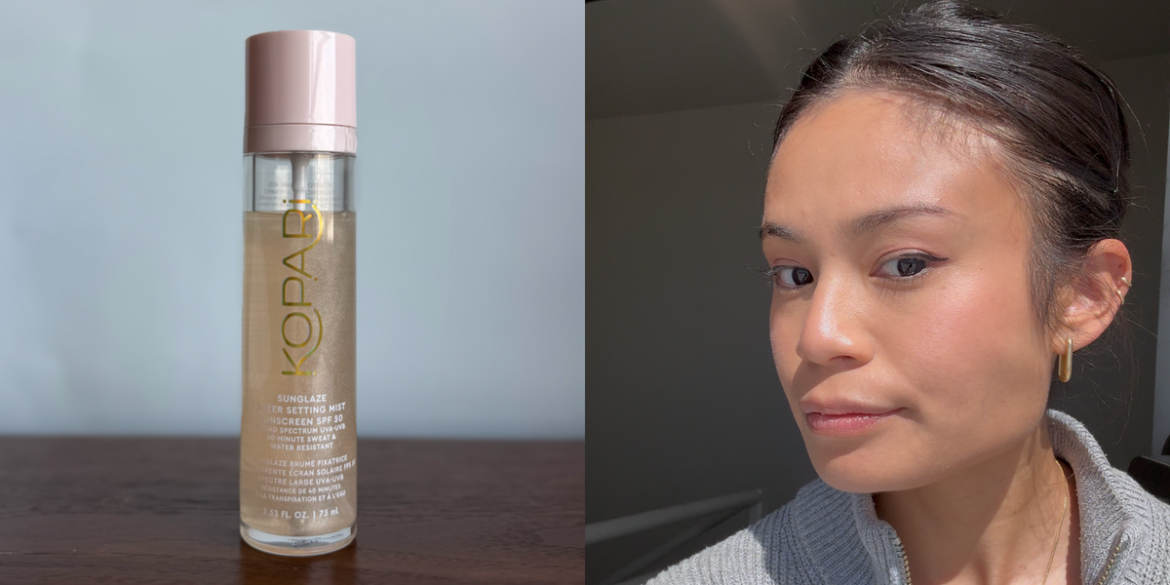
As someone who reads and learns about products every day, I’m not one to fall for every trending item. In fact, it takes a lot for me to spend money on anything! But when I came across several TikToks last year raving about the $34 Kopari Sunglaze Sheer Setting Mist that supposedly gives dewy, glassy skin, I was intrigued.
When this spray first came out, over 4,000 shoppers had viewed it on Ulta and several nearby stores were sold out, so I ran out to get my hands on one. This is my second summer using it at this point, so here are my honest findings and thoughts:

You need a lot of product to achieve the ‘glassy’ look
Of course, this all depends on how glassy you want your skin to appear, but even getting close to the ultra glassy looks I’ve seen on TikTok, I’m talking anywhere from 15 to 20 sprays—subjectively, even more. The $34 setting mist comes in a 2.5-ounce bottle, and those wanting a wetter, dewy look are going to run through one bottle quickly.
I prefer a subtle sheen, and roughly 10 sprays does just the trick. But by day three of using the mist, I noticed I had already used a good amount of product (about half an inch worth).
You also have to consider that several of the TikTokers that promote this setting mist also prep their skin with another luminous layer, like the Rhode Glazing Milk. I skipped the serum during my initial trial to see how this performed on its own, and you can see the results in the pictures. While I will say that while the sheen is truly subtle, I think it shines through more IRL than in pictures.

Without Kopari Sunglaze Sheer Setting Mist

With Kopari Sunglaze Sheer Setting Mist
The sheen is much more noticeable in natural light than indoors
The truth is, you’re not going to see the sheen indoors, even in a well-lit room. Sure, I’d catch the sheen when I’d head to the bathroom where I have a lighted mirror, but otherwise, it’s not very visible indoors.
But when I’d go outside in the sunlight, my skin would glow from several angles. I especially love the way it highlights my cheekbones and temples. My husband knew I was tryin this product, and in his mind, overly dewy looks “sweaty.” But during golden hour one day, he said I was “radiating” and he liked that my skin gave off “a soft glow, versus looking completely wet.”

With Kopari setting mist in soft light

With Kopari setting mist in harsh light
The glowing effects really last all day
I’m not saying the Kopari Sunglaze Sheer Setting Mist lasts 24 hours, but the first day I bought this, I applied it on my skin at 10am and still saw the same sheen when I checked in at 2pm, and again at 8pm right before I washed my face. Everyday afterwards, I saw the same long-lasting effects while trying the setting mist and never felt like I had to reapply the spray. But if needed, the 2.5-ounce bottle is light and small enough to throw in your purse.
Something to note though: Kopari claims that the product is 40-minute sweat- and water-resistant. But keep in mind that oil is literally listed among the ingredients. So if you’re wearing this over makeup, beware of your eyeliner smudging at some point throughout the day. Even with waterproof liquid liner, it will happen. My workaround: spray the setting mist after applying eyeliner and mascara. (I find it helps to dab away some of the oil on your lid, and apply some powder before adding your eyeliner).

After six hours of wear, no reapplication
While the mist contains SPF 50, you shouldn’t use it in place of your sunscreen
I wasn’t too sure how I felt about having all this shimmer on my skin at first, so before purchasing, I headed straight to the GH Beauty & Personal Care Lab to talk to our experts, who regularly evaluate beauty products every day.
At a glance, Senior Chemist Danusia Wnek didn’t suspect any red flags with the viral facial setting mist. She immediately recognized the brand, sharing that one of our staffers is a huge fan of Kopari’s Sunglaze Sheer Body Mist, saying it was “super glowy, especially when you are on the beach.” However, she noted that while it contains SPF 50, it shouldn’t replace your sunscreen. “People often don’t apply enough sunscreen, so I would recommend using sunscreen as you normally would and then applying this product as the last step,” Wnek says.
The brand claims that the setting mist is fine for all skin types, but you’ll want to use with caution
Here at GH, we’re always careful to agree with these claims, and if you have any concerns, speak to a dermatologist first. In my research, the only skin-related complaint I came across was that the mist “felt greasy” on some users’ skin. Additionally, a few reviews mentioned that the spray caused some discomfort for those with sensitive eyes.
It’s also safe to say that the shimmers in setting mist will for sure highlight any red spots, bumps or acne you may have, so take note, fellow users with redness!
Lastly, note that this setting spray is not scent-free. Some reviewers find the scent strong, but I find the bright and citrus scent subtle and inviting. My husband called it “juicy.” It’s definitely something to consider if you’re someone who wears other fragrances on your skin often.

The final takeaway

I really enjoy the Kopari Sunglaze Sheer Setting Mist and would recommend it to friends. I still use it quite a lot in the hotter seasons, on days I want to flaunt minimal makeup and glowing skin. While I don’t love that I need to use a lot of product to get the results I want, (and that I have to reconsider the way I apply my eyeliner), I still love the seamless application and lasting results. And after using it for one year, I’d say this also works exceptionally well paired with other glassy skincare serums.

Shanon Maglente is a writer and editor who specializes in deals, trends, and best-of product roundups. She has about a decade’s worth of experience, and has worked with Good Housekeeping as a writer and editor since 2019.
