
The end of blind spots?
Until now, the ability to see objects behind walls or around corners required expensive research equipment and bulky laser systems. Standard LiDAR works by sending light pulses and measuring the time it takes for them to reflect from objects within the direct line of sight.
The algorithm developed at MIT fundamentally changes how the data is processed. Instead of ignoring weak, scattered photons reflected from walls, floors, or ceilings, the software captures these barely noticeable signals.
By combining data collected from different angles as the device moves, the system synthesizes a complete picture, reconstructing the shape and motion of an object located outside the direct field of view.
Experimental results and key challenges
In laboratory tests, researchers used a standard consumer LiDAR sensor costing less than $100. During the experiments, the system successfully:
- Tracked movement: in real time, it detected the motion of a mannequin hidden behind a partition.
- Built 3D models: the algorithm created approximate digital replicas of objects that never entered the sensor’s direct field of view.
At this stage, the technology performs better when the system already knows the approximate shape of the object in advance. The next challenge for scientists is to train the AI to recognize completely unknown or changing shapes. According to MIT researchers, this will make the technology even more flexible.
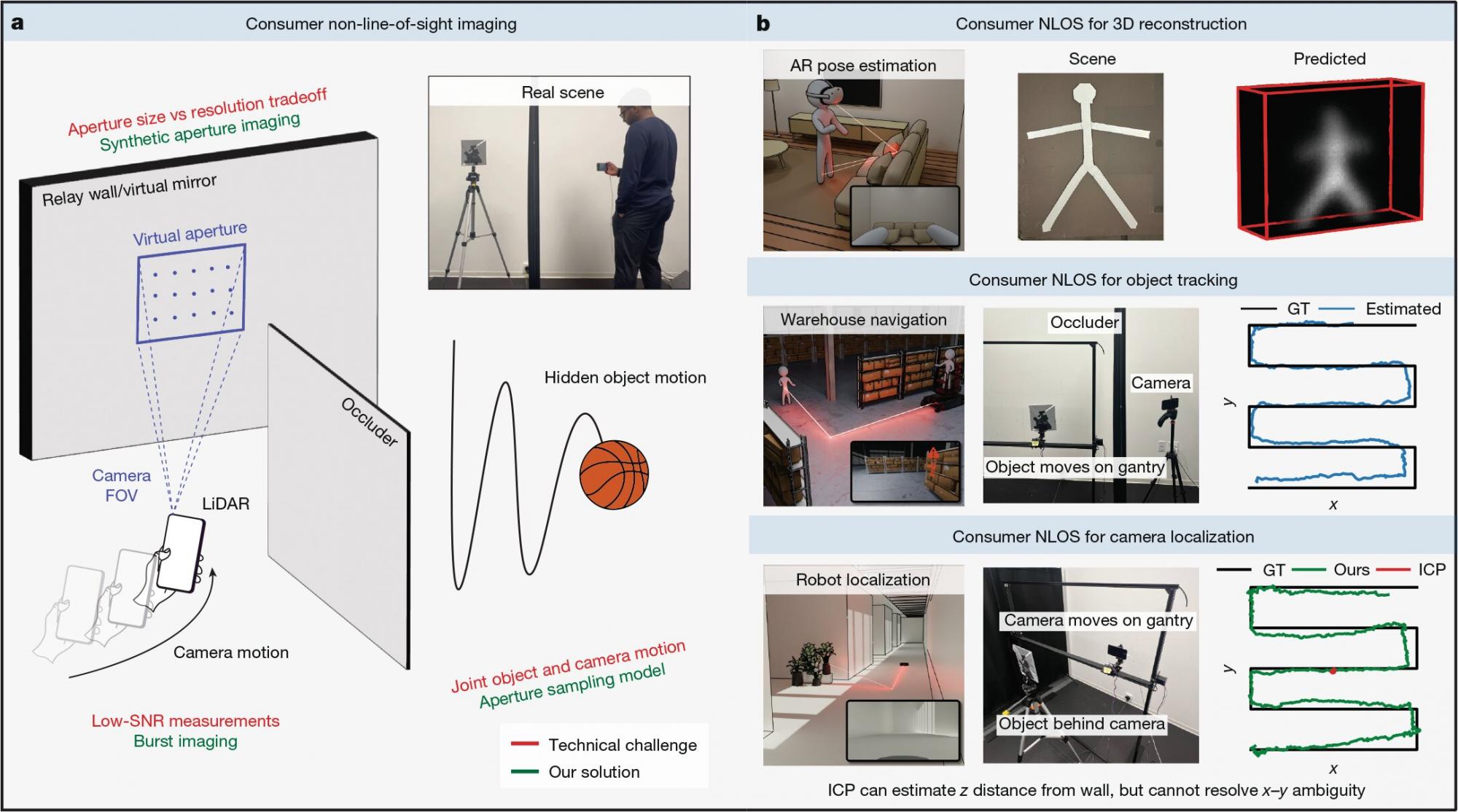 Visualization in line-of-sight conditions (screenshot: Nature)
What does this mean for the high-tech market?
The implementation of such technology could become a new standard for industries where spatial awareness is critical:
Autonomous robotics: robots could avoid collisions with people stepping out from around corners even before they become visible in the field of view.
Wearable devices: development of intelligent assistance systems for people with visual impairments, allowing them to “see” room layouts and obstacles in advance.
Consumer electronics: future generations of smartphones are expected to receive software updates for LiDAR that significantly expand augmented reality (AR) capabilities and safety functions.
“Our results represent a shift towards plug-and-play NLOS imaging, where anyone can image hidden objects with off-the-shelf hardware (for less than US$100) and no additional setup. We believe democratization of such capabilities will advance consumer applications of NLOS imaging,” the study authors explained.
