
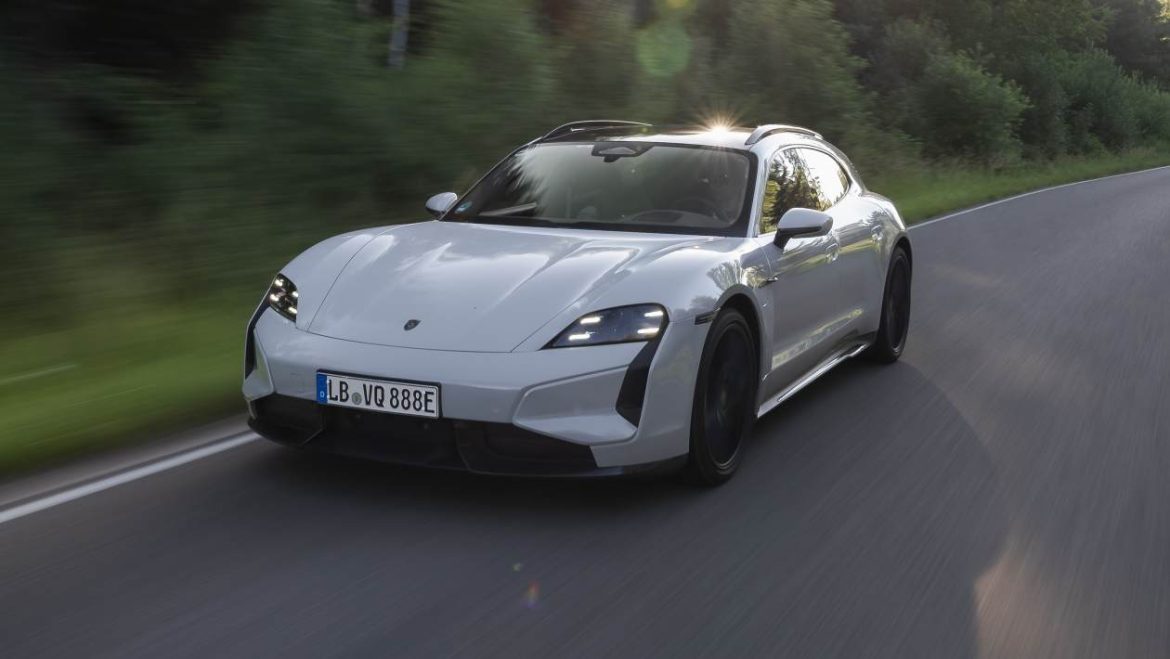
Next, the base Taycan can now go further on a charge, thanks to special low rolling resistance summer tyres: the key figure is 434 miles, a modest, but welcome, 12 miles further than it could before.
Then there’s E-Shift, Porsche’s take on virtual gearshifts. Available across the range (albeit necessarily combined with Sport Chrono, Bose audio, and Electric Sport Sound, so it’s cheaper on cars which already have those options specified), it gives the Taycan eight virtual gears, and operates similarly to the systems on the Hyundai Ioniq 5 N and Honda Super-N.
Porsche mulled over the idea way back when the Taycan was introduced, but has finally offered it for drivers looking for a little more interaction and feedback. The gears are tied to a combustion-esque synthesised sound, and like similar systems, each gear has its own unique torque map, engine-braking style regen and little gearshift jerks when changing gear. The car’s behaviour and sound changes depending on gear, speed and load too, just as a conventional car with an automatic gearbox would.
Unsurprisingly, it’s pretty effective. So much so that it’s easy to forget the whole thing is just lines of code, rather than mechanical objects spinning and meshing beneath you. Press the small blue E-Shift button on the steering wheel and the ‘engine’ wakes up with a flare of revs, idling away with a V8-esque murmur and more impressively, engine-style vibrations. Porsche has coded the electric motor (or motors, in all-wheel-drive cars) to fluctuate slightly, giving the impression of a combustion engine vibrating away in the background.
It really does feel like a conventional automatic, and an effective PDK-style one at that – gearshifts are (unsurprisingly) pretty instantaneous and it feels second nature to change down when you want more regen or for more torque going up a hill. Accelerate hard and the ‘engine’ will hit a virtual rev limiter too, set at 7,500rpm – apparently, the number that felt most natural for the car’s performance.
