
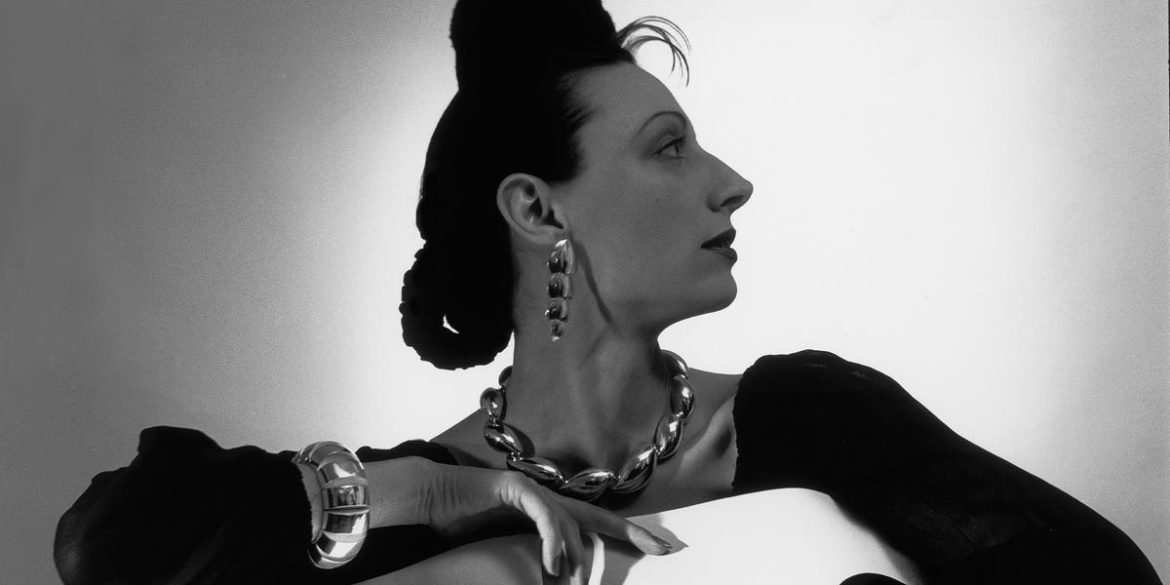
This summer, the Palais de Tokyo in Paris opens its doors to “Pomellato, le Joaillier Révolutionnaire,” a celebration of the jeweler’s history. On view from June 24 through July 20, 2026, the Milanese maison’s exhibition, which features a collection of photographs as well as iconic jewels, offers a rare glimpse into the archives of a brand that has spent over 50 years challenging conventions and redefining what fine jewelry can represent.
“This exhibition is not a retrospective, but a living archive: a dialogue between heritage and evolution,” Pomellato CEO Sabina Belli says. “It honors the artisans whose mastery gives form to each creation, and the women who wear Pomellato: intelligent, independent spirits who express themselves with freedom.”

Inside the exhibition, black and white portraits of Pomellato campaigns hang in front of colorful illuminations of jewelry pieces.
Founded in 1967 by Pino Rabolini, Pomellato emerged during a period of extraordinary social and cultural transformation, one that helped produce Italian design legends, ready-to-wear fashion, and second-wave feminism—and gave rise to a radically different vision of jewelry. In a time when traditional houses continued to emphasize ceremony and status, Pomellato was founded on the belief that jewels should be lived in, worn daily, and chosen by women for themselves. And it commissioned some of the world’s most celebrated photographers to capture a new image of femininity.

Early campaign imagery was distinctly sharp and geometric, emphasizing the same qualities in the jewelry pieces themselves. (Pomellato Archive, 1970)
Photographs follow the brand through the decades, starting with Gian Paolo Barbieri’s 1970s imagery before moving to Helmut Newton’s provocative black-and-white compositions from the ‘80s and the sculptural minimalism of Herb Ritts’s photographs from the 1990s. Additionally, images by Albert Watson, Horst P. Horst, Lord Snowdon, Michel Comte, and Javier Vallhonrat bring the jewelry to life, with each photographer lending their artistic voice to interpret the house’s codes.
“If image gave Pomellato a new visual language, women gave it its deepest meaning,” curator Alba Cappellieri explains. “The maison has always addressed women as conscious and independent subjects, never as mere muses.”

Milanese fashion photographer Gian Paolo Barbieri shot what is considered Pomellato’s first advertising campaign in 1971. Two photographs of actress Lilly Bistrattin were duplicated with the same frame to create this geometric composition.

Swiss photographer Michel Comte was known for his dramatic and poignant editorial work. As apart of a humanitarian project Pomellato launched to support the Red Cross in 1994, he shot global celebrities, including Salma Hayek (pictured here), who posed wearing pieces exclusively designed for the initiative.
In addition to photography, Pomellato’s design innovations receive equal attention. Among the highlights are its signature chains, as well as architectural rings, necklaces, and bracelets. Contemporary collections such as the Iconica are on view, too, demonstrating the continuous evolution of the brand’s heritage.

Pieces from the brand’s contemporary collections, including Nudo and Zigzag.
Color, too, has always been central to Pomellato’s identity. Decades before colorful gemstones became a widespread luxury trend, the brand pioneered what it called the “New Precious,” embracing unconventional stones and daring chromatic combinations. This spirit finds its ultimate expression in Nudo, the collection that has become one of their most recognizable jewelry designs.

Rings from the Nudo collection come in a rainbow of colors ranging from purple amethysts to sky blue topaz.
“[Pomellato’s] creations have accompanied changing ways of living,” Cappellieri says, “reflecting a vision of femininity that is plural, free, and profoundly self-aware.”
Pomellato, le Joaillier Révolutionnaire is open until July 20, 2026 at the Palais de Tokyo.
Carly Witteman is Town & Country’s Associate Fashion Editor, covering luxury style, jewelry and timepieces, beauty, and arts and culture while styling various photoshoots and projects for print. You can find her on Instagram at @carlymaewitteman, where she’s probably posting about a Broadway show, her new favorite pair of shoes, or her current read.
