
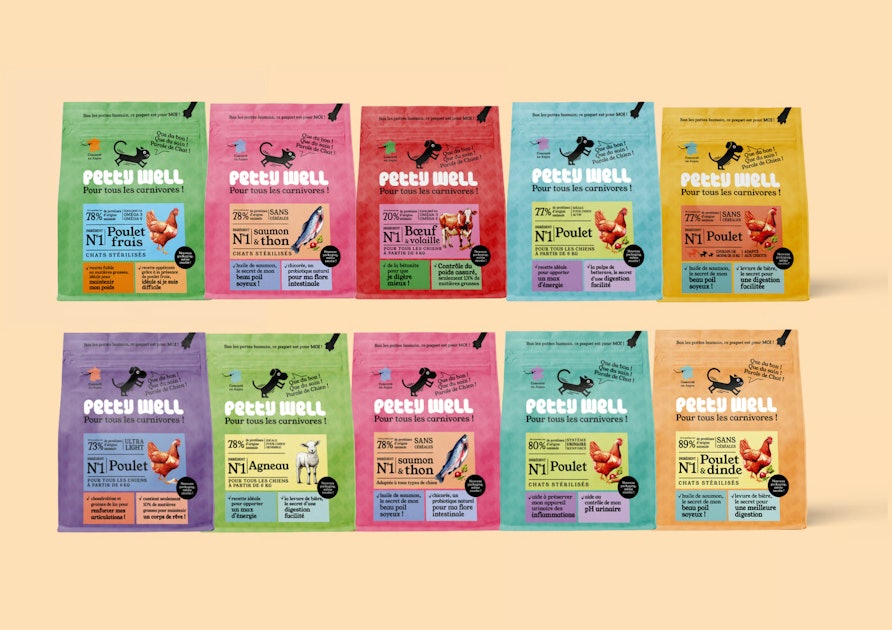
French pet food producer Petty Well is expanding its presence in its domestic market, with its dry and wet pet food currently available at more than 700 stores across the country, with sales at large local retailers that include Monoprix, Auchan, Intermarché and E. Leclerc driving the company’s growth.
“Today, we have the impression that companies explode overnight, especially in tech or AI. But a solid company is built slowly,” Alexis Zalta, the producer’s co-founder and chief operating officer, told local daily La Provence. “It often takes about 10 years for a company to reach its full potential.”
Zalta and Sacha Bigiaoui, who is Petty Well’s CEO, jointly launched the brand in 2018 with the aim to offer premium pet food for dogs and cats. The company produces its pet food in Maine-et-Loire, in the country’s northwest.
“Our grain-free dog kibble is made in France using quality ingredients to meet the nutritional needs of adult and neutered dogs,” noted the business. “Good kibble for a healthy daily balance. For cats, our grain-free cat kibble is formulated with veterinarians. Some recipes support urinary health, including our Urinary cat kibble recipes specially adapted for neutered cats. We also offer grain-free kitten kibble, rich in protein and nutritionally balanced to support healthy growth.”
Amid increasing demand for its pet food, in 2025, the French producer increased its revenues to more than €2 million (US$2.3 million), and was also able to post a net profit, Zalta said.
Belgian civil society lobbies for lower taxes on pet food, veterinary services
In Belgium, the country’s nongovernmental organizations, including animal rights association Gaia, are calling on the authorities to lower the value-added tax (VAT) on pet food and veterinary services.
Under Belgian law, pet food and veterinary services for pets are both covered by a 21% VAT rate. At the same time, veterinary services for farm animals are subject to a lower 6% levy, which is pushing some local NGOs to criticize the existing regulations as unfair toward pet owners and lobby for decreasing the tax rates.
“Veterinary care is not a luxury,” Sébastien de Jonge, the director of operations at Gaia, told local broadcaster RTL.
A spokesperson for Belgium’s Federal Public Service Finance said that, currently, the authorities are not working on legislation to reduce the levies on pet food and veterinary services.
Dutch competition watchdog probes vet services for pets
In the Netherlands, the country’s competition watchdog, the Authority for Consumers and Markets (ACM), has completed an investigation into veterinary services for pets. As part of its recommendations, the agency argues for banning commercial incentives for vets, and also recommends measures to reinforce the position of vets and improve emergency services.
The ACM “is in contact with the Dutch Ministry of Agriculture, Fisheries, Food Security and Nature (LVVN) as well as with the sector to discuss the findings of the market investigation as well as how to follow up on the recommendations,” the watchdog said in a statement.
The agency said that it also recommends Dutch policymakers improve responsible pet ownership.
“They can do so, on the one hand, by educating pet owners in a clear manner, so that they already make a well-informed decision when purchasing a pet, and thus are able to prevent unnecessary medical costs,” said the agency. “On the other hand, they can impose stricter measures on breeders and sellers of pets. In that context, ACM recommends devoting extra attention to the lowest-income households, because they can run into financial problems as a result of unexpected high medical costs.”
