
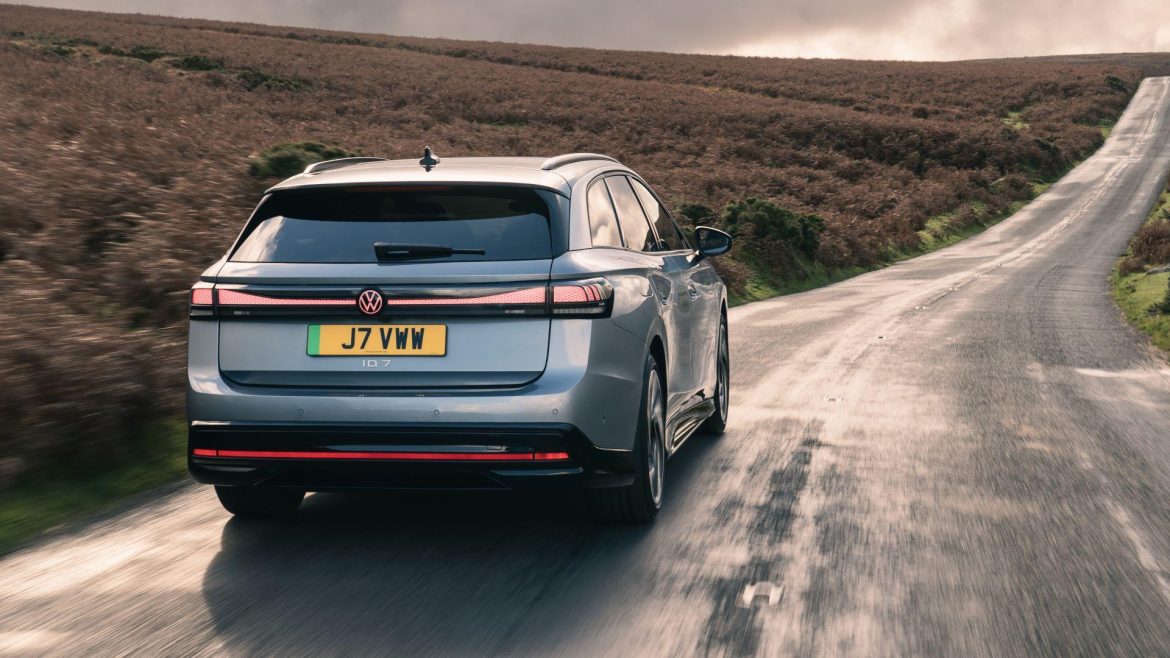
Performance & drive: What is the Volkswagen ID.7 Tourer like on the road?
No version of the ID.7 Tourer is slow – even the single motor offers plenty of performance in reserve for daily driving needs.
With 286hp at your disposal through the rear wheels, the base ID.7 dispatches overtakes and quick junction exits with ease. It’s right in the sweet spot of being fast enough to never feel underpowered but also not too fast that the traction control needs to step in.
The GTX version boasts 340hp, which isn’t that much of an upgrade on paper – nor is the second or so off the 0-62mph time. But it’s the grip and all-weather security that really makes the difference. You can pull away from a standstill pretty rapidly, although once up to speed it doesn’t feel much faster than the cheaper model.
Either way, we think the base model suits the needs of most people performance-wise, while also offering greater efficiency and range than the dual motor car.
In terms of regenerative braking, the ID.7 Tourer doesn’t give you as much control as we’d prefer, with only a single ‘B’ mode on the drive selector to strengthen the regen effect and no one-pedal driving function.
In normal mode it’s an adaptive system which uses cameras and sensors to apply braking when it thinks it’s needed, but we’d prefer more regen adjustment modes and steering wheel paddles to toggle between them.
Power, 0-62mph times
- Volkswagen ID.7 Tourer Pro: 286hp/6.6 secs
- Volkswagen ID.7 Tourer Pro S: 286hp/ 6.7 secs
- Volkswagen ID.7 Tourer GTX: 340hp/ 5.5 secs
Ride and handling
Just like the saloon ID.7, the Tourer is very much set up for comfort over driving engagement. And that’s fine, because there are plenty of sportily tuned rivals to cater for those needs.
The ID.7’s laid-back feel is great for comfort, making for an excellent long-distance cruiser. But the ride is also good around town, particularly if you specify the Dynamic Chassis Control (DCC) adaptive suspension. This is standard on the GTX but optional on other variants.
With DCC fitted, the ID.7 can be softened off to deal with rough roads or firmed up so there’s less of a floaty feel on twisting roads. Interestingly, you also get a quicker steering rack with DCC, making the car feel keener to change direction.
On challenging roads, the ID.7 is always safe and secure, without too much body roll. Overall, though, this is a heavy car that lacks the response, agility and confidence-inspiring feel of a BMW i4 or Tesla Model 3.
Noise and refinement
The ID.7 Tourer is very relaxing and refined at speed. Wind noise is kept to a minimum, the electric motor is barely audible and the suspension is quiet over bumps.
Having said that, the lack of an engine humming away in the background does mean that road noise is the dominant sound in the cabin at speed – a tiny bit more so than in the saloon. We don’t think it’s intrusive, just something you’ll turn the radio up to avoid.

Euro NCAP: is the Volkswagen ID.7 Tourer a safe car?
Euro NCAP hasn’t specifically tested the Tourer version of the ID.7, but the safety organisation has crash tested the saloon. It achieved the maximum five-star rating back in 2023.
Overall occupant protection scores are among the best in the class, with a 95% rating for adult occupant protection and an 88% score for child protection. But the ID.7 also scored highly for vulnerable road user protection and safety assist features.
Speaking of which, every ID.7 comes with the usual autonomous emergency braking, lane keeping assist and speed limit warning.
Also standard is adaptive cruise control, driver drowsiness alert, blind spot monitoring, a safe exit alert system and rear cross-traffic alert. And to help you park such a large car, every model gets a 360-degree camera system as well as a suite of sensors.
Charging, range and running costs
Every version of the ID.7 Tourer offers a very strong range on a charge. In fact, even the lowest range version goes further on a charge than any variant of the BMW i5 Touring.
The entry-level Pro model has a 77kWh usable battery pack, which promises up to 372 miles of range according to WLTP combined test standards. That’s very competitive by big car standards, although it’s around eight miles down on the ID.7 saloon.
The ID.7 Tourer Pro S, meanwhile, has an upgraded 86kWh usable battery for a range of up to 422 miles in the same standard. That’s slightly behind the longest-range Audi A6 e-tron Avant and ten miles down on the ID.7 saloon, but impressive given the price.
The GTX uses the same battery as the Pro S, but its extra performance and dual motors knock the official range down to 357 miles combined.
Some early ID.7 models didn’t feature a heat pump as standard. However, with Match Plus and GTX trims now all that’s available, a heat pump is standard on every version to help mitigate the effects of cold weather on range.
Range on a charge (WLTP figures)
- Volkswagen ID.7 Tourer Pro: 372 miles
- Volkswagen ID.7 Tourer Pro S: 422 miles
- Volkswagen ID.7 Tourer GTX: 357 miles
The ID.7 Tourer isn’t quite as impressive when it comes to charging speeds as it is with range, but it meets the standard we’d expect of a new EV.
The base Pro model has an acceptable peak DC charging rate of 175kW, which because the battery isn’t huge results in a decent 10-80% charge time of around 27 minutes at a suitable rapid charger.
Opting for the Pro S or GTX models ups that peak speed to 200kW. While that’s well short of the Audi A6 e-tron Avant’s 270kW, the ID.7 can still be topped up from 10-80-% in around 26 minutes – 5 minutes longer than the Audi.
To help achieve this peak speed at a public charger, the ID.7 has preconditioning via the in-built navigation. This gets the battery ready to accept the maximum charging current before you arrive at the charger.
In terms of home or destination charging, every ID.7 Tourer has an 11kW AC on-board charger as standard to make the most of three-phase supply. There is no Vehicle-to-Load tech, however, which is a pity in this day and age.
Charging speeds
(Figures from EV Database)
- 7kW charging: 12hr 15 mins (Pro)/ 13hr 45 mins (Pro S/GTX)
- 11kW charging: 8hr 15 mins/ 9hr 15 mins
- 50kW rapid charger (10 to 80% charge): 68 mins/ 76 mins
- 300kW+ rapid charger (10 to 80% charge): 27 mins/ 26 mins
How much does the Volkswagen ID.7 Tourer to insure?
Insurance groups for the ID.7 Tourer range from group 37 for the Pro Match Plus model, rising to 38 for the Pro S version and 41 for the GTX version.
Those groups are less than any version of the Audi A6 e-tron or BMW i5 Touring, although if an estate isn’t a priority then lower-spec versions of the Tesla Model 3 sit in lower groups.
