
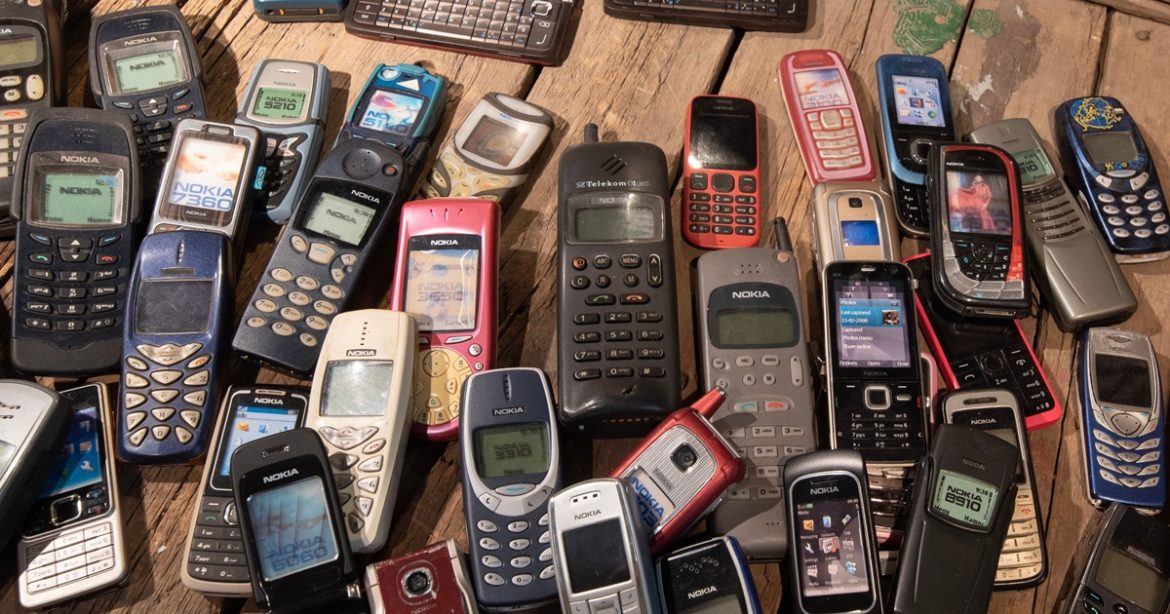

As we continue to innovate in the technology space, the amount of e-waste being produced globally is rapidly increasing. Recently, researchers demonstrated a fully working computer cluster using old discarded phones in an effort to show how old technology is still capable of being used. What challenges do we find with e-waste and new tech, what did the researchers demonstrate, and will there come a point where old technology becomes more desirable?
What Challenges Do We Face With Growing E-Waste And Modern Technology?
Ever since the invention of the first electronic components, e-waste has always been a fact of life. As technology improves, new devices are developed, and this often sees older technology quickly being replaced. While this is generally a good thing, the rate at which technology is changing is now introducing a whole array of problems.
The introduction of AI into modern devices along with the ever-growing need for high memory capabilities is seeing the need for new hardware, but the ability for AI and other complex algorithms to run on specialised hardware now puts significantly more stress on processing needs. Furthermore, the rapid increase in internet bandwidth is also seeing higher demands for improved network connections, with engineers now moving away from older Wi-Fi standards and turning to modern 5GHz and cellular 5G options.
However, considering that these markets are only growing, so is the amount of e-waste being produced. When this e-waste isn’t carefully handled, it can lead to massive amounts of environmental devastation, something which has already been going on for years in poorer nations. At the same time, throwing away old electronics also sees massive quantities of valuable minerals wasted, can see toxic compounds leak into groundwater, and can even contribute to long-lived carcinogens ending up in food sources consumed by local populations.
But the problem with e-waste is not just limited to the environment. As devices are thrown away in favour of newer devices, it also means that perfectly usable devices end up in landfill.
Researchers Turn Old Phones into Mini Datacenter
Recognising the challenges faced with e-waste and the need for new devices, researchers from University of California San Diego (UCSD) in partnership with Google recently published their findings on a new approach for reducing e-waste. According to the researchers, the growing number of discarded smartphones combined with the environmental impact of producing new devices presented engineers with a potential solution: turn old discarded smartphones into low-cost data centre platforms.
The idea behind the project is that by taking old smartphones which are rarely used or no longer in service, the computational power of those devices can be utilised for low-cost datacentre solutions. As such, the amount of e-waste produced from replacing old smartphones can potentially be reduced, the demand for new server hardware can be reduced, and the environmental impact from new device manufacturing can be minimised.
To demonstrate the potential capability of old devices, the researchers compared the performance of old smartphones with that of modern server CPUs. While the results from their testing showed that old smartphones are unable to compete on a multi-core basis, the single core performance could exceed that of modern server CPUs. At the same time, the researchers noted that when running basic software configurations, older smartphones can outperform modern server CPUs when running individual tasks.
Thus, the researchers turned to stripping down old smartphones and only utilising the core SoC and motherboard, with all other components being removed including batteries, cameras, screens, and sensors. After configuring the stripped-down devices with a Linux OS and Kubernetes, the researchers then created a cluster of 50 phones to see how well they would operate as a datacentre.
The results from this test showed that when running standard microservices, the phone cluster was able to scale to 25 phones while showing good scaling characteristics.
Looking forward, the researchers hope to create a cluster of about 2,000 phones which would be able to handle hundreds of simultaneous classes for students. Considering that each class would have around 20 attendees, this would allow for each student to have a private datacentre that would be able to run multiple applications simultaneously.
Will Older Technology Become More Desirable?
Historically, older technology has always been quickly replaced with newer technology, and when looking back on these technologies, it’s obvious why. Older CRT TVs were replaced with LCD TVs which provided greater picture quality, old desktop PCs were replaced with laptops which provided greater portability, and phones were replaced with phones that could do more.
However, the past decade has seen technology stagnate to some degree, and while there have certainly been improvements, these improvements haven’t been enough to see older systems quickly phased out. For example, servers from ten years ago use DDR4 memory with similar core counts and core speeds to modern systems. The same applies to desktop PCs, and now, even smartphones are starting to fall into this trap.
With rising energy costs, tougher economic times, and less disposable income, we may soon reach a point where new technology is no longer desirable. This will likely be particularly true in the automotive industry where EVs are now seeing steep price increases.
Going forward, there is a very real chance that older systems could become desirable, and the market for second-hand devices could massively expand. Considering that key technologies such as GPUs and memory are now effectively impossible to get a hold of, older devices could find themselves in demand, and this could help to reduce the amount of e-waste being produced.
So, how will the world look in the future? Will we still have datacentres? Will we still be reliant on AI? To me, it seems that the future will be a far more mixed market, and there is a very real chance that older devices will still be perfectly viable.
